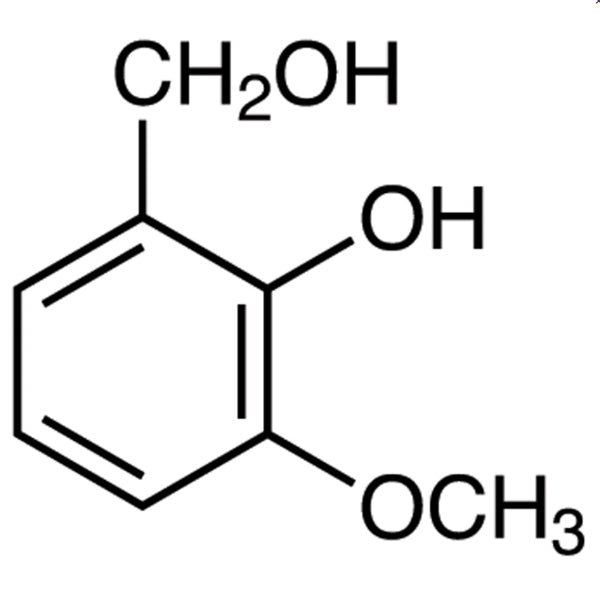
2-Hydroxy-3-methoxybenzyl Alcohol, identified by CAS number 4383-05-5, is an aromatic compound that carries three distinct functional groups on a single benzene ring: a phenolic hydroxyl group, a methoxy group, and a benzylic alcohol group. This combination makes it a versatile building block for researchers working in organic chemistry. The hydroxy-methoxy substitution pattern on the aromatic ring is a widely recognized motif in natural product chemistry, particularly among lignin-derived compounds and the many phenylpropanoids that are routinely studied in research laboratories.
What makes this compound valuable is the presence of three groups with different reactivity profiles within one small molecular framework. The benzylic alcohol group is more nucleophilic and is readily oxidized to the corresponding aldehyde. The phenol group can be deprotonated and participates in etherification as well as oxidative coupling reactions. The methoxy group acts as an electron donor that influences the orientation of aromatic substitution. The close proximity of the hydroxyl and methoxy groups also allows for intramolecular hydrogen bonding, which affects the conformation and spectroscopic behaviour of the molecule.
In Indonesian laboratories, this reagent is typically used in university research groups and institutional laboratories engaged in synthetic organic chemistry and natural product work. TCI reagent-grade quality supports reproducible results across synthesis steps, structural studies, and method development, where consistent starting material behaviour is essential for interpreting experimental outcomes correctly.
Related TCI products
- Synthetic building block preparation — the three differentiated functional groups allow selective transformations, giving researchers multiple handles for constructing more complex aromatic target molecules step by step.
- Natural product model studies — the hydroxy-methoxy aromatic pattern mirrors lignin-derived and phenylpropanoid structures, making it a practical reference substrate for studies on these natural product classes.
- Selective oxidation experiments — the benzylic alcohol group is readily oxidized to an aldehyde, making this compound a useful substrate for evaluating oxidation conditions and reagent selectivity.
- Etherification and oxidative coupling work — the phenolic hydroxyl can be deprotonated and engaged in ether formation or coupling reactions, supporting exploratory methodology development in synthetic laboratories.
- Spectroscopic and conformational investigation — the adjacent hydroxyl and methoxy groups permit intramolecular hydrogen bonding, providing a compact system for examining how such interactions influence spectroscopic signatures.
| Brand | TCI (Tokyo Chemical Industry), product code H1273 |
|---|---|
| CAS number | 4383-05-5 |
| Molecular formula | — |
| Purity | — |
| Category | Chemistry > Building Blocks > Non-Heterocyclic Building Blocks |
| Pack sizes | available in standard TCI research catalogue pack sizes; please confirm the required quantity when ordering |
| Physical form | — |
| Storage | keep in a tightly closed container, protected from light and moisture |
- Chemical name: 2-Hydroxy-3-methoxybenzyl Alcohol
Store this reagent in a tightly closed original container in a cool, dry, and well-ventilated area, away from direct sunlight and sources of ignition. Because phenolic compounds can be sensitive to air and light over extended periods, containers should be resealed promptly after each use and kept protected from moisture. Amber glass bottles or the supplied original packaging are suitable for storage. Handle the material in a fume hood using appropriate personal protective equipment, including safety goggles, chemical-resistant gloves, and a laboratory coat. Avoid inhalation of dust and contact with skin or eyes, and always consult the manufacturer's safety data sheet before use.
—
Produk Terkait
-
5-Bromo-2-methoxybenzylAlcohol TCI B3369
Regular price From Rp 1.035.300,00Regular price -
3-MethoxybenzylAlcohol TCI M1101
Regular price Rp 1.273.650,00Regular price -
2-MethoxybenzylAlcohol TCI M1017
Regular price Rp 1.961.400,00Regular price -
4-MethoxybenzylAlcohol TCI M0107
Regular price From Rp 477.750,00Regular price -
2-Hydroxy-5-nitrobenzylAlcohol TCI H1549
Regular price Rp 3.419.850,00Regular price -
4-Hydroxy-3-methoxy-alpha-methylbenzylAlcohol TCI H1386
Regular price From Rp 2.466.450,00Regular price -
2-Bromo-5-methoxybenzylBromide TCI B4423
Regular price From Rp 1.298.850,00Regular price -
3-BenzyloxybenzylAlcohol TCI B3857
Regular price Rp 2.174.550,00Regular price