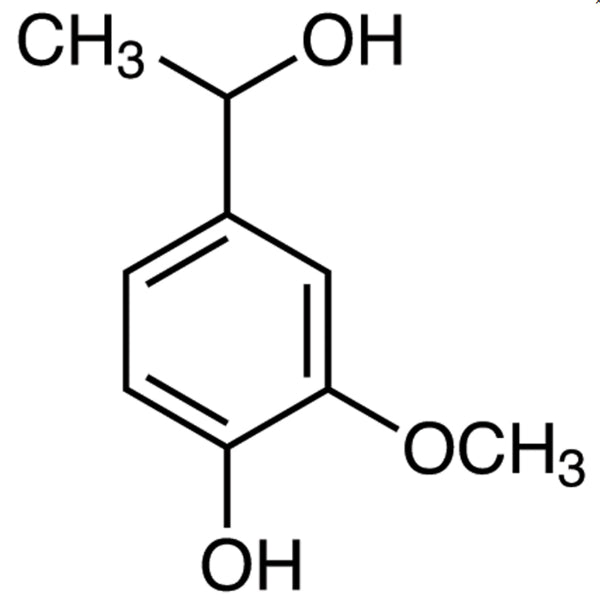
TCI H1386 4-Hydroxy-3-methoxy-alpha-methylbenzyl Alcohol is a secondary benzylic alcohol that carries a guaiacyl substitution pattern, meaning a phenolic hydroxyl group sits adjacent to a methoxy group on the aromatic ring. In the laboratory, this compound serves both as a non-heterocyclic building block and as a model compound, because its structure resembles the constituent units of lignin that are widely studied in biomass chemistry. The presence of the benzylic hydroxyl group provides a reactive site that is readily oxidised, dehydrated, or substituted, allowing researchers to trace transformation pathways clearly.
The property that makes this compound a frequent choice is the combination of three functional groups with distinctly different reactivities within a single small molecule. The benzylic hydroxyl group is the most easily oxidised, converting to the corresponding ketone; the phenol group can be alkylated or acylated; while the methoxy group remains relatively inert and serves to modulate the electron density of the ring. This difference in reactivity makes the compound highly useful for testing catalyst selectivity, particularly in biomass conversion research where catalysts must cleave specific bonds without damaging other groups.
In Indonesian laboratories, the material fits naturally into university and institutional research programmes working on biomass valorisation, lignin chemistry, and organic synthesis method development. It is typically handled at bench scale in synthesis and catalysis groups, where small quantities are sufficient for screening reaction conditions and comparing catalyst performance. The guaiacyl motif also supports work in natural product related synthesis, making the compound a practical reference substrate for laboratories building analytical and preparative expertise.
Related TCI products
- Lignin model compound studies: the guaiacyl pattern mirrors lignin constituent units, so reaction outcomes observed here can be interpreted in the context of real biomass substrates.
- Catalyst selectivity screening: the three functional groups of differing reactivity allow researchers to determine whether a catalyst cleaves the intended bond without attacking the phenol or methoxy group.
- Selective oxidation method development: the benzylic hydroxyl is readily oxidised to the corresponding ketone, giving a clean and easily monitored benchmark reaction for new oxidation systems.
- Non-heterocyclic building block in organic synthesis: the phenol group can be alkylated or acylated, providing a convenient handle for elaborating the aromatic core into larger target molecules.
- Biomass conversion research: as a small, well-defined stand-in for lignin fragments, it simplifies mechanistic study of transformation pathways that would be difficult to follow in complex feedstocks.
| Brand | TCI |
|---|---|
| CAS number | 2480-86-6 |
| Molecular formula | — |
| Purity | — |
| Category | Chemistry > Building Blocks > Non-Heterocyclic Building Blocks |
| Pack sizes | available in standard TCI research pack sizes; please confirm the currently available size when ordering |
| Physical form | — |
| Storage | store according to the conditions stated on the manufacturer's label and safety data sheet |
- Chemical class: secondary benzylic alcohol with guaiacyl substitution pattern
Store the container tightly closed in a cool, dry, well-ventilated area, away from direct sunlight, heat sources, and strong oxidising agents. Keep the material in its original manufacturer container wherever possible, or transfer it to a chemically compatible, clearly labelled vessel with a secure closure. Because the compound contains a phenolic group, minimise unnecessary exposure to air and moisture during weighing. Handle in a fume hood using appropriate personal protective equipment, including safety glasses, gloves, and a laboratory coat. Follow the manufacturer's safety data sheet for detailed handling requirements and dispose of residues through the laboratory's established chemical waste procedure.
—
Produk Terkait
-
4-Bromo-3-methylbenzylAlcohol TCI B5285
Regular price From Rp 2.359.350,00Regular price -
4-Bromo-2-methylbenzylAlcohol TCI B5231
Regular price From Rp 1.298.850,00Regular price -
5-Bromo-2-methylbenzylAlcohol TCI B5037
Regular price From Rp 4.240.950,00Regular price -
4-Bromo-alpha-methylbenzylAlcohol TCI B1955
Regular price From Rp 875.700,00Regular price -
3-MethylbenzylAlcohol TCI M1124
Regular price Rp 2.094.750,00Regular price -
2-MethylbenzylAlcohol TCI M0887
Regular price Rp 1.378.650,00Regular price -
4-MethylbenzylAlcohol TCI M0162
Regular price From Rp 955.500,00Regular price -
2,4-Dichloro-alpha-methylbenzylAlcohol TCI D4508
Regular price From Rp 1.035.300,00Regular price