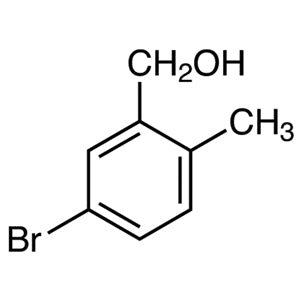
4-Bromo-2-methylbenzyl Alcohol is a chemical compound widely used as a building block in organic synthesis. It serves as a key intermediate in the development of complex organic molecules, particularly in reactions involving bromo substitution and heterocyclic ring formation. Its structural simplicity allows for versatile chemical transformations, making it a valuable resource for chemists working in both academic and industrial settings. This compound is essential for researchers aiming to design and synthesize new pharmaceuticals, agrochemicals, and specialty chemicals.
The compound's chemical properties make it a preferred choice for various laboratory applications. It exhibits high polarity due to the presence of both hydroxyl and bromo groups, enabling solubility in organic solvents such as ethyl acetate and ethanol. This solubility profile supports its use in reactions requiring high reactivity and stability under controlled conditions. Additionally, its stability in certain environments enhances its reliability as a reagent in synthetic processes. However, it remains sensitive to heat and UV light, necessitating careful handling and storage.
In Indonesian laboratories, 4-Bromo-2-methylbenzyl Alcohol is commonly used in organic chemistry research, particularly in higher education institutions and research centers. Its availability and adherence to international quality standards make it a trusted material for both teaching and advanced research. The compound's role in synthetic pathways supports its widespread use in the development of new chemical compounds and materials.
Related TCI products
- Organic synthesis reactions where bromo substitution and hydroxyl functionality are required.
- Heterocyclic compound formation due to its ability to participate in ring-opening and cyclization reactions.
- Reactions involving hydrolysis or oxidation where polar functional groups are essential.
- Solvent-based reactions that benefit from the compound’s solubility in organic solvents.
- Research applications in pharmaceutical and agrochemical development requiring versatile intermediates.
| Brand | TCI |
|---|---|
| CAS number | 17100-58-2 |
| Molecular formula | — |
| Purity | — |
| Category | Chemistry > Building Blocks > Non-Heterocyclic Building Blocks |
| Pack sizes | Available in various quantities as per standard chemical supply practices |
| Physical form | Liquid |
| Storage | Store in a cool, dark place away from heat and UV light |
This compound should be stored in a cool, dark environment to prevent degradation due to heat and UV exposure. It is recommended to keep it in a tightly sealed container made of glass or high-density polyethylene to minimize contamination and evaporation. Due to its polar nature, it is important to handle it with appropriate personal protective equipment, including gloves and safety goggles, to avoid skin contact or inhalation. The compound should be stored away from incompatible materials such as strong oxidizers or acids. Regular monitoring of storage conditions ensures the compound remains chemically stable and suitable for use in laboratory applications.
—
Produk Terkait
-
4-Bromo-3-methylbenzylAlcohol TCI B5285
Regular price From Rp 2.359.350,00Regular priceRp 1.649.550,00Sale price From Rp 2.359.350,00 -
5-Bromo-2-methylbenzylAlcohol TCI B5037
Regular price From Rp 4.240.950,00Regular priceRp 2.965.200,00Sale price From Rp 4.240.950,00 -
4-Bromo-alpha-methylbenzylAlcohol TCI B1955
Regular price From Rp 875.700,00Regular priceRp 612.150,00Sale price From Rp 875.700,00 -
3-MethylbenzylAlcohol TCI M1124
Regular price Rp 2.094.750,00Regular priceRp 1.464.750,00Sale price Rp 2.094.750,00 -
2-MethylbenzylAlcohol TCI M0887
Regular price Rp 1.378.650,00Regular priceRp 963.900,00Sale price Rp 1.378.650,00 -
4-MethylbenzylAlcohol TCI M0162
Regular price From Rp 955.500,00Regular priceRp 667.800,00Sale price From Rp 955.500,00 -
4-Hydroxy-3-methoxy-alpha-methylbenzylAlcohol TCI H1386
Regular price From Rp 2.518.950,00Regular priceRp 1.776.600,00Sale price From Rp 2.518.950,00 -
2,4-Dichloro-alpha-methylbenzylAlcohol TCI D4508
Regular price From Rp 1.035.300,00Regular priceRp 723.450,00Sale price From Rp 1.035.300,00