

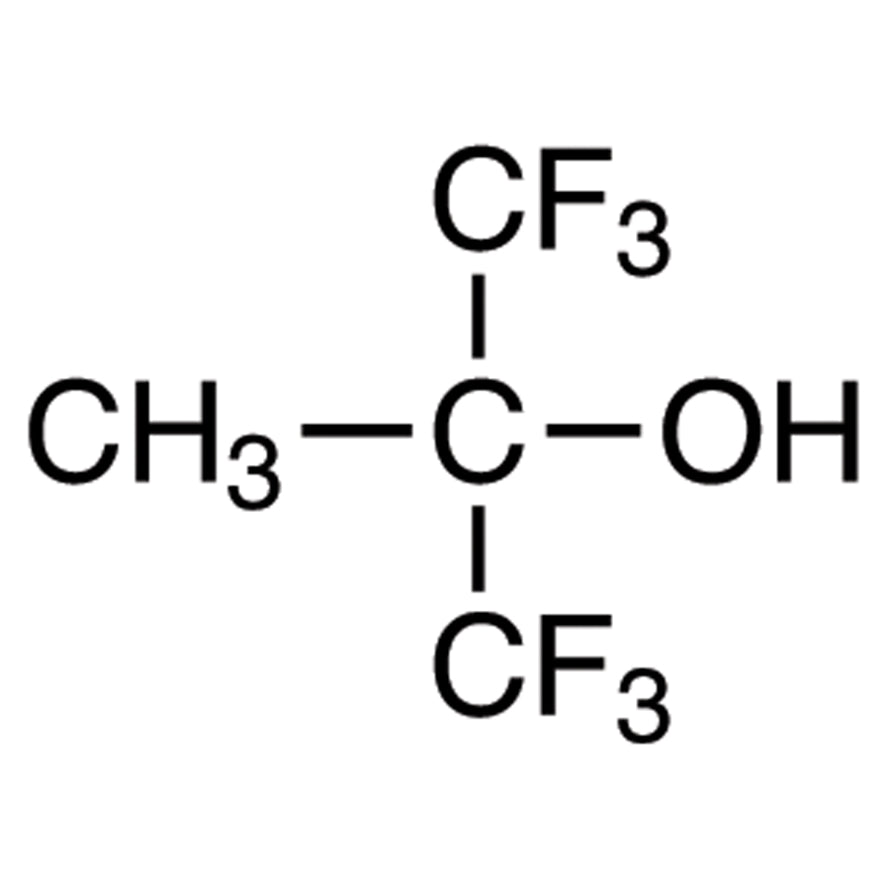
1,1,1,3,3,3-Hexafluoro-2-methyl-2-propanol is a tertiary alcohol in which two trifluoromethyl groups are bonded to the same carbon atom that carries the hydroxyl group and a methyl group. This arrangement places it within the family of fluorinated alcohols, whose behaviour differs markedly from that of ordinary alcohols. In the laboratory the compound serves as a fluorinated building block used to introduce the hexafluoroisopropyl moiety into target molecules, and also as a reaction medium or additive capable of altering the course of a chemical transformation. Its role is significant because fluorination is a widely applied strategy for tuning the physicochemical properties of designed molecules.
The characteristic that makes this material a preferred choice is the strong electron-withdrawing effect exerted by the two trifluoromethyl groups adjacent to the hydroxyl group. This effect renders the hydroxyl proton far more acidic than that of a conventional tertiary alcohol, while simultaneously making the compound a strong hydrogen-bond donor yet a weak nucleophile. That combination is valuable when researchers need to dissolve or stabilise charged intermediates without provoking side reactions originating from the solvent itself. Few conventional laboratory alcohols offer this particular balance of properties, which is why fluorinated alcohols occupy a distinct niche in synthetic practice.
In Indonesian laboratories, this compound is typically encountered in synthetic organic chemistry groups at universities and research institutes, as well as in industrial R&D units engaged in fluorine chemistry and molecular design work. It is generally ordered in small research quantities for method development, exploratory reaction screening, and the preparation of fluorinated intermediates. Because it is a reasonably volatile liquid, it is normally handled inside a fume hood with the usual attention given to volatile organic reagents.
TCI brochures (PDF)
- Fluorous Chemistry 2025-01-21 · p. 5
Related TCI products
- TCI H0724 718-64-9 1,1,1,3,3,3-Hexafluoro-2-phenyl-2-propanol
- TCI T3493 69804-19-9 2,2,3,3-Tetrafluoro-3-[[1,1,1,2,3,3-hexafluoro-3-[(1,2,2-trifluorovinyl)oxy]propan-2-yl]oxy]propionitrile
- TCI H1279 918-21-8 Hexafluoro-2,3-bis(trifluoromethyl)-2,3-butanediol
- TCI H0746 376-90-9 2,2,3,3,4,4-Hexafluoro-1,5-pentanediol
- TCI H0649 382-31-0 2,2,3,4,4,4-Hexafluoro-1-butanol
- TCI T3095 78573-45-2 3-[3-(Trifluoromethyl)phenyl]-1-propanol
- Introduction of the hexafluoroisopropyl group: it acts as a fluorinated building block, allowing the intact hexafluoroisopropyl moiety to be transferred into a target molecule during synthetic construction work.
- Fluorinated reaction medium: its strong hydrogen-bond donating character and weak nucleophilicity allow it to solvate reactive intermediates while remaining largely inert toward them.
- Reaction additive for transformation control: added in sub-stoichiometric or co-solvent amounts, it can alter the pathway and outcome of a chemical transformation under investigation.
- Stabilisation of charged intermediates: the pronounced electron-withdrawing effect of the two trifluoromethyl groups supports charged species that would otherwise decompose in conventional alcoholic solvents.
- Physicochemical property tuning in molecular design: fluorination through this reagent is used by researchers to adjust the physicochemical behaviour of newly designed and synthesised molecules.
| Brand | TCI (Tokyo Chemical Industry), catalogue number H1349 |
|---|---|
| CAS number | 1515-14-6 |
| Molecular formula | — |
| Purity | — |
| Category | Chemistry > Building Blocks > Fluorinated Building Blocks |
| Pack sizes | available in the research-scale pack sizes listed on this product page |
| Physical form | liquid, reasonably volatile |
| Storage | keep tightly closed in a cool, well-ventilated place away from ignition sources |
- Chemical name: 1,1,1,3,3,3-Hexafluoro-2-methyl-2-propanol
Store the container tightly closed in a cool, dry and well-ventilated area, away from heat, open flame and other ignition sources. Because the material is a reasonably volatile liquid, keep it in the original tightly sealed bottle supplied by the manufacturer, or in a chemically compatible sealed glass container, and reseal it immediately after each use to limit evaporative loss. All dispensing and transfer operations should be performed inside a functioning fume hood. Analysts should wear a laboratory coat, chemical splash goggles and suitable chemical-resistant gloves, avoid inhalation of vapour and contact with skin and eyes, and follow the manufacturer's safety data sheet together with institutional chemical waste procedures for disposal.
—
Produk Terkait
-
1,1,1,3,3,3-Hexafluoro-2-phenyl-2-propanol TCI H0724
Regular price From Rp 1.724.100,00Regular price -
2,2,3,3-Tetrafluoro-3-[[1,1,1,2,3,3-hexafluoro-3-[(1,2,2-trifluorovinyl)oxy]propan-2-yl]oxy]propionitrile TCI T3493
Regular price From Rp 4.347.000,00Regular price -
Hexafluoro-2,3-bis(trifluoromethyl)-2,3-butanediol TCI H1279
Regular price From Rp 2.625.000,00Regular price -
2,2,3,3,4,4-Hexafluoro-1,5-pentanediol TCI H0746
Regular price Rp 903.000,00Regular price -
2,2,3,4,4,4-Hexafluoro-1-butanol TCI H0649
Regular price Rp 1.565.550,00Regular price -
3-[3-(Trifluoromethyl)phenyl]-1-propanol TCI T3095
Regular price From Rp 823.200,00Regular price -
3,3,3-Trifluoro-1-propanol TCI T2986
Regular price From Rp 1.035.300,00Regular price -
2-Trifluoromethyl-2-propanol TCI T1710
Regular price Rp 2.359.350,00Regular price

![69804-19-9 2,2,3,3-Tetrafluoro-3-[[1,1,1,2,3,3-hexafluoro-3-[(1,2,2-trifluorovinyl)oxy]propan-2-yl]oxy]propionitrile - AMI Scientific](http://amiscientific.com/cdn/shop/files/TCI2510T3493.jpg?v=1768819782&width=533)
![69804-19-9 2,2,3,3-Tetrafluoro-3-[[1,1,1,2,3,3-hexafluoro-3-[(1,2,2-trifluorovinyl)oxy]propan-2-yl]oxy]propionitrile - AMI Scientific](http://amiscientific.com/cdn/shop/files/TCI2510T3493_2f6bddec-1b38-407e-8eff-cb77397f9f37.jpg?v=1769058235&width=533)


![78573-45-2 3-[3-(Trifluoromethyl)phenyl]-1-propanol - AMI Scientific](http://amiscientific.com/cdn/shop/files/TCI2510T3095.jpg?v=1769058156&width=533)

