

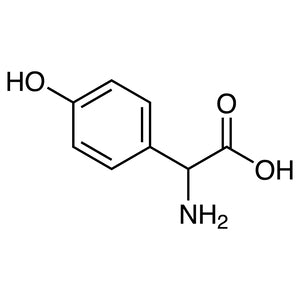
DL-2-(4-Hydroxyphenyl)glycine (CAS 938-97-6) is a non-proteinogenic amino acid supplied in racemic form, in which the amino and carboxyl groups are attached directly to the same carbon atom that also bears a phenol ring. This arylglycine structure makes it a well-recognised material in both peptide chemistry and pharmaceutical chemistry, because the 4-hydroxyphenylglycine framework forms part of the side chain of a number of semi-synthetic beta-lactam antibiotics. In the laboratory the compound is used as a synthetic starting material, as a building block for unusual peptides, and as a substrate in biocatalysis research.
The property that leads researchers to select this compound is the combination of three reactive functional groups within a relatively small molecule: an amine, a carboxylic acid, and a phenol. All three can be selectively protected or modified, which gives considerable freedom in synthetic design. The aromatic ring bearing a hydroxyl group provides hydrogen-bonding capability together with ultraviolet absorption that assists reaction monitoring and chromatographic analysis. The racemic form is itself an advantage in chiral resolution research, whether enzymatic or through diastereomeric salt formation, because it supplies both enantiomers in a single material.
In Indonesian laboratories this compound is typically handled in university organic and medicinal chemistry groups, in pharmaceutical research units, and in biotechnology laboratories working on enzymatic transformations. It is normally weighed out in small quantities for bench-scale synthesis, protection and coupling trials, or resolution experiments, then characterised using standard chromatographic and spectroscopic methods available in the host laboratory. Its role is that of a defined starting material rather than a routine bulk reagent.
- Synthetic starting material for organic preparations, where the amine, carboxylic acid and phenol groups can each be selectively protected or derivatised to build more elaborate target structures.
- Building block for non-standard peptides, since the arylglycine backbone introduces a rigid aromatic residue that differs from the common proteinogenic amino acids used in routine peptide assembly.
- Substrate in biocatalysis research, where enzymatic systems are evaluated for their ability to transform or discriminate between the two enantiomers present in the racemic material.
- Model compound in chiral resolution studies, because the racemate supplies both enantiomers and suits enzymatic resolution as well as classical diastereomeric salt formation approaches.
- Reference material in medicinal chemistry teaching and research relating to beta-lactam antibiotics, given that the 4-hydroxyphenylglycine framework appears as a side chain in semi-synthetic members of that class.
| Brand | TCI |
|---|---|
| CAS number | 938-97-6 |
| Molecular formula | — |
| Purity | — |
| Category | Chemistry > Chemical Biology > Peptide Chemistry |
| Pack sizes | available in the standard catalogue pack sizes offered by the manufacturer; please confirm the required size when ordering |
| Physical form | — |
| Storage | keep in the closed original container under the conditions stated on the manufacturer's label |
- Product code: H1853
- Chemical name: DL-2-(4-Hydroxyphenyl)glycine
Store the material in its original tightly closed container in a cool, dry and well-ventilated area, away from direct sunlight, moisture and incompatible chemicals. Amber glass or the supplied manufacturer packaging is suitable, and containers should be resealed promptly after each use to limit exposure to air and humidity. Handle in a fume hood using a laboratory coat, safety goggles and chemical-resistant gloves, and avoid generating or inhaling dust while weighing. Use clean, dry spatulas to prevent contamination of the stock, label any decanted portions clearly, and consult the manufacturer's safety data sheet before first use and for waste disposal guidance.
—
Product Categories
Produk Terkait
-
N-(4-Hydroxyphenyl)glycine TCI H0292
Regular price Rp 1.829.100,00Regular price -
N-(Diphenylmethylene)glycinetert-ButylEster TCI D2322
Regular price From Rp 769.650,00Regular price -
N-(4-Cyanophenyl)glycine TCI C2771
Regular price From Rp 610.050,00Regular price -
4-AminobutyricAcid TCI A0282
Regular price From Rp 505.050,00Regular price -
DL-Homoserine TCI A0319
Regular price From Rp 2.386.650,00Regular price -
DL-2-Amino-n-octanoicAcid TCI A0382
Regular price From Rp 2.279.550,00Regular price -
L-Isoserine TCI I0828
Regular price From Rp 1.298.850,00Regular price -
DL-Allothreonine(containsThreonine) TCI A0214
Regular price From Rp 875.700,00Regular price


