

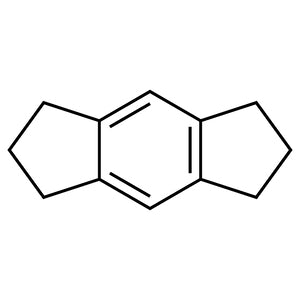
1,2,3,5,6,7-Hexahydro-s-indacene, identified by CAS number 495-52-3, is a polycyclic hydrocarbon consisting of a central benzene core flanked symmetrically by two hydrogenated five-membered rings. As a non-heterocyclic building block, this compound is highly valued because its framework creates a distinctive spatial environment around the central positions of the aromatic ring. Organic and organometallic chemistry researchers use it as a foundational scaffold for constructing bulky ligands, particularly in catalyst designs that require steric control around the metal centre so that reactions proceed selectively.
The principal properties that make this compound a preferred choice are its structural symmetry and the steric character generated by the fused five-membered rings. These two aliphatic rings hold substituents in specific positions, creating a spatial pocket that is considerably more rigid than freely rotating alkyl groups. The aromatic core nevertheless remains capable of undergoing electrophilic aromatic substitution reactions such as nitration, halogenation, and acylation, allowing researchers to introduce new functional groups as footholds for subsequent synthetic steps. Its hydrocarbon nature also gives it good solubility in common organic solvents used in synthesis.
In Indonesian laboratories, this building block is typically encountered in university research groups and institutional laboratories working on organic synthesis and organometallic chemistry, where multi-step routes toward sterically demanding ligands are developed. It is handled as a research-scale reagent within fume hoods during reaction setup, weighing, and workup, and is normally supplied by specialised chemical distributors serving academic and industrial research users who require defined building blocks rather than bulk commodity chemicals.
Related TCI products
- TCI D4897 154793-49-4 4,4-Difluoro-1,3-dimethyl-4-bora-3a,4a-diaza-s-indacene
- TCI T4428 13929-58-3 1,4,4a,5,8,8a-Hexahydro-1,4:5,8-dimethanonaphthalene (mixture of isomers) (stabilized with BHT)
- TCI B3707 188975-88-4 N-Boc-hexahydro-1H-azepin-4-one
- TCI N1217 133710-62-0 1,3-Dioxo-1,3,3a,4,7,7a-hexahydro-2H-4,7-methanoisoindol-2-yl Trifluoromethanesulfonate
- TCI H1885 19744-83-3 3,3,6,6-Tetramethyl-9-phenyl-3,4,5,6,7,9-hexahydro-1H-xanthene-1,8(2H)-dione
- TCI H1830 67705-41-3 Hexahydro-1H,4H,7H-3a,6a,9a-triazaphenalene
- Bulky ligand synthesis — the rigid fused-ring framework anchors substituents in fixed positions, producing the steric bulk required for ligands that shield a reactive metal centre.
- Catalyst design and development — researchers exploit its symmetric scaffold to control the spatial environment around metal centres, improving selectivity in catalytic transformations that depend on steric discrimination.
- Electrophilic aromatic substitution studies — the intact benzene core readily undergoes nitration, halogenation, and acylation, giving chemists reliable entry points for installing new functional handles.
- Multi-step organic synthesis — as a defined non-heterocyclic building block it serves as the starting scaffold from which longer synthetic sequences toward complex target molecules are constructed.
- Organometallic chemistry research — its hydrocarbon character and solubility in common organic solvents make it convenient for preparing and manipulating ligand precursors under standard laboratory conditions.
| Brand | TCI |
|---|---|
| CAS number | 495-52-3 |
| Molecular formula | — |
| Purity | — |
| Category | Chemistry > Building Blocks > Non-Heterocyclic Building Blocks |
| Pack sizes | available in standard research-scale packaging; please confirm the specific pack size when ordering |
| Physical form | — |
| Storage | store in a cool, dry place away from heat and ignition sources, in a tightly closed container |
- Product code: H1942
Store the compound in its original tightly closed container, kept in a cool, dry, and well-ventilated area away from heat, sparks, open flames, and strong oxidising agents. Glass containers with chemically resistant closures are suitable, and containers should be reclosed promptly after each use to limit exposure to air and moisture. Handle the material inside a fume hood and wear standard personal protective equipment, including safety goggles, a laboratory coat, and chemically resistant gloves. Avoid inhalation of dust or vapour and direct skin contact. Label all secondary containers clearly, keep the substance segregated from incompatible materials, and dispose of residues and contaminated consumables in accordance with institutional chemical waste procedures. Always consult the manufacturer's safety data sheet before use.
—
Produk Terkait
-
4,4-Difluoro-1,3-dimethyl-4-bora-3a,4a-diaza-s-indacene TCI D4897
Regular price Rp 7.261.800,00Regular priceRp 5.093.550,00Sale price Rp 7.261.800,00 -
1,4,4a,5,8,8a-Hexahydro-1,4:5,8-dimethanonaphthalene(mixtureofisomers)(stabilizedwithBHT) TCI T4428
Regular price Rp 4.056.150,00Regular priceRp 2.836.050,00Sale price Rp 4.056.150,00 -
N-Boc-hexahydro-1H-azepin-4-one TCI B3707
Regular price Rp 4.954.950,00Regular priceRp 3.480.750,00Sale price Rp 4.954.950,00 -
1,3-Dioxo-1,3,3a,4,7,7a-hexahydro-2H-4,7-methanoisoindol-2-ylTrifluoromethanesulfonate TCI N1217
Regular price Rp 1.510.950,00Regular priceRp 1.072.050,00Sale price Rp 1.510.950,00 -
3,3,6,6-Tetramethyl-9-phenyl-3,4,5,6,7,9-hexahydro-1H-xanthene-1,8(2H)-dione TCI H1885
Regular price Rp 5.962.950,00Regular priceRp 4.185.300,00Sale price Rp 5.962.950,00 -
Hexahydro-1H,4H,7H-3a,6a,9a-triazaphenalene TCI H1830
Regular price Rp 3.392.550,00Regular priceRp 2.387.700,00Sale price Rp 3.392.550,00 -
Hexahydro-4-azepinoneHydrochloride TCI H1673
Regular price Rp 742.350,00Regular priceRp 534.450,00Sale price Rp 742.350,00 -
1,3,4,6,7,8-Hexahydro-4,6,6,7,8,8-hexamethylcyclopenta[g]-2-benzopyran(ca50%inDiethylPhthalate) TCI G0415
Regular price Rp 742.350,00Regular priceRp 534.450,00Sale price Rp 742.350,00


![1,3,4,6,7,8-Hexahydro-4,6,6,7,8,8-hexamethylcyclopenta[g]-2-benzopyran (ca. 50% in Diethyl Phthalate) (CAS 1222-05-5) - TCI G0415 - AMI Scientific](http://amiscientific.com/cdn/shop/files/TCI2510G0415.jpg?v=1767115181&width=533)