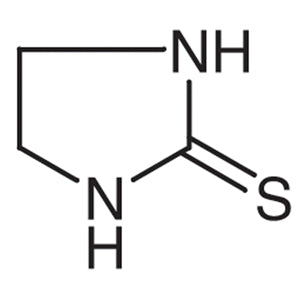
Ethylenethiourea, also known as 2-imidazolidinethione, is a saturated five-membered heterocyclic compound carrying a thiocarbonyl group positioned between two nitrogen atoms. This structure makes it the sulfur analogue of ethylene urea and gives the compound strongly nucleophilic character at its sulfur atom. In the laboratory, the material is used as an advanced non-heterocyclic building block in organic synthesis, as a sulfur source in the formation of thiazole rings and thiols, and as a reference material in studies of rubber chemistry and pesticides. Its role is closely tied to research concerning dithiocarbamate compounds.
The property that leads researchers to select this compound is the controlled reactivity of its cyclic thiourea group. The sulfur atom behaves as a soft nucleophile, so it reacts readily with alkyl halides and carbonyl compounds, while the ring framework holds both nitrogen atoms in a fixed geometry, so the products that form are more predictable than those obtained from open-chain thioureas. The compound is a solid at room temperature, dissolves in water and polar solvents, and is widely known as an accelerator in rubber vulcanisation, particularly for polychloroprene rubber.
In Indonesian laboratories, this material is typically used in university and institutional organic synthesis groups, in rubber and polymer technology research, and in analytical work supporting pesticide and dithiocarbamate studies. Because it is a defined synthetic building block supplied under a TCI catalogue number, it fits routine bench-scale preparations as well as method development and reference work, where consistent identity of the starting material matters more than the scale of the reaction being run.
- Organic synthesis building block — serves as an advanced non-heterocyclic building block whose cyclic thiourea group reacts predictably with a range of electrophilic partners.
- Thiazole ring formation — acts as a sulfur source in the construction of thiazole rings, where the nucleophilic sulfur atom supplies the required heteroatom during cyclisation.
- Thiol preparation — provides sulfur for the formation of thiols, with the ring framework helping control the course of the reaction compared with open-chain thioureas.
- Rubber chemistry research — used as a reference material in rubber chemistry studies, reflecting its established role as an accelerator in polychloroprene rubber vulcanisation.
- Pesticide and dithiocarbamate studies — employed as a reference material in pesticide research, since its chemistry is closely associated with dithiocarbamate compounds under investigation.
| Brand | TCI |
|---|---|
| CAS number | 96-45-7 |
| Molecular formula | — |
| Purity | — |
| Category | Chemistry > Building Blocks > Non-Heterocyclic Building Blocks |
| Pack sizes | available in the pack sizes listed for this TCI catalogue item |
| Physical form | solid at room temperature; soluble in water and polar solvents |
| Storage | store in a closed container under the conditions stated on the manufacturer's label |
- Chemical name: Ethylenethiourea (2-imidazolidinethione)
Store the container tightly closed in a cool, dry and well-ventilated area, away from moisture, incompatible chemicals and sources of ignition, and follow any storage conditions specified on the manufacturer's label. Suitable containers are the original supplier packaging or clean, chemically resistant glass or plastic bottles with secure closures, kept clearly labelled. Handle the solid in a fume hood using gloves, safety glasses and a laboratory coat, avoid generating or inhaling dust, and wash hands after handling. Consult the manufacturer's safety data sheet before use and dispose of residues and contaminated materials through the laboratory's chemical waste procedures.
—
Produk Terkait
-
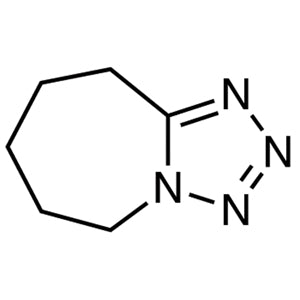
1,5-Pentamethylenetetrazole TCI P0046
Regular price From Rp 903.000,00Regular price -
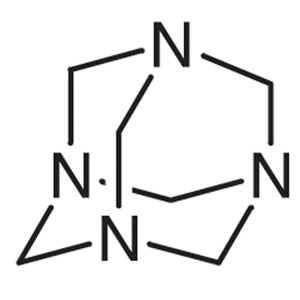
Hexamethylenetetramine TCI H0093
Regular price From Rp 477.750,00Regular price