

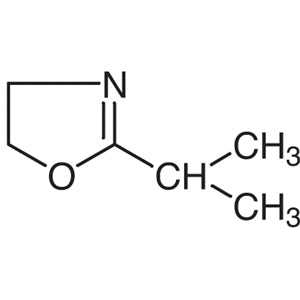
2-Isopropyl-2-oxazoline is a five-membered heterocyclic monomer containing both a nitrogen and an oxygen atom within the same ring, with an isopropyl group attached at the second position. The compound serves as a principal starting material for cationic ring-opening polymerization, yielding poly(2-isopropyl-2-oxazoline). That polymer belongs to the polyoxazoline family, a class of materials widely studied as an alternative to polyethylene glycol for biomedical purposes because of its ready solubility, good tolerability, and the precision with which chain length can be designed. Supplied by TCI, it reaches the laboratory as a defined building block for polymer synthesis.
The appeal of this monomer lies in the combination of straightforward polymerization behaviour and the thermoresponsive character of the polymer it produces. Cationic ring-opening polymerization proceeds in a controlled, living manner, so researchers can set the molecular weight, obtain a narrow weight distribution, and construct specific block architectures or end groups according to their design. Poly(2-isopropyl-2-oxazoline) itself is known to display lower critical solution temperature behaviour in water, changing from dissolved to precipitated when heated past a certain threshold. That property makes it attractive for systems where a response to temperature is the intended function rather than an incidental effect.
In Indonesian laboratories, this monomer is typically encountered in university polymer chemistry groups, pharmaceutical formulation research, and materials science work at national research institutes. It is normally handled at bench scale in synthesis laboratories equipped for inert-atmosphere work, where small quantities are dispensed for controlled polymerization runs. Researchers preparing polyoxazoline-based carriers or thermoresponsive materials order it as a defined heterocyclic building block alongside the initiators and solvents needed for the same reaction sequence.
- Cationic ring-opening polymerization: the oxazoline ring opens cleanly under cationic initiation, giving researchers a living polymerization that runs in a controlled fashion from monomer to defined polymer chain.
- Synthesis of poly(2-isopropyl-2-oxazoline): this monomer is the direct precursor to that polymer, making it the required feedstock whenever the thermoresponsive polyoxazoline itself is the synthetic target.
- Thermoresponsive materials research: because the resulting polymer shows lower critical solution temperature behaviour in water, the monomer supports studies where temperature-triggered solubility change is the property under investigation.
- Block copolymer construction: the living character of the polymerization lets researchers build specific block structures and defined end groups, so the monomer suits segmented architecture design work.
- Biomedical polymer studies as a polyethylene glycol alternative: the polyoxazoline family is widely examined for this role, so the monomer is used where solubility and tolerability are the properties being assessed.
| Brand | TCI |
|---|---|
| CAS number | 10431-99-9 |
| Molecular formula | — |
| Purity | — |
| Category | Chemistry > Building Blocks > Heterocyclic Building Blocks |
| Pack sizes | available in standard TCI research-scale packaging; please confirm the currently listed sizes when ordering |
| Physical form | — |
| Storage | keep in the closed original container under the conditions stated on the product label and safety data sheet |
- Catalogue number: I0642
Store the container closed in a cool, well-ventilated area away from heat sources, ignition sources, and direct sunlight, and follow the storage conditions given on the manufacturer's label and safety data sheet. Keep the material in its original supplier container; where transfer is necessary, use containers of compatible material with a tight closure, and label them clearly. As a reactive monomer intended for controlled polymerization, it should be protected from moisture and handled under inert atmosphere where the experimental protocol requires it. Dispense in a fume hood, wear safety glasses, gloves, and a laboratory coat, and consult the safety data sheet before first use.
—
Produk Terkait
-
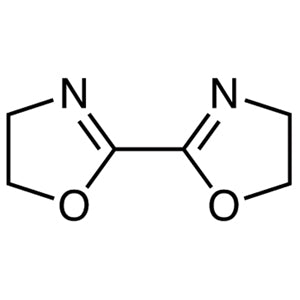
2,2'-Bis(2-oxazoline) TCI B1226
Regular price From Rp 2.782.500,00Regular price -
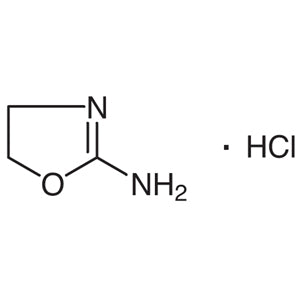
2-Amino-2-oxazolineHydrochloride TCI A0923
Regular price From Rp 7.023.450,00Regular price -
2,4,4-Trimethyl-2-oxazoline TCI T1060
Regular price Rp 2.466.450,00Regular price -
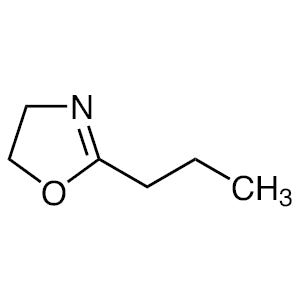
2-Propyl-2-oxazoline TCI P1739
Regular price From Rp 1.326.150,00Regular price -
2-Methyl-2-oxazoline TCI M0857
Regular price From Rp 1.167.600,00Regular price -
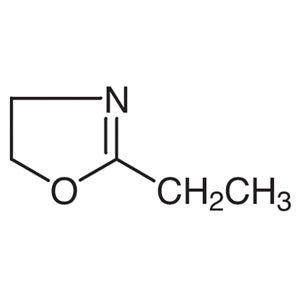
2-Ethyl-2-oxazoline TCI E0373
Regular price From Rp 689.850,00Regular price -
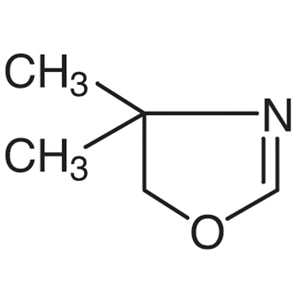
4,4-Dimethyl-2-oxazoline TCI D2742
Regular price Rp 1.724.100,00Regular price -
2,2'-Bis[(4S)-4-benzyl-2-oxazoline] TCI B6639
Regular price From Rp 2.068.500,00Regular price


![2,2'-Bis[(4S)-4-benzyl-2-oxazoline] (CAS 133463-88-4) - TCI B6639 - AMI Scientific](http://amiscientific.com/cdn/shop/files/TCI2510B6639.jpg?v=1767094079&width=533)