

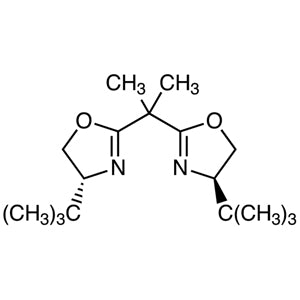
TCI I0795 (R,R)-(+)-2,2'-Isopropylidenebis(4-tert-butyl-2-oxazoline), CAS 131833-97-1, is a chiral bisoxazoline ligand, widely known in the literature as a member of the BOX ligand family. Its molecule consists of two oxazoline rings joined by an isopropylidene bridge, each carrying a tert-butyl group at the 4-position with the (R,R) configuration. In the laboratory this compound is not used on its own but is complexed with transition metal salts such as copper, zinc, or iron to form chiral catalysts that steer a reaction toward one particular enantiomer.
The main characteristics that make this ligand a preferred choice are its C2 symmetry and the rigidity of its framework. C2 symmetry reduces the number of possible transition states, so selectivity becomes easier to predict and enantiomeric outcomes tend to be high. The two oxazoline nitrogen atoms act as bidentate donors that bind the metal strongly and form a stable chelate ring, while the very bulky tert-butyl groups create a well-defined steric environment around the metal center. This combination directs the substrate to approach from a single face only. BOX ligands are also well known for their versatility.
In Indonesian laboratories, this ligand is typically used in academic and industrial research groups working on asymmetric synthesis, particularly in university chemistry departments, pharmaceutical research units, and fine chemical development laboratories. It is normally handled in small quantities on a research scale, prepared as a metal complex immediately before use, and applied in method development work where a specific enantiomer of a target molecule must be obtained rather than a racemic mixture.
TCI brochures (PDF)
- Chiral Ligands 2024-12-13 · p. 3
- Asymmetric Synthesis 2026-03-18 · p. 4
- Ligands 2025-12-01 · p. 3
Related TCI products
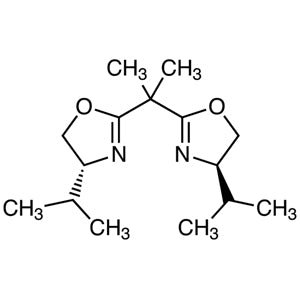
- TCI I1089 150529-94-5 (R,R)-2,2'-Isopropylidenebis(4-isopropyl-2-oxazoline)
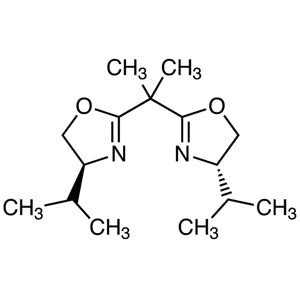
- TCI I1051 131833-92-6 (S,S)-2,2'-Isopropylidenebis(4-isopropyl-2-oxazoline)
- TCI I0582 131457-46-0 (S,S)-2,2'-Isopropylidenebis(4-phenyl-2-oxazoline)
- TCI I0567 131833-93-7 (S,S)-(-)-2,2'-Isopropylidenebis(4-tert-butyl-2-oxazoline)
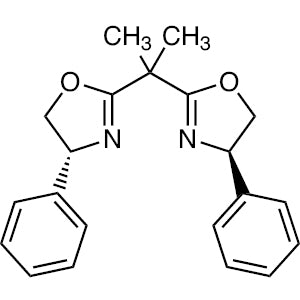
- TCI D2823 150529-93-4 (R,R)-2,2'-Isopropylidenebis(4-phenyl-2-oxazoline)
- TCI B4104 117408-98-7 (S)-4-tert-Butyl-2-(2-pyridyl)oxazoline
- Copper-catalyzed asymmetric reactions: the bidentate oxazoline nitrogen donors form a stable chelate with copper salts, giving a well-defined chiral catalyst for enantioselective transformations.
- Zinc-based chiral catalysis: complexation with zinc salts produces a catalyst whose rigid C2-symmetric framework makes the facial approach of the substrate predictable and reproducible.
- Iron-mediated asymmetric synthesis: the ligand binds iron centers through both oxazoline nitrogens, creating the defined steric pocket needed to favor formation of a single enantiomer.
- Enantioselective method development: the bulky tert-butyl groups at the 4-position give strong steric differentiation, making this ligand a useful reference point when screening chiral catalyst systems.
- Academic research on ligand structure and selectivity: as a well-documented member of the BOX family, it serves as a benchmark ligand for studying how C2 symmetry influences transition states.
| Brand | TCI |
|---|---|
| CAS number | 131833-97-1 |
| Molecular formula | — |
| Purity | — |
| Category | Chemistry > Asymmetric Synthesis > Chiral Catalysts, Chiral Ligands, Chiral Reagents |
| Pack sizes | available in research-scale packaging; please confirm the currently offered sizes when ordering |
| Physical form | — |
| Storage | — |
- Product code: I0795
- Chemical class: chiral bisoxazoline (BOX) ligand, (R,R) configuration, C2-symmetric
Store the container tightly closed in a cool, dry place, away from moisture, direct sunlight, and sources of heat, and follow the storage conditions stated on the manufacturer's label and safety data sheet. Keep the material in its original container or in a chemically compatible, well-sealed vessel, and reseal it promptly after each use to limit exposure to atmospheric moisture. Handle in a fume hood using gloves, safety glasses, and a laboratory coat. Weigh and transfer the ligand with clean, dry equipment, and prepare metal complexes only as needed. Dispose of waste in accordance with applicable laboratory chemical waste procedures.
—
Produk Terkait
-
(R,R)-2,2'-Isopropylidenebis(4-isopropyl-2-oxazoline) TCI I1089
Regular price From Rp 1.856.400,00Regular price -
(S,S)-2,2'-Isopropylidenebis(4-isopropyl-2-oxazoline) TCI I1051
Regular price From Rp 2.332.050,00Regular price -
(S,S)-2,2'-Isopropylidenebis(4-phenyl-2-oxazoline) TCI I0582
Regular price From Rp 2.068.500,00Regular price -
(S,S)-(-)-2,2'-Isopropylidenebis(4-tert-butyl-2-oxazoline) TCI I0567
Regular price From Rp 2.625.000,00Regular price -
(R,R)-2,2'-Isopropylidenebis(4-phenyl-2-oxazoline) TCI D2823
Regular price From Rp 2.094.750,00Regular price -
(S)-4-tert-Butyl-2-(2-pyridyl)oxazoline TCI B4104
Regular price From Rp 4.240.950,00Regular price -
2,2'-Bis(2-oxazoline) TCI B1226
Regular price From Rp 2.782.500,00Regular price -
2,2'-Bis[(4S)-4-benzyl-2-oxazoline] TCI B6639
Regular price From Rp 2.068.500,00Regular price



![2,2'-Bis[(4S)-4-benzyl-2-oxazoline] (CAS 133463-88-4) - TCI B6639 - AMI Scientific](http://amiscientific.com/cdn/shop/files/TCI2510B6639.jpg?v=1767094079&width=533)