

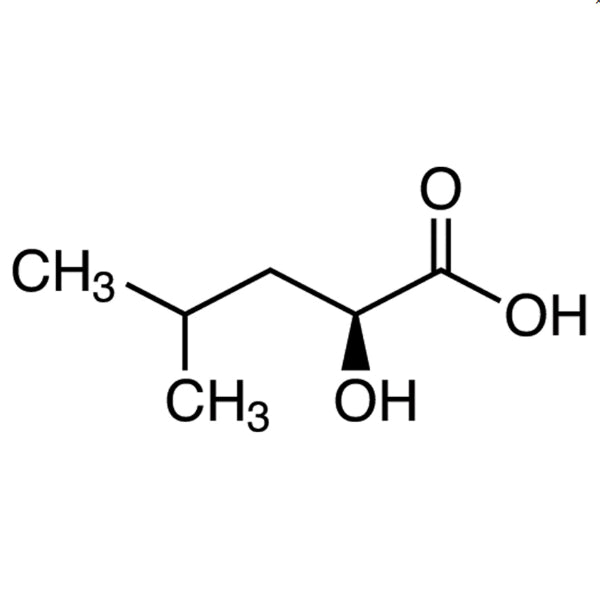
L-Leucic Acid is a chiral hydroxy acid that is structurally an analogue of leucine in which the amino group has been replaced by a hydroxyl group. The compound serves as a valuable chiral building block in asymmetric synthesis because it carries a stereogenic centre whose configuration is already defined. In the laboratory, it is used to assemble depsipeptides, biodegradable polyesters, and other target molecules that demand optical purity. Its role becomes important when researchers want to exchange an amide bond in a peptide backbone for an ester bond without altering the carbon skeleton or its spatial configuration.
The characteristic that makes this material a preferred choice is the presence of two complementary functional groups, a carboxylic acid and a secondary hydroxyl, on a molecule that is already enantiomerically pure. That combination allows stepwise polymerisation, lactone formation, and selective coupling at one end of the molecule only. The branched isobutyl side chain provides steric hindrance that is useful for directing selectivity in asymmetric reactions, while at the same time contributing hydrophobic character to the final product. Reagent-grade chiral material from TCI helps maintain the stereochemical purity that is central to this kind of work.
In Indonesian laboratories, this building block is typically found in university and institutional research groups working on peptidomimetics, biodegradable polymer chemistry, and natural product synthesis. It is normally ordered in small quantities for method development and multi-step synthetic routes rather than for routine analysis, and is kept alongside other chiral reagents in a controlled storage area. Groups preparing publications or theses that depend on defined stereochemistry rely on reagent-grade material of this type for reproducible results.
TCI brochures (PDF)
- Chiral Building Blocks 2025-04-14 · p. 12
- Depsipeptide synthesis: the hydroxyl group allows an ester linkage to replace a selected amide bond in a peptide backbone while the carbon skeleton and stereochemistry stay unchanged.
- Biodegradable polyester preparation: the carboxylic acid and secondary hydroxyl on the same molecule permit stepwise polymerisation, giving chains with defined stereochemistry along the polymer backbone.
- Asymmetric synthesis as a chiral building block: the pre-defined stereogenic centre is carried through subsequent transformations, so optical purity is established from the starting material rather than induced later.
- Lactone formation studies: intramolecular reaction between the carboxylic acid and the hydroxyl group provides access to ring systems useful in natural product and methodology work.
- Peptidomimetic and backbone modification research: the leucine-like isobutyl side chain preserves the hydrophobic character of the parent residue while the amide-to-ester change alters hydrogen bonding and stability.
| Brand | TCI |
|---|---|
| CAS number | 13748-90-8 |
| Molecular formula | — |
| Purity | — |
| Category | Chemistry > Asymmetric Synthesis > Chiral Building Blocks |
| Pack sizes | available in standard research-scale pack sizes; please confirm the current options when ordering. |
| Physical form | — |
| Storage | keep in a cool, dry place in the tightly closed original container. |
- Product code: L0026
Store the material in a cool, dry area, away from direct sunlight, moisture, and sources of heat or ignition, keeping the container tightly closed at all times. The original supplier container is the most suitable option; if transfer is necessary, use a clean, dry, chemically compatible container that is clearly labelled with the product name and CAS number. Handle the compound in a well-ventilated area or fume hood, and wear standard laboratory personal protective equipment including a lab coat, safety glasses, and suitable gloves. Avoid generating dust, prevent contact with skin and eyes, and follow the supplier safety data sheet and your institutional chemical waste procedures for disposal. Because the material is used for its optical purity, minimise exposure to air and humidity during weighing to protect sample quality.
—
Produk Terkait
-
DL-LeucicAcid TCI L0104
Regular price From Rp 2.545.200,00Regular price -
(-)-Verbenone TCI V0072
Regular price Rp 1.353.450,00Regular price -
(R)-1-[4-(Trifluoromethyl)phenyl]ethan-1-ol TCI T4357
Regular price Rp 2.889.600,00Regular price -
(S)-TrichostaticAcid TCI T3402
Regular price Rp 7.659.750,00Regular price -
(R)-TrichostaticAcid TCI T3401
Regular price Rp 7.579.950,00Regular price -
(S)-(+)-1,2,3,4-Tetrahydro-1-naphthol TCI T2360
Regular price From Rp 1.696.800,00Regular price -
(R)-(-)-1,2,3,4-Tetrahydro-1-naphthol TCI T2359
Regular price From Rp 1.724.100,00Regular price -
(S)-3,3,3-Trifluoro-2-hydroxy-2-methylpropionicAcid TCI T1901
Regular price Rp 5.009.550,00Regular price


![76155-79-8 (R)-1-[4-(Trifluoromethyl)phenyl]ethan-1-ol - AMI Scientific](http://amiscientific.com/cdn/shop/files/TCI2510T4357.jpg?v=1768363692&width=533)


