

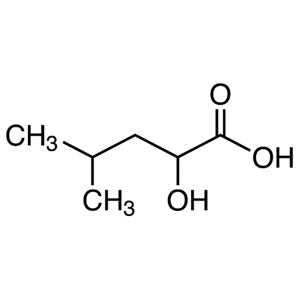
DL-Leucic Acid is a branched α-hydroxy acid that is structurally the hydroxy analogue of the amino acid leucine, with the amino group replaced by a hydroxyl group. As a non-heterocyclic building block, this compound presents two reactive functional groups at once — a carboxylic acid and a secondary hydroxyl — within a single small molecule. That combination makes it a valuable starting material for the synthesis of esters, lactides, and degradable polymers. The DL racemic designation indicates that both enantiomers are present in equal proportion, so the material suits work that does not demand a specific optical purity.
The property that makes DL-Leucic Acid a frequent choice is its isobutyl side chain, which imparts hydrophobic character to the hydroxy acid framework. When the compound is polymerised or copolymerised with other hydroxy acids, that alkyl branch influences the glass transition temperature, the solubility, and the degradation rate of the resulting material. Because the hydroxyl and carboxyl groups sit on adjacent positions, the compound readily forms both intramolecular and intermolecular ester linkages, and it can also act as a simple chelating ligand. These characteristics give formulators a straightforward way to tune polymer behaviour without redesigning an entire monomer system.
In Indonesian laboratories, DL-Leucic Acid is typically encountered in synthetic organic chemistry groups and polymer research units working on degradable materials. It is handled on the bench in university research laboratories, in institutional materials science facilities, and in industrial R&D settings where ester and lactide chemistry is explored. Because it functions as an intermediate rather than a finished formulation, it is generally ordered in research-scale quantities to support method development, monomer preparation, and exploratory copolymer studies.
Related TCI products
- Degradable polymer synthesis — the bifunctional hydroxy acid structure allows direct polycondensation into polyester chains whose degradation rate can be adjusted through the isobutyl branch.
- Lactide and cyclic ester preparation — the adjacent hydroxyl and carboxyl groups favour intramolecular esterification, making this compound a practical precursor for substituted lactide monomers.
- Copolymer property tuning — incorporating this hydroxy acid alongside other hydroxy acids modifies glass transition temperature and solubility without requiring a completely new monomer design.
- Ester synthesis and derivatisation — the free carboxylic acid provides a straightforward handle for esterification chemistry while the secondary hydroxyl remains available for further functionalisation.
- Simple chelation studies — the neighbouring hydroxyl and carboxylate functions can coordinate metal centres, supporting exploratory coordination chemistry and ligand screening work on a small scale.
| Brand | TCI |
|---|---|
| CAS number | 498-36-2 |
| Molecular formula | — |
| Purity | — |
| Category | Chemistry > Building Blocks > Non-Heterocyclic Building Blocks |
| Pack sizes | research-scale packaging as listed by the manufacturer for this catalogue item |
| Physical form | — |
| Storage | keep in the original tightly closed container in a cool, dry place away from moisture |
- Catalogue number: L0104
Store DL-Leucic Acid in its original tightly closed container in a cool, dry, well-ventilated area, protected from moisture and away from direct sunlight and heat sources. Hydroxy acids are hygroscopic in character, so containers should be resealed promptly after each use and returned to the storage cabinet rather than left open on the bench. Handle the material in a fume hood or well-ventilated workspace while wearing safety glasses, chemical-resistant gloves, and a laboratory coat. Use clean, dry glass or chemically compatible plastic vessels for weighing and transfer, avoid contact with skin and eyes, and consult the manufacturer's safety data sheet before first use.
—
Produk Terkait
-
L-LeucicAcid TCI L0026
Regular price From Rp 610.050,00Regular price
