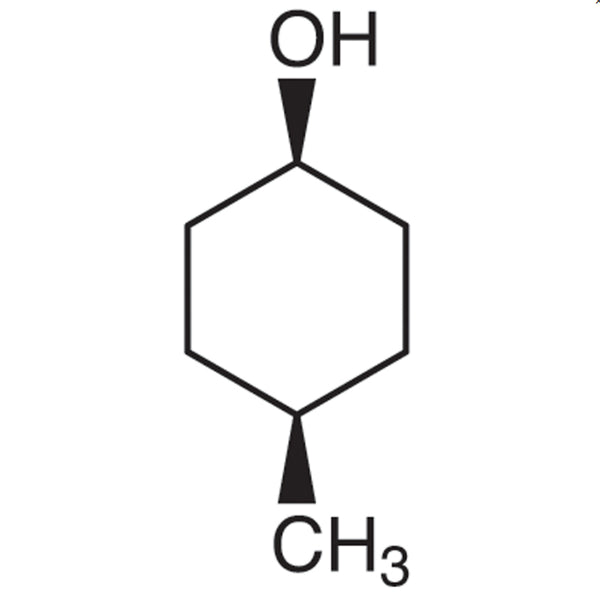
TCI M0353 cis-4-Methylcyclohexanol is a cyclohexane alcohol carrying a methyl group at the four position, directly across the ring from the hydroxyl group, and it is supplied in a defined *cis* configuration. Placing the substituents at positions 1 and 4 makes this compound the cleanest possible example for discussing the influence of ring geometry without interference from steric hindrance between neighbouring substituents. In the laboratory it serves as a non-heterocyclic building block, a model substrate for research work, and a comparison standard in both chromatographic and spectroscopic analysis.
The property that gives this material its value is its decisive conformational behaviour. In the *cis*-1,4 isomer, one substituent sits axial while the other is equatorial in every chair conformation, and the relatively bulky methyl group tends to anchor the ring so that the hydroxyl group is pushed into the axial position. As a result, the hydroxyl group in this isomer experiences a steric environment clearly different from that of the *trans* isomer, and that difference is readable in acetylation and oxidation rates as well as in the chemical shift of the carbinol proton.
Its liquid form makes it straightforward to measure out with a syringe for millimole-scale reactions, which suits the working style of most Indonesian laboratories. University organic chemistry groups, stereochemistry teaching laboratories, and research units studying conformational effects can dispense the quantity they need directly from the container without a weighing step. The defined *cis* configuration also makes it a practical reference material for analytical laboratories that need to distinguish isomers in a sample.
Related TCI products
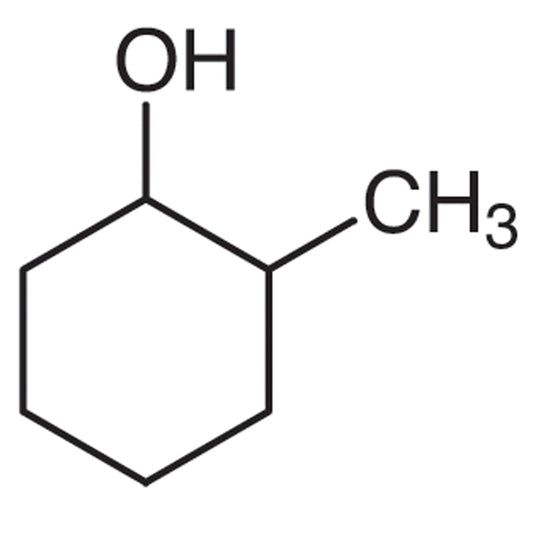
- TCI M0194 583-59-5 2-Methylcyclohexanol (cis- and trans- mixture)
- TCI T2693 116-02-9 cis-3,3,5-Trimethylcyclohexanol (contains ca. 20% trans- isomer)
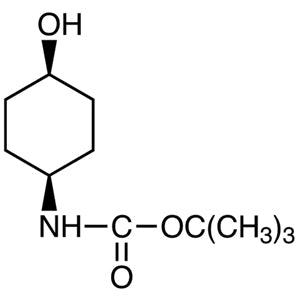
- TCI B5367 167081-25-6 cis-4-(tert-Butoxycarbonylamino)cyclohexanol
- TCI B4714 224309-64-2 4-(tert-Butoxycarbonylamino)cyclohexanol
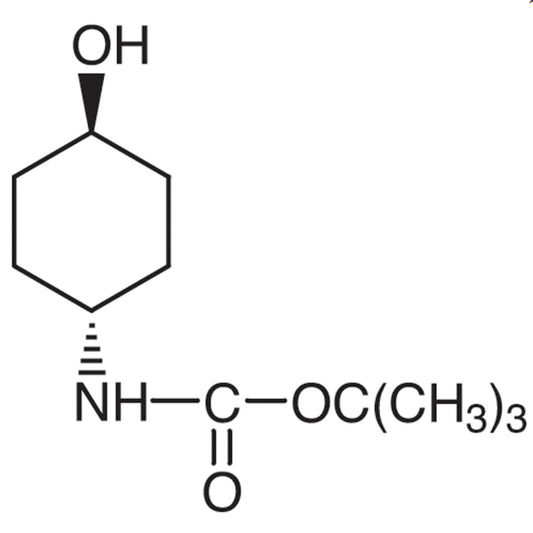
- TCI B3564 111300-06-2 trans-4-(tert-Butoxycarbonylamino)cyclohexanol
- TCI B1930 70568-60-4 4-Butylcyclohexanol (cis- and trans- mixture)
- Non-heterocyclic building block for synthesis — the defined *cis* configuration lets the hydroxyl group be carried forward into further transformations while the stereochemical relationship across the ring is retained.
- Model substrate for conformational studies — the fixed axial-equatorial arrangement of the 1,4 substituents provides a clean system for examining how ring geometry governs reactivity without neighbouring-group interference.
- Comparison standard in chromatographic analysis — a supply of known *cis* configuration allows the *cis* and *trans* isomers in an unknown sample to be assigned by comparing retention behaviour side by side.
- Spectroscopic reference material — the distinct chemical shift of the carbinol proton in this isomer serves as a reliable comparison point when interpreting spectra of related cyclohexanol compounds.
- Reactivity studies of hydroxyl groups — the differing acetylation and oxidation rates relative to the *trans* isomer make this material well suited to experiments measuring how steric environment affects alcohol reactivity.
| Brand | TCI |
|---|---|
| CAS number | 7731-28-4 |
| Molecular formula | — |
| Purity | — |
| Category | Chemistry > Building Blocks > Non-Heterocyclic Building Blocks |
| Pack sizes | available in the standard TCI catalogue pack sizes; please confirm the option you require when ordering |
| Physical form | liquid, suitable for measuring out by syringe |
| Storage | keep in a closed original container under the conditions stated on the manufacturer's label |
Store the container tightly closed in a cool, dry, well-ventilated area, away from heat sources, direct sunlight, and strong oxidising agents. Keep the material in its original manufacturer container, or in glass vessels fitted with a chemically resistant closure, since organic alcohols may attack certain plastics over time. Dispense in a fume hood and wear safety glasses, gloves, and a laboratory coat. Because this material is a liquid, close the container immediately after use to limit vapour release and moisture uptake, and always consult the manufacturer's safety data sheet before handling.
—
Produk Terkait
-
2-Methylcyclohexanol(cis-andtrans-mixture) TCI M0194
Regular price From Rp 505.050,00Regular price -
cis-3,3,5-Trimethylcyclohexanol(containsca.20%trans-isomer) TCI T2693
Regular price From Rp 584.850,00Regular price -
cis-4-(tert-Butoxycarbonylamino)cyclohexanol TCI B5367
Regular price Rp 2.147.250,00Regular price -
4-(tert-Butoxycarbonylamino)cyclohexanol TCI B4714
Regular price From Rp 557.550,00Regular price -
trans-4-(tert-Butoxycarbonylamino)cyclohexanol TCI B3564
Regular price From Rp 1.829.100,00Regular price -
4-Butylcyclohexanol(cis-andtrans-mixture) TCI B1930
Regular price From Rp 3.446.100,00Regular price -
4,4'-Bicyclohexanol(mixtureofisomers) TCI B1621
Regular price From Rp 1.565.550,00Regular price -
trans-4-tert-Butylcyclohexanol TCI B1271
Regular price From Rp 4.718.700,00Regular price