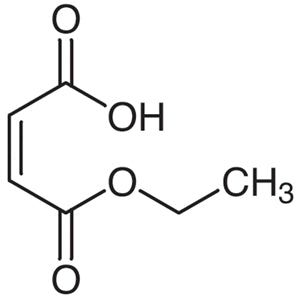
Ethyl Hydrogen Maleate (EHM) is a chemical compound widely utilized in laboratory settings for the synthesis of complex molecules. As a key building block in organic chemistry, it plays a crucial role in substitution and coupling reactions, enabling the formation of both heterocyclic and non-heterocyclic compounds. Its simple molecular structure provides versatility, making it a valuable reagent in various industrial and research applications. EHM is particularly favored for its ability to participate in efficient and rapid chemical reactions, contributing to the development of new compounds and pharmaceuticals.
The chemical properties of Ethyl Hydrogen Maleate make it a preferred choice for laboratory use. It exhibits stability under controlled conditions, although it remains sensitive to moisture and water exposure. This sensitivity necessitates careful handling and storage to maintain its integrity. Despite this, its high reactivity allows for effective participation in a wide range of chemical transformations. The compound’s chemical stability and reactivity balance make it ideal for use in controlled laboratory environments where precision and consistency are essential.
In Indonesian laboratories, Ethyl Hydrogen Maleate is commonly used in organic chemistry research, especially in academic institutions and research organizations. It is an essential component in the synthesis of new compounds, drug development, and chemical testing. Its availability and reliability make it a go-to reagent for chemists working on diverse projects, ensuring consistent results in both educational and industrial research settings.
- Organic synthesis reactions benefit from Ethyl Hydrogen Maleate due to its reactivity and role in coupling and substitution processes.
- Drug development projects often utilize this compound as a building block for creating complex pharmaceutical molecules.
- Analytical chemistry applications rely on EHM for its stability and predictable chemical behavior in controlled environments.
- Educational institutions use EHM in teaching organic chemistry to demonstrate fundamental reaction mechanisms and synthesis techniques.
- Industrial research laboratories incorporate EHM in the development of new materials and chemical products due to its versatility and effectiveness.
| Brand | TCI |
|---|---|
| CAS number | 3990-03-2 |
| Molecular formula | — |
| Purity | — |
| Category | Chemistry > Building Blocks > Non-Heterocyclic Building Blocks |
| Pack sizes | Available in various quantities as per supplier specifications |
| Physical form | Solid, typically in crystalline or powder form |
| Storage | Requires dry, cool storage away from moisture and light |
Ethyl Hydrogen Maleate should be stored in a dry, cool environment to prevent moisture absorption, which can affect its chemical stability. It is recommended to keep the compound in airtight containers made of materials such as glass or polyethylene to minimize exposure to humidity. Laboratory personnel should handle the material with care, using appropriate personal protective equipment to avoid direct contact. Due to its sensitivity to water, it is essential to maintain a controlled storage environment and ensure that the compound is used promptly after opening. Proper labeling and storage conditions help maintain the integrity of the compound and ensure safe handling in laboratory settings.
—
Produk Terkait
-
MonomethylMaleate TCI M0624
Regular price From Rp 1.696.800,00Regular price -
MonosodiumMaleateTrihydrate TCI M0016
Regular price Rp 1.246.350,00Regular price -
DisodiumMaleate TCI M0014
Regular price From Rp 584.850,00Regular price -
DimethylMaleate TCI M0012
Regular price From Rp 505.050,00Regular price -
DiethylMaleate TCI M0010
Regular price From Rp 505.050,00Regular price -
DibutylMaleate TCI M0009
Regular price From Rp 477.750,00Regular price -
PotassiumHydrogenPhthalate TCI P0309
Regular price From Rp 477.750,00Regular price -
SodiumHydrogenFumarate TCI F0071
Regular price From Rp 875.700,00Regular price