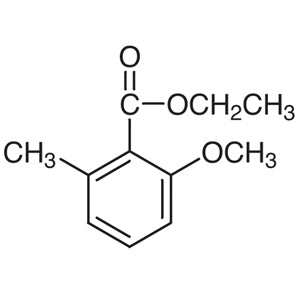
TCI M1120 is Ethyl 2-Methoxy-6-methylbenzoate, the ethyl ester of a benzoic acid carrying a methoxy group and a methyl group at both ortho positions relative to the ester function. The compound is a non-heterocyclic building block used in the synthesis of densely substituted aromatic molecules, particularly when researchers require a substitution pattern that is already established from the outset. In the laboratory, this material saves several synthetic steps, because arranging methoxy and methyl groups on a benzene ring is often difficult to achieve selectively when the pattern has to be constructed from simpler starting materials.
The most notable characteristic is the steric environment surrounding the ester group, which is flanked by two substituents at the ortho positions. This steric hindrance leaves the ester relatively shielded, so that its hydrolysis demands more forcing conditions — a property that is in fact exploited to achieve selectivity when a molecule carries several ester groups. The methoxy group is electron-donating and directs subsequent electrophilic substitution reactions, while the methyl group can be functionalised further, for example through benzylic halogenation, to become a new point of attachment.
In Indonesian laboratories, this combination of features makes the material suitable for university research groups and industrial R&D units working on multi-step aromatic synthesis. It is typically ordered for medicinal chemistry and natural product intermediate work, where a pre-arranged ring substitution pattern shortens the route. Laboratories preparing reference materials and small-scale synthetic intermediates also draw on it when selective transformations on a crowded aromatic ring are required.
Related TCI products
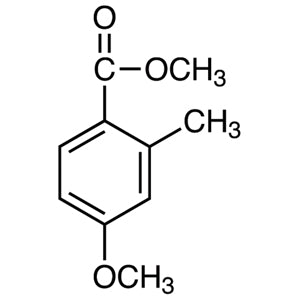
- TCI M2889 35598-05-1 Methyl 4-Methoxy-2-methylbenzoate
- TCI M1427 3556-83-0 Methyl 3-Methoxy-4-methylbenzoate
- TCI B5414 65874-27-3 tert-Butyl 4-Formylbenzoate
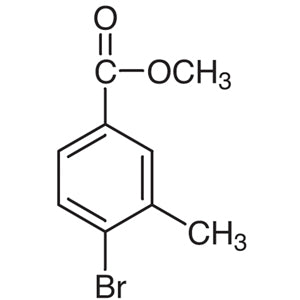
- TCI B2256 148547-19-7 Methyl 4-Bromo-3-methylbenzoate
- TCI B1231 606-28-0 Methyl 2-Benzoylbenzoate
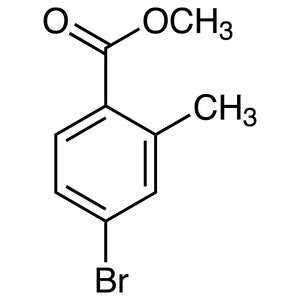
- TCI M3630 99548-55-7 Methyl 4-Bromo-2-methylbenzoate
- Multi-step aromatic synthesis — the pre-installed methoxy and methyl substitution pattern removes several selectivity-limited steps that would otherwise be needed to decorate a benzene ring from simpler precursors.
- Selective ester chemistry — the hindered ortho-flanked ester resists hydrolysis under mild conditions, allowing other, less shielded ester groups in a polyfunctional molecule to be cleaved first.
- Electrophilic substitution studies — the electron-donating methoxy group directs incoming electrophiles to defined ring positions, giving predictable regiochemistry for researchers designing further ring functionalisation.
- Benzylic functionalisation work — the methyl substituent serves as a handle for benzylic halogenation, converting an otherwise inert position into a new connection point for chain extension.
- Medicinal chemistry intermediate preparation — the densely substituted aromatic core provides a ready scaffold for research groups assembling analogue libraries around a fixed substitution motif.
| Brand | TCI |
|---|---|
| CAS number | 6520-83-8 |
| Molecular formula | — |
| Purity | — |
| Category | Chemistry > Building Blocks > Non-Heterocyclic Building Blocks |
| Pack sizes | available in the catalogue pack sizes offered by TCI for this catalogue number |
| Physical form | — |
| Storage | store according to the conditions stated on the manufacturer label and accompanying documentation |
- Chemical name: Ethyl 2-Methoxy-6-methylbenzoate
Store the container tightly closed in a cool, dry and well-ventilated area, away from direct sunlight, heat sources and incompatible chemicals such as strong oxidising agents, strong acids and strong bases. Keep the material in its original manufacturer container, or transfer it to a chemically compatible sealed glass container that is clearly labelled with the substance name and CAS number. Handle in a fume hood using safety glasses, laboratory gloves and a laboratory coat. Avoid contact with skin and eyes and avoid breathing vapour. Always consult the Safety Data Sheet supplied with the product before use, and dispose of residues and contaminated materials in accordance with applicable laboratory chemical waste procedures.
—
Produk Terkait
-
Methyl4-Methoxy-2-methylbenzoate TCI M2889
Regular price From Rp 1.246.350,00Regular price -
Methyl3-Methoxy-4-methylbenzoate TCI M1427
Regular price From Rp 1.298.850,00Regular price -
tert-Butyl4-Formylbenzoate TCI B5414
Regular price From Rp 4.797.450,00Regular price -
Methyl4-Bromo-3-methylbenzoate TCI B2256
Regular price From Rp 903.000,00Regular price -
Methyl2-Benzoylbenzoate TCI B1231
Regular price From Rp 903.000,00Regular price -
Methyl4-Bromo-2-methylbenzoate TCI M3630
Regular price From Rp 1.936.200,00Regular price -
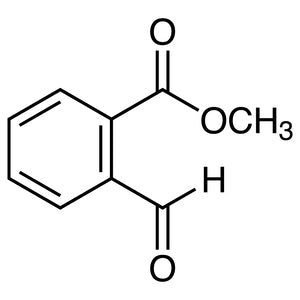
Methyl2-Formylbenzoate TCI M3552
Regular price From Rp 3.392.550,00Regular price -
Methyl3-Formylbenzoate TCI M3500
Regular price From Rp 1.829.100,00Regular price