


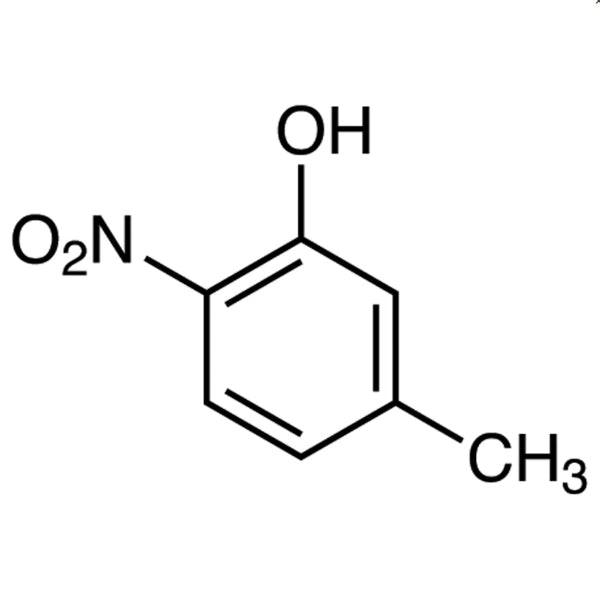
TCI M1122 6-Nitro-m-cresol is a substituted phenol derivative that carries two important functional groups on a single aromatic ring — a phenolic hydroxyl group and a nitro group — together with a methyl substituent that governs the reactivity pattern of the ring. The compound belongs to the family of non-heterocyclic building blocks, the starting materials chemists use to construct larger molecular frameworks. In synthetic organic laboratories, materials of this kind serve as a practical entry point because the substitution pattern is already established from the outset, sparing researchers the need to perform their own nitration step, which typically produces isomer mixtures and demands tedious separation work.
The characteristic that makes this material a frequent choice lies in the combination of an electron-withdrawing group and an electron-donating group positioned close to one another on the ring. The nitro group lowers the electron density of the aromatic system while simultaneously increasing the acidity of the phenolic proton, so the compound is readily deprotonated and reacted as an oxygen nucleophile in alkylation and acylation reactions. On the other hand, the nitro group is itself reducible to an amine, opening a route toward aminophenol derivatives and further downstream transformations built on that scaffold.
In Indonesian laboratories, reagents of this class are generally held in university organic chemistry research groups, government and institutional research centres, and the development units of companies working on fine chemicals. They are typically ordered in modest quantities appropriate to bench-scale synthesis and method development work, stored alongside other building-block reagents in the chemical inventory, and drawn upon when a particular substitution pattern is required for a target molecule rather than being consumed in bulk routine testing.
- Organic synthesis intermediate — the pre-established substitution pattern lets researchers begin a synthetic route directly, avoiding a nitration step that would otherwise generate isomer mixtures requiring difficult separation.
- Aminophenol derivative preparation — the nitro group can be reduced to an amine, giving access to aminophenol scaffolds that serve as the foundation for a wide range of further transformations.
- O-alkylation and O-acylation chemistry — the enhanced acidity of the phenolic proton allows straightforward deprotonation, so the resulting phenolate acts as an effective oxygen nucleophile in ether and ester formation.
- Fine chemical research and development — the compound functions as a defined starting material for building larger molecular frameworks in laboratories developing new specialty chemical products and synthetic routes.
- Academic teaching and methodology studies — the coexistence of electron-withdrawing and electron-donating substituents on one ring makes this a useful substrate for demonstrating substituent effects on aromatic reactivity and acidity.
| Brand | TCI |
|---|---|
| CAS number | 700-38-9 |
| Molecular formula | — |
| Purity | — |
| Category | Chemistry > Building Blocks > Non-Heterocyclic Building Blocks |
| Pack sizes | available in standard TCI research-scale packaging; please confirm the currently offered sizes when ordering. |
| Physical form | — |
| Storage | store according to the conditions stated on the product label and the accompanying Safety Data Sheet. |
- Catalogue Number: M1122
Keep the container tightly closed and store it in a cool, dry, well-ventilated area away from direct sunlight, heat sources, and incompatible materials, following the conditions printed on the manufacturer's label and Safety Data Sheet. Retain the material in its original container wherever possible; if transfer is necessary, use a chemically compatible, clearly labelled vessel with a secure closure. Handle the compound in a fume hood using appropriate personal protective equipment, including safety glasses, gloves, and a laboratory coat. Avoid inhalation of dust and contact with skin and eyes, and wash thoroughly after handling. Dispose of residues and contaminated packaging in accordance with applicable laboratory waste procedures.
—
Produk Terkait
-
4-Nitro-o-cresol TCI N0670
Regular price From Rp 875.700,00Regular price -
3-Nitro-o-cresol TCI N0627
Regular price From Rp 1.220.100,00Regular price -
2-Nitro-m-cresol TCI N0552
Regular price From Rp 875.700,00Regular price -
4-Nitro-m-cresol TCI N0351
Regular price From Rp 769.650,00Regular price -
3-Nitro-p-cresol TCI N0210
Regular price From Rp 610.050,00Regular price -
5-Nitro-o-cresol TCI N0185
Regular price Rp 2.411.850,00Regular price -
4-Chloro-6-nitro-m-cresol TCI C1684
Regular price From Rp 3.870.300,00Regular price -
3,4,5,6-Tetrabromo-o-cresol TCI T1528
Regular price Rp 610.050,00Regular price


