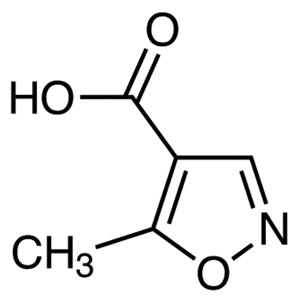
TCI M1740 5-Methylisoxazole-4-carboxylic Acid is a heterocyclic building block built around an isoxazole ring carrying a methyl group at the five position and a carboxylic acid group at the four position. The isoxazole ring, which contains adjacent oxygen and nitrogen atoms within a five-membered ring, is a highly valued scaffold in medicinal chemistry because of its adequate stability and its ability to act as a bioisostere for other functional groups. This compound serves as an important intermediate in laboratories developing biologically active molecules as well as in those studying heterocyclic chemistry more broadly.
The principal appeal of this compound lies in its readily elaborated carboxylic acid group. That group can be activated to the acid chloride, an active ester, or a mixed anhydride, and then coupled with a wide range of amines to give the amides that form the core of many target structures. The methyl group on the ring contributes a small degree of steric hindrance along with an electronic contribution that influences the stability and the ring-opening behaviour of the isoxazole ring under certain conditions, a property that is in fact exploited deliberately in the design of particular molecules.
In Indonesian laboratories, this building block is typically used in university and institutional research groups working on synthetic organic chemistry, in medicinal chemistry programmes exploring heterocyclic scaffolds, and in analytical work where a defined reference compound is required. It is generally ordered in small research quantities appropriate to bench-scale synthesis, then stored alongside other fine chemicals in a dedicated reagent cabinet and drawn upon across a series of coupling and derivatisation experiments.
Related TCI products
- Amide coupling and library synthesis: the carboxylic acid can be activated and coupled with diverse amines, allowing a research group to generate a family of related amide analogues from a single starting material.
- Medicinal chemistry scaffold development: the isoxazole ring functions as a bioisostere for other functional groups, so this acid gives chemists a compact, stable core for exploring structure–activity relationships in candidate molecules.
- Heterocyclic chemistry teaching and methodology studies: the compound illustrates the reactivity of an oxygen–nitrogen five-membered ring, making it useful for investigating ring stability and ring-opening pathways under controlled laboratory conditions.
- Preparation of activated intermediates: conversion to acid chlorides, active esters, or mixed anhydrides provides reactive species that can be carried directly into subsequent condensation steps without isolation of unstable material.
- Derivatisation for analytical reference work: defined heterocyclic acids of this type serve as characterised starting points when a laboratory needs a consistent reference compound for chromatographic or spectroscopic method development.
| Brand | TCI (Tokyo Chemical Industry) |
|---|---|
| CAS number | 42831-50-5 |
| Molecular formula | — |
| Purity | — |
| Category | Chemistry > Building Blocks > Heterocyclic Building Blocks |
| Pack sizes | available in standard research-scale packaging; please confirm the currently listed pack options when ordering |
| Physical form | — |
| Storage | keep in the tightly closed original container, in a cool, dry, well-ventilated place |
- Product code: M1740
- Chemical name: 5-Methylisoxazole-4-carboxylic Acid
Store the container tightly closed in a cool, dry and well-ventilated area, away from direct sunlight, moisture and sources of ignition, and keep it separated from strong bases and strong oxidising agents. The original supplier container is the most suitable storage vessel; if the material must be transferred, use a clean, chemically compatible, well-sealed glass container with a clear label showing the chemical name and CAS number. Handle the solid in a fume hood using a laboratory coat, safety goggles and suitable chemical-resistant gloves, avoid raising dust, and wash hands thoroughly after use. Always consult the manufacturer's Safety Data Sheet before first use and follow local regulations for waste disposal.
—
Produk Terkait
-
3-Methylisoxazole-5-carboxylicAcid TCI M2953
Regular price Rp 2.916.900,00Regular price -
5-Methylisoxazole-3-carboxylicAcid TCI M2405
Regular price From Rp 1.298.850,00Regular price -
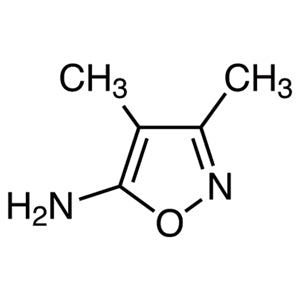
5-Amino-3,4-dimethylisoxazole TCI A3179
Regular price From Rp 1.193.850,00Regular price -
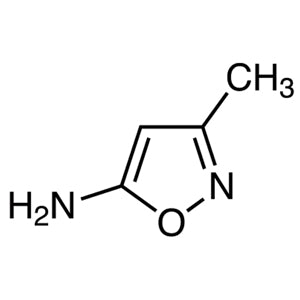
5-Amino-3-methylisoxazole TCI A2867
Regular price From Rp 1.008.000,00Regular price -
3-Amino-5-methylisoxazole TCI A0980
Regular price Rp 2.518.950,00Regular price -
5-Methylisoxazole TCI M0813
Regular price From Rp 1.115.100,00Regular price -
3-Hydroxy-5-methylisoxazole TCI H1348
Regular price From Rp 1.696.800,00Regular price -
Ethyl3,5-Dimethylisoxazole-4-carboxylate TCI E1212
Regular price From Rp 664.650,00Regular price