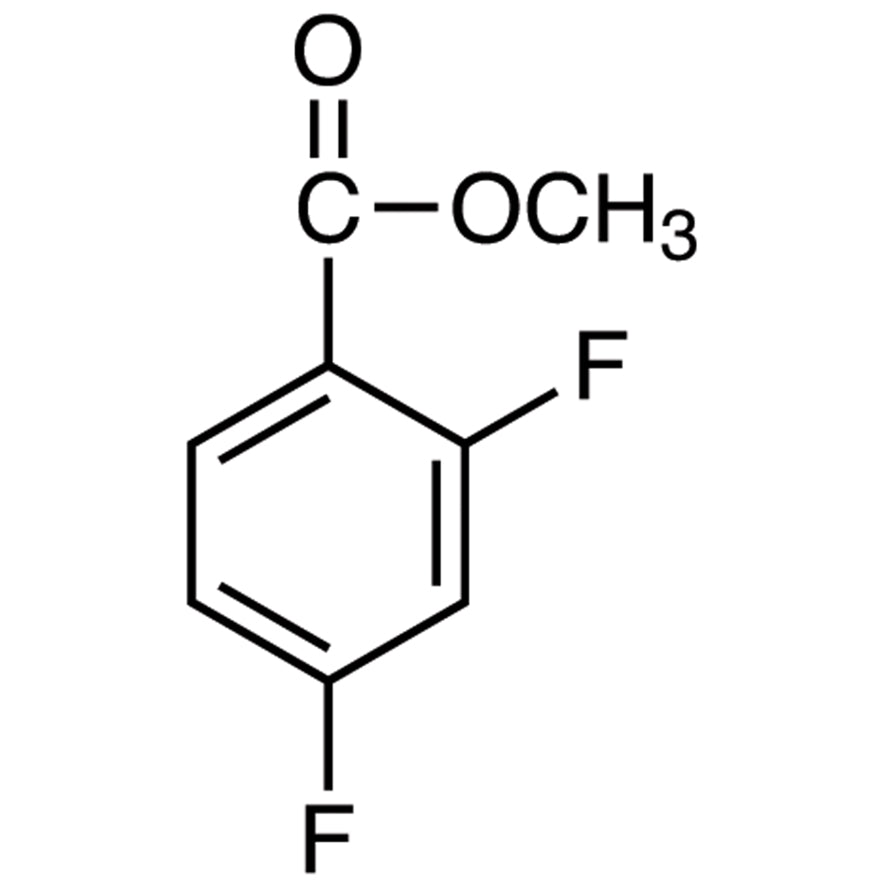

TCI M1879 Methyl 2,4-Difluorobenzoate is the methyl ester of 2,4-difluorobenzoic acid, an aromatic fluorinated compound carrying two fluorine atoms at the ortho and para positions relative to the ester group. Fluorinated compounds play an increasingly important role in medicinal chemistry and materials science, because fluorine is able to meaningfully alter the electronic character, metabolic stability, and membrane permeability of a molecule despite its small size. In the laboratory, this compound serves as a ready-to-use fluorinated building block that saves the chemist from carrying out a direct fluorination step, a process that normally demands specialised reagents and considerably more complicated handling.
The characteristics that make this compound a frequent choice are its neatly defined fluorine substitution pattern combined with useful reactivity. Fluorine atoms are strongly electron-withdrawing, so the aromatic ring becomes more electron-poor and therefore open to nucleophilic aromatic substitution, particularly at the position activated by the ester group. This property allows one of the fluorine atoms to be replaced selectively with nucleophiles such as amines, alkoxides, or thiolates. The methyl ester group itself can be hydrolysed, giving the chemist a second, independent point of transformation on the same molecule.
In Indonesian laboratories, this material is typically encountered in university and institutional research groups working on organic synthesis, medicinal chemistry, and materials development, as well as in industrial R&D units preparing intermediates on a small scale. It is generally ordered as a stock item for multi-step synthesis routes, where a defined fluorinated starting material shortens the sequence and improves reproducibility between batches. Its role is usually that of a starting point rather than a final product.
TCI brochures (PDF)
- Fluorination Reagents, Fluorinated Building Blocks 2026-03-18 · p. 31
Related TCI products
- Nucleophilic aromatic substitution studies: the electron-poor ring activated by the ester group allows one fluorine atom to be displaced selectively by amines, alkoxides, or thiolates under controlled conditions.
- Medicinal chemistry intermediate preparation: fluorine substitution modifies the electronic character, metabolic stability, and membrane permeability of candidate molecules, making this a practical entry point for analogue series.
- Fluorinated building block supply for multi-step synthesis: using a pre-fluorinated starting material removes the need for a direct fluorination step that would otherwise require specialised reagents and far more demanding handling.
- Ester hydrolysis and derivatisation work: the methyl ester provides a second, independent handle that can be converted to the corresponding acid and onward to amides or other derivatives.
- Materials science research: fluorinated aromatic compounds are used in the development of materials whose electronic properties depend on a well-defined substitution pattern on the aromatic ring.
| Brand | TCI (Tokyo Chemical Industry) |
|---|---|
| CAS number | 106614-28-2 |
| Molecular formula | — |
| Purity | — |
| Category | Chemistry > Building Blocks > Fluorinated Building Blocks |
| Pack sizes | available in standard TCI research-scale packaging; please confirm the currently available size when ordering |
| Physical form | — |
| Storage | store in a cool, dry place in a tightly closed original container, away from light and sources of ignition |
- Catalogue code: M1879
Store this product in its original tightly closed container in a cool, dry, and well-ventilated area, protected from direct sunlight, heat, and sources of ignition. Amber glass or the manufacturer's supplied container is suitable; avoid transferring the material into containers of unknown chemical compatibility. Handle the compound in a fume hood using safety glasses, chemically resistant gloves, and a laboratory coat, since aromatic esters can irritate the eyes, skin, and respiratory tract. Keep the container closed when not in use to limit exposure to moisture and vapour loss, label all working aliquots clearly, and consult the manufacturer's safety data sheet before first use. Dispose of residues and contaminated materials as chemical waste according to institutional procedures.
—
Produk Terkait
-
Ethyl2,4-Difluorobenzoate TCI E0935
Regular price From Rp 584.850,00Regular price -
Ethyl2,3,4,5-Tetrafluorobenzoate TCI T2094
Regular price From Rp 903.000,00Regular price -
EthylPentafluorobenzoate TCI P1419
Regular price From Rp 1.035.300,00Regular price -
MethylPentafluorobenzoate TCI P1418
Regular price From Rp 928.200,00Regular price -
Methyl4-Bromo-2-fluorobenzoate TCI M3229
Regular price From Rp 1.510.950,00Regular price -
Methyl2-Fluoro-5-nitrobenzoate TCI M3115
Regular price Rp 1.803.900,00Regular price -
Methyl2-Chloro-4-fluorobenzoate TCI M3102
Regular price From Rp 955.500,00Regular price -
Methyl2-Bromo-5-fluorobenzoate TCI M3101
Regular price From Rp 2.411.850,00Regular price