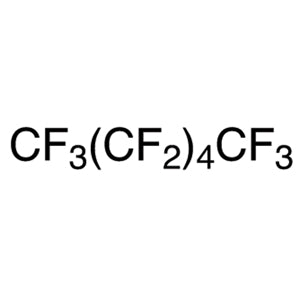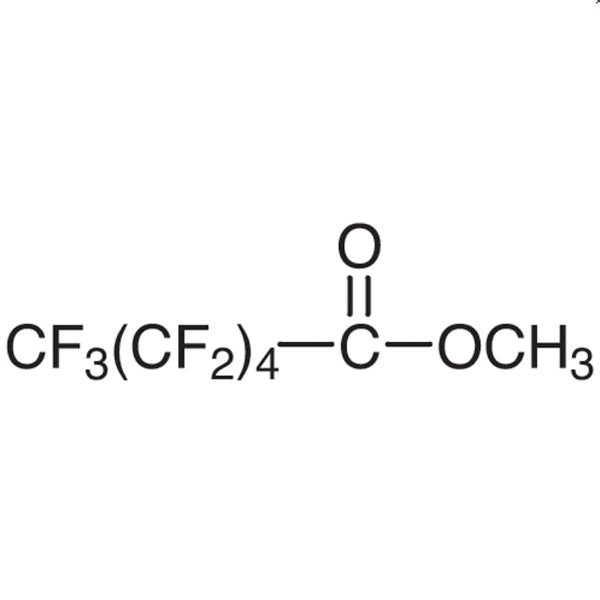
Methyl Undecafluorohexanoate from TCI, supplied under catalogue code M1913, is a six-carbon methyl ester in which every hydrogen position on the alkyl portion has been replaced by a fluorine atom. As a fluorinated building block, this compound provides a perfluorohexyl fragment that is ready to be transferred into a target molecule through transformations of the ester group. In the laboratory it becomes a practical choice whenever researchers require a fluorous chain longer than that of shorter-carbon homologues, so that the resulting surface properties and fluorous-phase affinity become considerably more pronounced.
The characteristic that makes this material a preferred selection is the length of its perfluorinated chain, which strikes a balance between strongly fluorous behaviour and handling that remains straightforward for a liquid. The perfluorohexyl chain is rigid, highly hydrophobic and simultaneously oleophobic, and possesses low surface energy, which makes it especially useful in the design of coatings and specialty surfactants. The powerful electron-withdrawing nature of the fluorinated chain renders the ester carbonyl group more electrophilic, so that reaction with amines yields perfluorinated amides while reduction furnishes fluorous alcohols.
In Indonesian laboratories this material is typically used in synthetic chemistry groups at universities and research institutes, in industrial research units working on surface treatment, and in development work on fluorous reagents. It suits investigators who need a defined perfluoroalkyl fragment as a starting point rather than building the fluorinated chain themselves, and it is handled with the same standard practices applied to reactive esters in a fume-hooded synthetic workspace.
TCI brochures (PDF)
- Fluorous Chemistry 2025-01-21 · p. 8
- Perfluoroalkyl fragment transfer in synthesis, where the ester group acts as a ready handle for introducing the intact perfluorohexyl chain into a target molecule.
- Preparation of perfluorinated amides, since the strongly electron-withdrawing fluorous chain makes the ester carbonyl more electrophilic and therefore more reactive toward amine partners.
- Synthesis of fluorous alcohols by reduction of the ester function, giving access to fluorous-tagged intermediates that retain the full perfluorohexyl segment after transformation.
- Development of specialty surfactants, because the rigid, simultaneously hydrophobic and oleophobic perfluorohexyl chain delivers the low surface energy such formulations depend upon.
- Coating design and surface-property research, where the longer perfluorinated chain produces more pronounced fluorous character than shorter-carbon homologues can provide.
| Brand | TCI, supplied under catalogue code M1913 |
|---|---|
| CAS number | 424-18-0 |
| Molecular formula | — |
| Purity | — |
| Category | Chemistry > Building Blocks > Fluorinated Building Blocks |
| Pack sizes | available in the pack sizes listed for this catalogue item |
| Physical form | liquid, described as remaining easy to handle in that state |
| Storage | store according to the conditions stated on the manufacturer's label |
Keep this material in its original tightly closed container, stored in a cool, dry and well-ventilated area away from heat sources, ignition sources and direct sunlight. Chemically compatible glass or fluoropolymer containers are appropriate, and containers should be resealed promptly after each use to limit exposure to atmospheric moisture, since the ester carbonyl is rendered more electrophilic by the fluorinated chain. Handle inside a functioning fume hood while wearing safety goggles, a laboratory coat and suitable chemical-resistant gloves. Avoid contact with skin and eyes as well as inhalation of vapours, keep the compound separated from amines, reducing agents and other incompatible reactive substances, and always consult the manufacturer's safety data sheet before use.
—
Produk Terkait
-
1H,1H-Undecafluoro-1-hexanol TCI U0074
Regular price Rp 3.207.750,00Regular price -
UndecafluorohexanoicAcid TCI U0067
Regular price From Rp 2.227.050,00Regular price -
1H-Tridecafluorohexane TCI T2496
Regular price Rp 2.969.400,00Regular price -
Decafluorobenzophenone TCI D1631
Regular price From Rp 1.246.350,00Regular price -
1H,1H,7H-Dodecafluoro-1-heptanol TCI D1101
Regular price From Rp 1.167.600,00Regular price -
Tetradecafluorohexane TCI P0839
Regular price From Rp 3.367.350,00Regular price -
1,6-Dibromododecafluorohexane TCI D3572
Regular price From Rp 1.644.300,00Regular price -
MethylUndecafluoroamylKetone TCI U0071
Regular price Rp 6.070.050,00Regular price