


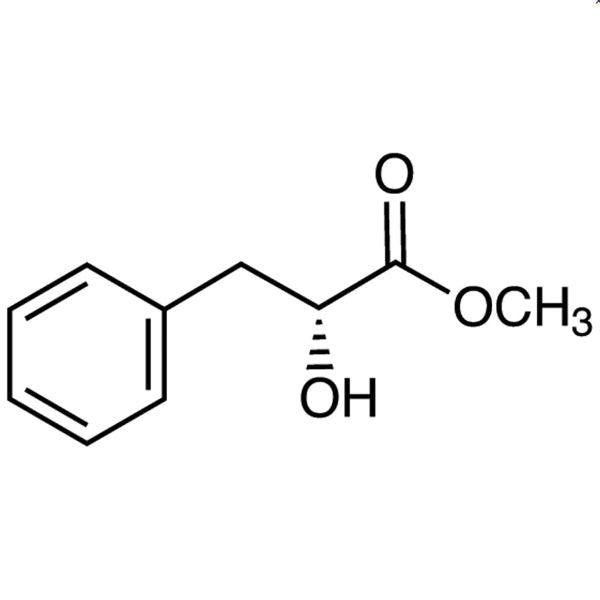

Methyl D-3-Phenyllactate is the methyl ester of 3-phenyllactic acid in the D configuration, a chiral compound carrying a secondary hydroxy group and an ester group on a benzyl-substituted three-carbon backbone. In asymmetric synthesis laboratories, it serves as a chiral building block that supplies a ready-made stereogenic centre, so researchers do not need to construct chirality from scratch through catalysis or resolution. Its free hydroxy group can be esterified, etherified, activated, or inverted in configuration, while the ester group is readily hydrolysed or converted into an amide.
The characteristics that make this material valuable are its defined stereochemical purity and the combination of two complementary functional groups positioned close to one another. The α-hydroxy ester motif is a structural pattern frequently encountered in depsipeptides — peptides in which some amide bonds are replaced by ester linkages — and the adjacent phenyl ring resembles the side chain of phenylalanine, which simplifies the design of peptide analogues. Beyond that, the compound can function as a chiral auxiliary or as a precursor toward chiral diols, epoxides, and amines through established transformations.
In Indonesian laboratories, this building block is typically used by university and institutional research groups working on asymmetric synthesis, medicinal chemistry, and peptidomimetic design, where a defined stereocentre must be introduced reliably into a target molecule. It is also encountered in graduate research projects that explore stereoselective transformations, and in method development work where an enantiomerically defined α-hydroxy ester is required as a starting material or reference substrate.
TCI brochures (PDF)
- Chiral Building Blocks 2025-04-14 · p. 11
- Chiral building block in asymmetric synthesis — supplies a pre-formed stereogenic centre, allowing researchers to reach enantioenriched targets without developing a separate catalytic or resolution step.
- Depsipeptide and peptidomimetic construction — the α-hydroxy ester motif matches the ester linkage found in depsipeptides, while the benzyl group mimics the phenylalanine side chain for analogue design.
- Precursor to chiral diols, epoxides, and amines — the ester and hydroxy groups can be transformed sequentially to access other stereodefined intermediates for further synthetic work.
- Chiral auxiliary applications — the defined configuration and the sterically distinct benzyl substituent allow the molecule to direct the stereochemical outcome of reactions on an attached substrate.
- Functional group manipulation studies — the free secondary hydroxy group can be esterified, etherified, activated, or inverted, making the compound useful for teaching and developing selective protection strategies.
| Brand | TCI |
|---|---|
| CAS number | 27000-00-6 |
| Molecular formula | — |
| Purity | — |
| Category | Chemistry > Asymmetric Synthesis > Chiral Building Blocks |
| Pack sizes | available in standard research and laboratory pack sizes; please confirm the currently listed options when ordering |
| Physical form | — |
| Storage | keep in a cool, dry place in a tightly closed original container |
- Product code: M2350
Store the container tightly closed in a cool, dry, well-ventilated area, away from direct sunlight, heat, and sources of ignition, and separated from strong oxidising agents, strong acids, and strong bases. The original supplier container is the preferred storage vessel; where transfer is necessary, use clean, chemically compatible glassware with a secure closure and label it clearly. Handle the material in a fume hood, wearing safety glasses, chemically resistant gloves, and a laboratory coat. Avoid contact with skin and eyes and avoid inhaling vapours or aerosols. Keep the container closed when not in use to limit moisture uptake, and consult the manufacturer's safety data sheet for the complete handling, first-aid, and disposal guidance before use.
—
Produk Terkait
-
D-(+)-3-PhenyllacticAcid TCI P1981
Regular price From Rp 1.060.500,00Regular price -
L-(-)-3-PhenyllacticAcid TCI P1168
Regular price From Rp 980.700,00Regular price -
EthylL-(-)-O-Tosyllactate TCI T1241
Regular price From Rp 769.650,00Regular price -
(-)-Verbenone TCI V0072
Regular price Rp 1.353.450,00Regular price -
(R)-1-[4-(Trifluoromethyl)phenyl]ethan-1-ol TCI T4357
Regular price Rp 2.889.600,00Regular price -
(S)-TrichostaticAcid TCI T3402
Regular price Rp 7.659.750,00Regular price -
(R)-TrichostaticAcid TCI T3401
Regular price Rp 7.579.950,00Regular price -
(S)-(+)-1,2,3,4-Tetrahydro-1-naphthol TCI T2360
Regular price From Rp 1.696.800,00Regular price


![76155-79-8 (R)-1-[4-(Trifluoromethyl)phenyl]ethan-1-ol - AMI Scientific](http://amiscientific.com/cdn/shop/files/TCI2510T4357.jpg?v=1768363692&width=533)


