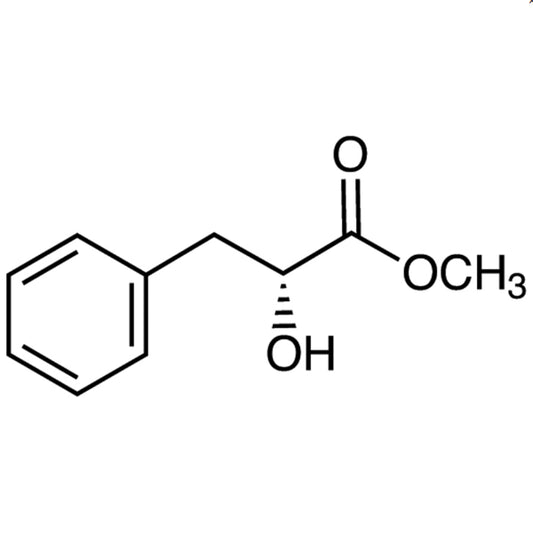
TCI P1981 D-(+)-3-Phenyllactic Acid is an aromatic α-hydroxy acid supplied as the D-enantiomer. Chemically it is 2-hydroxy-3-phenylpropanoic acid with a single defined configuration. In the chemistry laboratory it serves as a chiral building block for asymmetric synthesis, where the stereochemical configuration of the starting material helps determine the configuration of the final product. Lactic acid bacteria also produce this compound naturally as a metabolite, so it is relevant to food microbiology research as well as synthetic organic chemistry.
D-(+)-3-Phenyllactic Acid is valued for its enantiomeric purity. Researchers can introduce a defined chiral centre into a target molecule without first resolving a racemic mixture. That saves synthetic steps and reduces the risk of carrying unwanted stereoisomers through a reaction sequence. The compound has both a hydroxyl group and a carboxylic acid group, and each can be modified selectively into esters, amides, or other derivatives. Phenyllactic acid is also widely studied for its broad-spectrum antimicrobial activity against bacteria and moulds, which makes it a candidate natural preservative in biopreservation research.
In Indonesian laboratories, this compound is used in two main areas: synthetic organic chemistry and food science research. Traditional fermented foods such as tempe, tape, and dadih are rich sources of lactic acid bacteria isolates. Universities and research institutes study these isolates for their metabolites and possible use in food preservation. In this work, a well-defined D-(+)-3-Phenyllactic Acid reference compound helps researchers identify, compare, and evaluate the phenyllactic acid produced by bacterial strains, and it can also serve as a chiral starting material in synthesis projects.
TCI brochures (PDF)
- Chiral Building Blocks 2025-04-14 · p. 13
- Asymmetric synthesis: as a single-enantiomer chiral building block, it lets chemists introduce a defined stereocentre into target molecules without a separate racemate resolution step.
- Derivative preparation: its hydroxyl and carboxylic acid groups can be converted selectively into esters, amides, and related derivatives, so it is a versatile intermediate for building more complex chiral molecules.
- Food microbiology research: phenyllactic acid is a natural metabolite of lactic acid bacteria, so this compound is a useful reference material when studying the metabolic output of bacterial isolates.
- Biopreservation studies: because phenyllactic acid shows broad-spectrum antimicrobial activity against bacteria and moulds, researchers use it to evaluate natural preservative candidates for food systems.
- Research on traditional fermented foods: it supports studies of lactic acid bacteria isolated from Indonesian products such as tempe, tape, and dadih, where it serves as a comparison standard for metabolites the strains produce.
| Brand | TCI (product code P1981) |
|---|---|
| CAS number | 7326-19-4 |
| Molecular formula | — |
| Purity | — |
| Category | Chemistry > Asymmetric Synthesis > Chiral Building Blocks |
| Pack sizes | as offered in the TCI catalogue for this product code |
| Physical form | — |
| Storage | follow the storage conditions on the TCI label and Safety Data Sheet |
- Chemical name: D-(+)-3-Phenyllactic Acid (2-hydroxy-3-phenylpropanoic acid, D-enantiomer)
Keep D-(+)-3-Phenyllactic Acid in its original, tightly closed container in a cool, dry, well-ventilated place, away from direct sunlight, heat, and incompatible substances such as strong oxidising agents. Use clean, dry tools when dispensing, and close the container promptly so moisture and contaminants cannot reduce the material's quality or enantiomeric integrity. Wear standard laboratory protective equipment, including safety glasses, gloves, and a lab coat. Avoid breathing in dust and avoid contact with skin and eyes. Always read the TCI Safety Data Sheet before use, and dispose of residues according to local laboratory waste regulations.
—
Produk Terkait
-
L-(-)-3-PhenyllacticAcid TCI P1168
Regular price From Rp 1.033.200,00Regular priceRp 738.150,00Sale price From Rp 1.033.200,00 -
MethylD-3-Phenyllactate TCI M2350
Regular price From Rp 822.150,00Regular priceRp 590.100,00Sale price From Rp 822.150,00 -
DL-4-HydroxyphenyllacticAcid TCI H0542
Regular price From Rp 3.340.050,00Regular priceRp 2.350.950,00Sale price From Rp 3.340.050,00 -
(-)-Verbenone TCI V0072
Regular price Rp 1.405.950,00Regular priceRp 998.550,00Sale price Rp 1.405.950,00 -
(R)-1-[4-(Trifluoromethyl)phenyl]ethan-1-ol TCI T4357
Regular price Rp 2.889.600,00Regular priceRp 2.020.200,00Sale price Rp 2.889.600,00 -
(S)-TrichostaticAcid TCI T3402
Regular price Rp 7.712.250,00Regular priceRp 5.408.550,00Sale price Rp 7.712.250,00 -
(R)-TrichostaticAcid TCI T3401
Regular price Rp 7.632.450,00Regular priceRp 5.352.900,00Sale price Rp 7.632.450,00 -
(S)-(+)-1,2,3,4-Tetrahydro-1-naphthol TCI T2360
Regular price From Rp 1.696.800,00Regular priceRp 1.186.500,00Sale price From Rp 1.696.800,00