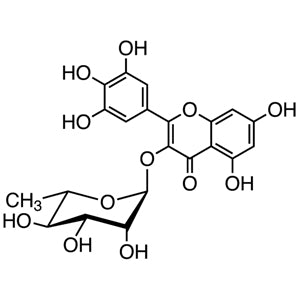
TCI M2361 Myricitrin is a naturally occurring flavonoid glycoside built from the aglycone myricetin bonded to a rhamnose sugar unit. The material belongs to the field of glycoscience, the discipline that studies the role of carbohydrates and sugar-linked compounds in biological systems. In laboratory work, myricitrin is commonly used as a reference standard in phytochemical analysis and as a test material in research examining the biological activity of flavonoid compounds, including antioxidant studies and investigations of how flavonoid glycosides interact with various cellular systems.
The characteristic that makes myricitrin widely sought after is the combination of a flavonol skeleton rich in hydroxyl groups with a single rhamnose sugar unit. The abundance of hydroxyl groups on the B ring of myricetin forms the basis of its capacity to act as a free radical scavenger, while the sugar portion increases its solubility in polar solvents compared with the free aglycone. This difference in behaviour between the glycoside form and the aglycone is frequently taken as a point of comparison in research, both in extraction studies and in biological activity testing at the cellular level.
Phytochemistry and natural product laboratories in Indonesia make extensive use of well-characterised flavonoid standards of this kind. The material supports routine identification and comparison work on plant extracts, where a defined reference compound is needed to confirm the presence of flavonoid glycosides. It also serves teaching and research groups working on the chemistry of sugar-linked plant metabolites and their behaviour in analytical systems.
TCI brochures (PDF)
- Polyphenols 2024-12-05 · p. 1
- Phytochemicals 2025-12-17 · p. 11
- Reagents for Glyco Chemistry & Biology 5th Edition · p. 64
- Phytochemical reference standard: serves as a defined comparison compound when confirming the presence of flavonoid glycosides in plant extracts during routine identification work.
- Antioxidant activity research: the hydroxyl-rich flavonol skeleton makes it a suitable test material in studies examining free radical scavenging behaviour of natural compounds.
- Glycoside versus aglycone comparison studies: its single rhamnose unit allows direct comparison against free myricetin in solubility and activity investigations.
- Extraction method development: the improved solubility in polar solvents from the sugar portion makes it useful for evaluating and optimising plant extract recovery procedures.
- Cellular interaction studies: used as a test compound in research investigating how flavonoid glycosides interact with various cellular systems under controlled laboratory conditions.
| Brand | TCI |
|---|---|
| CAS number | 17912-87-7 |
| Molecular formula | — |
| Purity | — |
| Category | Chemistry > Chemical Biology > Glycoscience |
| Pack sizes | available in standard TCI research pack sizes; please confirm the currently listed options when ordering |
| Physical form | — |
| Storage | store according to the conditions stated on the manufacturer label and accompanying documentation |
- Compound class: flavonoid glycoside (myricetin aglycone with rhamnose sugar unit)
Store the material in its original tightly closed container, following the storage conditions stated on the manufacturer label and in the accompanying documentation. Keep the container protected from moisture and direct light, and return it promptly to its designated storage location after each use. Handle the compound in a well-ventilated area using standard personal protective equipment, including a laboratory coat, gloves and eye protection. Use clean, dry spatulas when weighing to avoid contaminating the remaining stock, and prepare solutions immediately before use where analytical accuracy is required. Consult the manufacturer safety data sheet before first handling and follow institutional procedures for waste disposal.
—
Produk Terkait
-
Icariin TCI I0862
Regular price From Rp 1.829.100,00Regular price -
Wogonoside TCI W0012
Regular price From Rp 5.672.100,00Regular price -
PotengriffiosideA TCI T4196
Regular price Rp 7.844.550,00Regular price -
Baicalin TCI B2835
Regular price Rp 2.677.500,00Regular price -
Sophoricoside TCI S0835
Regular price Rp 8.665.650,00Regular price -
Puerarin TCI P1886
Regular price From Rp 1.405.950,00Regular price -
Piceid TCI P1878
Regular price From Rp 2.439.150,00Regular price -
Phlorizin TCI P0248
Regular price From Rp 1.936.200,00Regular price