

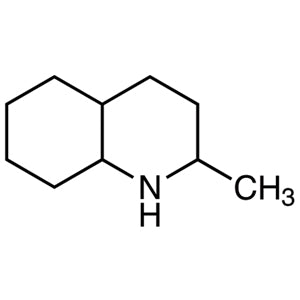
TCI M3189 2-Methyldecahydroquinoline (mixture of isomers), CAS 20717-43-5, is a saturated bicyclic amine built on a decahydroquinoline framework — a quinoline core that has been fully hydrogenated — carrying a methyl group at the two position. In organic synthesis laboratories, this compound serves as a heterocyclic building block: a ring-bearing starting material that already supplies a complex carbon–nitrogen skeleton, so researchers do not have to construct that framework from scratch. The secondary amine nitrogen held within the ring provides a highly useful pivot point for further molecular elaboration.
The characteristics that lead chemists to select this material are the combination of a rigid yet genuinely three-dimensional aliphatic framework and the dependable reactivity of a secondary amine. The product is supplied as a mixture of isomers, so researchers obtain stereochemical diversity in a single container — an advantage during early screening stages, when the optimal configuration is not yet known. The basic character of the nitrogen allows the formation of salts, amides, sulfonamides, carbamates, and reductive amination products using entirely conventional procedures. The saturated framework also contributes character that a flat aromatic ring cannot provide.
In Indonesian laboratories, this type of building block is typically used in university and institutional research groups working on organic synthesis and medicinal chemistry, where saturated nitrogen heterocycles are assembled into candidate structures. It is handled at bench scale on standard synthetic setups, drawn upon for exploratory route development, and stored as part of a reagent inventory that supports repeated small-scale reactions rather than bulk production work.
Related TCI products
- TCI V0195 106-87-6 3-(Oxiran-2-yl)-7-oxabicyclo[410]heptane (mixture of isomers)
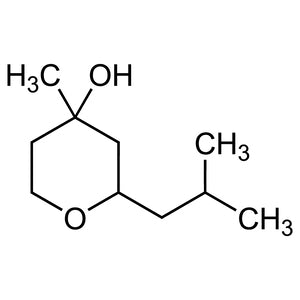
- TCI T4346 63500-71-0 2-Isobutyl-4-methyltetrahydro-2H-pyran-4-ol (mixture of isomers)
- TCI O0590 2886-89-7 1,2:5,6-Diepoxyhexahydroindan (mixture of isomers)
- TCI M3665 41088-52-2 Methyl 7-Oxabicyclo[410]heptane-3-carboxylate (mixture of isomers)
- TCI E1611 2386-87-0 (7-Oxabicyclo[410]heptan-3-yl)methyl 7-Oxabicyclo[410]heptane-3-carboxylate (mixture of isomers)
- TCI E0956 106-86-5 1,2-Epoxy-4-vinylcyclohexane (mixture of isomers)
- Heterocyclic scaffold construction — the fully hydrogenated decahydroquinoline core delivers a ready-made carbon–nitrogen ring system, saving researchers the multi-step effort of building that framework themselves.
- Reductive amination — the secondary ring nitrogen reacts with aldehydes and ketones under standard conditions, giving access to tertiary amine derivatives without requiring specialised reagents or unusual handling.
- Amide and sulfonamide preparation — the basic nitrogen readily undergoes acylation and sulfonylation, allowing chemists to append diverse substituents onto a rigid three-dimensional aliphatic platform.
- Carbamate formation and nitrogen protection — the secondary amine accepts common carbamate-forming reagents, making it straightforward to mask or later reveal the nitrogen during multi-step synthetic sequences.
- Early-stage screening libraries — supply as a mixture of isomers gives stereochemical variety from one container, which is useful when the optimal configuration has not yet been determined.
| Brand | TCI (Tokyo Chemical Industry) |
|---|---|
| CAS number | 20717-43-5 |
| Molecular formula | — |
| Purity | — |
| Category | Chemistry > Building Blocks > Heterocyclic Building Blocks |
| Pack sizes | available in standard TCI research-scale packaging; please confirm the current size options when ordering |
| Physical form | — |
| Storage | keep in a tightly closed container, following the conditions stated on the manufacturer's label and safety data sheet |
- Product code: M3189
- Composition: supplied as a mixture of isomers
Store the container tightly closed in a cool, dry, well-ventilated area away from heat, ignition sources, and incompatible materials such as strong acids and strong oxidising agents, in line with the manufacturer's label and safety data sheet. Keep the material in its original supplier container, or in a chemically compatible, clearly labelled alternative with a secure closure. As with any amine, handle it inside a fume hood and wear nitrile gloves, safety goggles, and a laboratory coat. Avoid inhalation of vapour and any contact with skin or eyes, reseal the container promptly after dispensing, and dispose of residues and contaminated materials through the institution's approved chemical waste route.
—
Produk Terkait
-
3-(Oxiran-2-yl)-7-oxabicyclo[410]heptane(mixtureofisomers) TCI V0195
Regular price From Rp 3.870.300,00Regular price -
2-Isobutyl-4-methyltetrahydro-2H-pyran-4-ol(mixtureofisomers) TCI T4346
Regular price From Rp 1.378.650,00Regular price -
1,2:5,6-Diepoxyhexahydroindan(mixtureofisomers) TCI O0590
Regular price From Rp 2.411.850,00Regular price -
Methyl7-Oxabicyclo[410]heptane-3-carboxylate(mixtureofisomers) TCI M3665
Regular price From Rp 1.220.100,00Regular price -
(7-Oxabicyclo[410]heptan-3-yl)methyl7-Oxabicyclo[410]heptane-3-carboxylate(mixtureofisomers) TCI E1611
Regular price Rp 980.700,00Regular price -
1,2-Epoxy-4-vinylcyclohexane(mixtureofisomers) TCI E0956
Regular price From Rp 610.050,00Regular price -
Ethyl3-Methyl-3-phenylglycidate(mixtureofisomers) TCI E0873
Regular price From Rp 557.550,00Regular price -
1,2-Epoxycyclododecane(mixtureofisomers) TCI E0322
Regular price Rp 1.220.100,00Regular price
![106-87-6 3-(Oxiran-2-yl)-7-oxabicyclo[4.1.0]heptane (mixture of isomers) - AMI Scientific](http://amiscientific.com/cdn/shop/files/TCI2510V0195.jpg?v=1767145750&width=533)

![41088-52-2 Methyl 7-Oxabicyclo[4.1.0]heptane-3-carboxylate (mixture of isomers) - AMI Scientific](http://amiscientific.com/cdn/shop/files/TCI2510M3665.jpg?v=1767128633&width=533)
![(7-Oxabicyclo[4.1.0]heptan-3-yl)methyl 7-Oxabicyclo[4.1.0]heptane-3-carboxylate (mixture of isomers) (CAS 2386-87-0) - TCI E1611 - AMI Scientific](http://amiscientific.com/cdn/shop/files/TCI2510E1611.jpg?v=1767113123&width=533)


