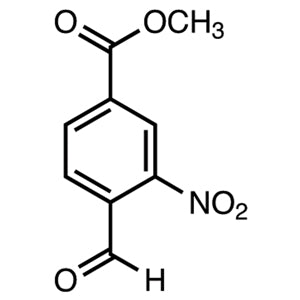
TCI M3198 Methyl 4-Formyl-3-nitrobenzoate, bearing CAS number 153813-69-5, is a multifunctional aromatic compound that carries an aldehyde group, a nitro group, and a methyl ester group on a single benzene ring. It belongs to the class of non-heterocyclic building blocks, meaning simple aromatic starting materials used to construct more complex molecules. In synthetic laboratories, a molecule presenting three distinct functional groups like this one is highly valued because it allows researchers to carry out stepwise, directed transformations from one common starting point.
The property that makes this compound a frequent choice is the orderly, differentiated reactivity of its three groups. The aldehyde group is ready to react in condensation reactions, reductive amination, imine formation, and Wittig reactions. The nitro group can be reduced to an aromatic amine, and because it sits adjacent to the aldehyde group, the reduction product often closes directly to form heterocyclic rings such as quinoxalines or benzimidazoles. The methyl ester group provides a third handle that can be hydrolysed to a carboxylic acid at a late stage. The electron-withdrawing nitro group also increases the reactivity of the aldehyde toward nucleophiles.
In Indonesian laboratories, this building block is typically used in university and institutional research groups working on organic synthesis, medicinal chemistry, and the preparation of heterocyclic scaffolds. It suits bench-scale exploratory work where a single intermediate must be diversified into several analogues. Researchers generally handle it in standard glassware under a fume hood, drawing small portions from the supplied pack for individual reaction steps while keeping the remainder sealed for later use.
- Heterocycle construction: the adjacent nitro and aldehyde groups allow reduction followed by spontaneous ring closure to quinoxaline or benzimidazole cores in a single planned sequence.
- Medicinal chemistry analogue synthesis: three orthogonal functional groups let a research team diversify one common intermediate into several related target molecules without redesigning the route.
- Reductive amination studies: the aldehyde group reacts readily with primary and secondary amines, and nitro activation increases its electrophilicity toward nucleophilic addition.
- Wittig and condensation chemistry: the aromatic aldehyde serves as a reliable carbonyl partner for olefination and classical condensation reactions in teaching and research settings.
- Carboxylic acid intermediate preparation: the methyl ester provides a protected acid handle that can be hydrolysed at a late stage after the other transformations are complete.
| Brand | TCI (Tokyo Chemical Industry) |
|---|---|
| CAS number | 153813-69-5 |
| Molecular formula | — |
| Purity | — |
| Category | Chemistry > Building Blocks > Non-Heterocyclic Building Blocks |
| Pack sizes | supplied in standard TCI research-scale packaging; please confirm the available pack size when ordering |
| Physical form | — |
| Storage | keep in the tightly closed original container, protected from light and moisture |
- Product code: M3198
Store the container tightly closed in a cool, dry, and well-ventilated place, away from direct sunlight, heat sources, and moisture. Keep the material in its original supplier container or in a clean amber glass bottle with a chemically resistant closure, clearly labelled with the compound name and CAS number. Handle the solid inside a fume hood, using nitrile gloves, safety glasses, and a laboratory coat, and avoid generating or inhaling dust. Weigh out only the quantity required for each reaction and reseal the container promptly. As a nitroaromatic compound, it should be kept away from strong reducing agents, strong bases, and sources of ignition, and stored separately from incompatible chemicals. Always consult the manufacturer's safety data sheet before use, and dispose of residues and contaminated materials through the laboratory's designated chemical waste stream.
—
Produk Terkait
-
Methyl4-Hydroxy-3-nitrobenzoate TCI M3649
Regular price From Rp 848.400,00Regular price -
Methyl4-Methoxy-3-nitrobenzoate TCI M2873
Regular price From Rp 610.050,00Regular price -
Methyl2-Hydroxy-3-nitrobenzoate TCI M2864
Regular price From Rp 769.650,00Regular price -
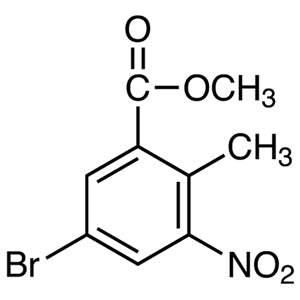
Methyl5-Bromo-2-methyl-3-nitrobenzoate TCI M2845
Regular price From Rp 637.350,00Regular price -
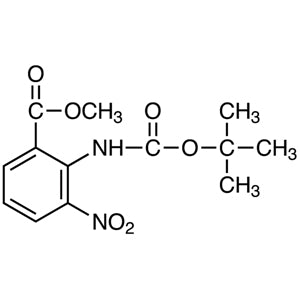
Methyl2-(tert-Butoxycarbonylamino)-3-nitrobenzoate TCI M2797
Regular price From Rp 2.491.650,00Regular price -
Methyl2-(Bromomethyl)-3-nitrobenzoate TCI M2422
Regular price From Rp 980.700,00Regular price -
Methyl2-Chloro-5-nitrobenzoate TCI C1732
Regular price From Rp 717.150,00Regular price -
Ethyl5-Bromo-2-chlorobenzoate TCI B2255
Regular price From Rp 928.200,00Regular price