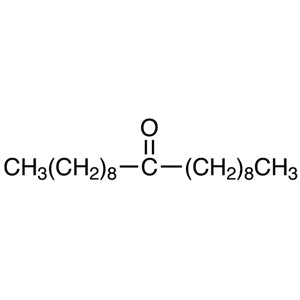
10-Nonadecanone from TCI is a symmetrical aliphatic ketone with nineteen carbon atoms. Its carbonyl group sits exactly in the middle of the chain, so an identical nonyl chain runs off each side. For this reason the compound is also known as dinonyl ketone. It is classed as a long-chain non-heterocyclic building block. In the laboratory, 10-Nonadecanone is used as a starting material for synthesis, as a model compound in lipid and wax studies, and as a reference standard in the chromatographic analysis of oxygenated hydrocarbon compounds.
Its symmetrical structure makes this compound useful in many kinds of study. A single carbonyl group between two long hydrocarbon chains produces a strongly hydrophobic molecule that still has one clearly defined reactive site. The carbonyl group can be reduced to a secondary alcohol, converted to an amine through reductive amination, or used in Grignard and Wittig reactions to build symmetrically branched molecules. Because the starting material is symmetrical, its derivatives are simpler as well, and their NMR spectra are easier to interpret. This makes it a practical choice for researchers who want predictable reactions and clear results.
In Indonesia, this material is relevant to organic chemistry, analytical chemistry, oleochemistry and materials science laboratories. Research groups working on long-chain compounds can use it as a well-defined model substance. Analytical laboratories can use it as a reference when working with oxygenated hydrocarbons. Synthesis laboratories at universities and research institutions can use it as an intermediate for building symmetrical long-chain molecules.
- Organic synthesis starting material: the single central carbonyl group gives one clear reactive site, so chemists can build symmetrical long-chain derivatives in a controlled way.
- Reduction to secondary alcohols: the ketone can be reduced to the matching secondary alcohol, which makes it suitable for preparing symmetrical long-chain alcohols for further research.
- Grignard and Wittig reactions: the carbonyl group takes part in these carbon–carbon bond-forming reactions, so researchers can produce symmetrically branched molecules whose NMR spectra are easier to interpret.
- Model compound in lipid and wax studies: its two long hydrophobic nonyl chains resemble the structures found in lipids and waxes, which makes it a useful, well-defined model substance.
- Chromatographic reference standard: its defined symmetrical structure makes it suitable as a comparison standard when analysing oxygenated hydrocarbon compounds by chromatography.
| Brand | TCI (product code N0658) |
|---|---|
| CAS number | 504-57-4 |
| Molecular formula | — |
| Purity | — |
| Category | Chemistry > Building Blocks > Non-Heterocyclic Building Blocks |
| Pack sizes | please ask AMI Scientific which pack sizes are available |
| Physical form | refer to the TCI product label and Certificate of Analysis |
| Storage | — |
- Synonym: Dinonyl ketone
Store 10-Nonadecanone in its original, tightly closed container in a cool, dry and well-ventilated place, away from direct sunlight, heat sources and strong oxidising agents. Follow the storage conditions on the TCI label and Safety Data Sheet (SDS). If you move the material to another container, use clean, dry and clearly labelled glass or chemically compatible containers. Handle the compound according to good laboratory practice. Wear safety glasses, gloves and a lab coat, avoid creating dust or breathing it in, and work in a fume hood when heating it or using solvents. Read the SDS before first use, and dispose of waste according to your institution's rules and local regulations.
—
Produk Terkait
-
Nonadecanophenone TCI N0664
Regular price From Rp 1.590.750,00Regular price -
MethylNonadecanoate TCI N0460
Regular price From Rp 4.188.450,00Regular price -
NonadecanoicAcid TCI N0283
Regular price From Rp 3.155.250,00Regular price -
3-Tetradecanone TCI T1760
Regular price Rp 1.856.400,00Regular price -
2-Tetradecanone TCI T1314
Regular price Rp 5.990.250,00Regular price -
2-Pentadecanone TCI P1063
Regular price Rp 2.306.850,00Regular price -
3-Hexadecanone TCI H0565
Regular price From Rp 3.260.250,00Regular price -
9-Heptadecanone TCI H0536
Regular price From Rp 4.743.900,00Regular price