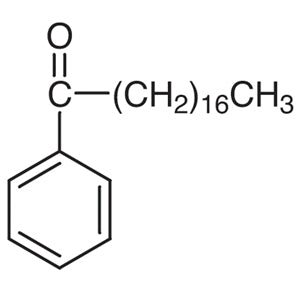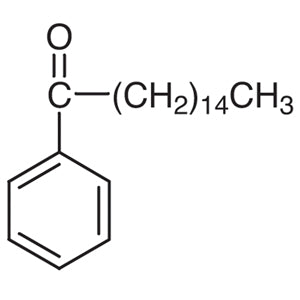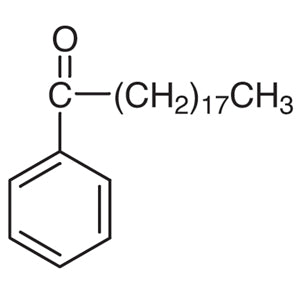
Nonadecanophenone from TCI is an aromatic ketone in the alkyl phenone family. Its molecule is built from a benzene ring bonded to a carbonyl group, followed by a long saturated alkyl chain, so the acyl chain holds nineteen carbons in total. The compound is classed as a non-heterocyclic building block. In the laboratory, long-chain alkyl phenones such as Nonadecanophenone serve as starting materials for synthesis and, just as importantly, as reference compounds in liquid chromatography, where a well-defined, easily detected molecule is needed.
Nonadecanophenone is chosen because its structure pairs an aromatic chromophore, the phenyl ketone, which absorbs strongly in the UV region, with a highly hydrophobic hydrocarbon chain. The homologous series of alkyl phenones is widely used for retention index standards in reversed-phase HPLC, because retention time rises steadily as chain length grows and the compounds are easy to detect with a UV detector. As one of the long-chain members of that series, Nonadecanophenone helps calibrate the retention region of very nonpolar compounds. Its carbonyl group can also be reduced, aminated, or used in addition reactions to make derivatives.
In Indonesia, this material is useful for laboratories that run reversed-phase HPLC methods and need a dependable reference for strongly retained, nonpolar analytes. This includes university analytical chemistry laboratories, research institutes, and industrial quality control laboratories developing or checking chromatographic methods. Synthetic chemistry groups can also use Nonadecanophenone as a non-heterocyclic building block when they need a long hydrophobic chain attached to an aromatic ketone, for example when preparing derivatives through reactions at the carbonyl group.
- Retention index standard in reversed-phase HPLC: as a long-chain member of the alkyl phenone homologous series, its retention time fits the regular increase that comes with growing chain length.
- Calibration of the nonpolar retention region: the very hydrophobic nineteen-carbon acyl chain helps analysts map and calibrate the retention window where strongly nonpolar compounds elute.
- UV detector method checks: the phenyl ketone chromophore absorbs strongly in the UV region, so the compound is easy to detect and useful when setting up or checking UV-based chromatographic methods.
- Starting material for organic synthesis: as a non-heterocyclic building block, it supplies an aromatic ketone joined to a long saturated chain, a useful scaffold for building more complex molecules.
- Preparation of carbonyl derivatives: its carbonyl group can be reduced, aminated, or used in addition reactions, so researchers can make a range of derivatives that keep the long hydrophobic chain.
| Brand | TCI (product code N0664) |
|---|---|
| CAS number | 103044-68-4 |
| Molecular formula | — |
| Purity | — |
| Category | Chemistry > Building Blocks > Non-Heterocyclic Building Blocks |
| Pack sizes | see the product listing for the pack sizes currently offered |
| Physical form | as supplied by TCI; check the certificate of analysis and label |
| Storage | keep the container tightly closed in a cool, dry place; follow the TCI label and SDS |
Store Nonadecanophenone in its original, tightly closed container in a cool, dry, well-ventilated area, away from direct sunlight, heat sources, and strong oxidising agents. Always check the TCI label and Safety Data Sheet for the exact storage conditions. If you need to move the material to another container, use clean, dry, chemically compatible glass containers with good seals, and label them clearly. Handle the compound in a well-ventilated area or fume hood, and wear standard laboratory protection: safety glasses, gloves, and a lab coat. Don't let it contact skin or eyes, and don't inhale any dust. When preparing chromatographic standards, use clean glassware and suitable solvents so the reference stays pure. Dispose of waste according to local regulations and your institution's chemical waste procedures.
—
Produk Terkait
-
Decanophenone TCI D0026
Regular price From Rp 1.724.100,00Regular price -
Undecanophenone TCI U0053
Regular price From Rp 2.597.700,00Regular price -
Dodecanophenone TCI L0018
Regular price From Rp 1.246.350,00Regular price -
Tetradecanophenone TCI T0804
Regular price From Rp 1.538.250,00Regular price -
Pentadecanophenone TCI P1903
Regular price Rp 3.922.800,00Regular price -
Octadecanophenone TCI O0185
Regular price From Rp 1.510.950,00Regular price -
Heptadecanophenone TCI H0780
Regular price From Rp 2.174.550,00Regular price -
Hexadecanophenone TCI H0590
Regular price From Rp 1.485.750,00Regular price