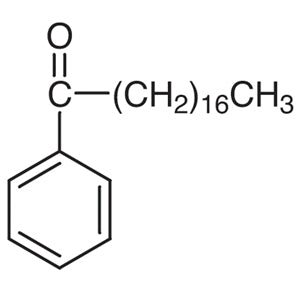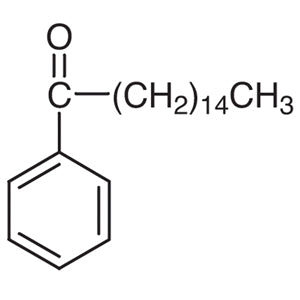
Hexadecanophenone is an aromatic-aliphatic ketone that joins a phenyl ring to a long, saturated straight-chain hydrocarbon at its carbonyl group. This quasi-amphiphilic structure places the compound at the boundary between the world of aromatic compounds and the world of lipids, which is why it is frequently used as a model compound in studies of long-chain behaviour. In the laboratory, the material serves as a building block for the synthesis of long-chain alkylbenzene derivatives, as a reference compound in the development of analytical methods, and as a test substance in materials and surface research.
The property that makes this compound a preferred choice is the contrast between its polar and non-polar regions within a single molecule. The carbonyl group provides a clear reaction site for reduction, condensation, or derivative formation, while the long hexadecyl chain confers strong hydrophobic character, a tendency to crystallise cleanly, and limited solubility in polar solvents. As a solid at room temperature, the compound is easy to weigh accurately and remains stable under ordinary storage conditions, which is a practical advantage over many other long-chain ketones. Its long chromatographic retention is also useful as a marker.
In Indonesian laboratories, Hexadecanophenone is typically handled in organic synthesis groups, analytical chemistry units, and materials or surface science laboratories at universities, research institutes, and industrial R&D facilities. Its solid physical form simplifies weighing, transfer, and routine storage in a standard chemical cabinet without specialised cold-chain arrangements. Supplied under the TCI brand within the Non-Heterocyclic Building Blocks category, it fits naturally into method development work and small-scale synthetic routes where a well-defined long-chain aromatic ketone is required.
- Synthesis of long-chain alkylbenzene derivatives — the reactive carbonyl group offers a defined site for reduction or condensation while the hexadecyl chain is carried through intact into the product.
- Reference compound in analytical method development — its long chromatographic retention makes it a useful late-eluting marker when establishing separation windows, retention indices, and system suitability checks.
- Model compound for long-chain behaviour studies — the combination of an aromatic head and a saturated sixteen-carbon tail allows researchers to probe chain packing, ordering, and conformational effects systematically.
- Test substance in materials and surface research — strong hydrophobic character from the long alkyl chain makes it suitable for examining wetting, adsorption, and surface modification phenomena on prepared substrates.
- Preparation of derivatives for structure–property comparison — the carbonyl group permits straightforward conversion into related families of compounds, giving a consistent long-chain backbone across an entire series.
| Brand | TCI |
|---|---|
| CAS number | 6697-12-7 |
| Molecular formula | — |
| Purity | — |
| Category | Chemistry > Building Blocks > Non-Heterocyclic Building Blocks |
| Pack sizes | available in the standard catalogue pack sizes offered for this item; please confirm the required quantity when ordering |
| Physical form | solid at room temperature |
| Storage | stable under ordinary laboratory storage conditions |
- Product code: H0590
Store Hexadecanophenone in its original tightly closed container, kept in a cool, dry, and well-ventilated chemical cabinet away from direct sunlight, heat sources, and strong oxidising agents. Glass bottles with chemically resistant caps are suitable, and containers should be resealed promptly after each use to prevent moisture uptake and contamination of the solid. Handle the material in a fume hood or a well-ventilated area, wearing safety glasses, a laboratory coat, and chemical-resistant gloves. Use clean, dry spatulas when weighing to avoid cross-contamination, and clearly label all secondary containers and prepared solutions. Clean up any spilled solid by careful sweeping or vacuum collection rather than dry brushing, and dispose of residues and contaminated materials in accordance with the applicable institutional chemical waste procedures.
—
Produk Terkait
-
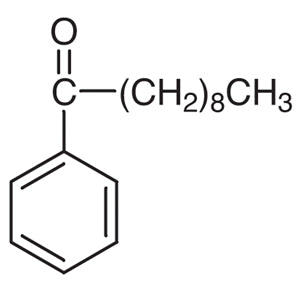
Decanophenone TCI D0026
Regular price From Rp 1.724.100,00Regular price -
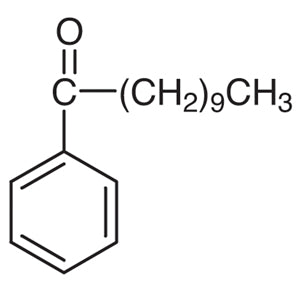
Undecanophenone TCI U0053
Regular price From Rp 2.597.700,00Regular price -
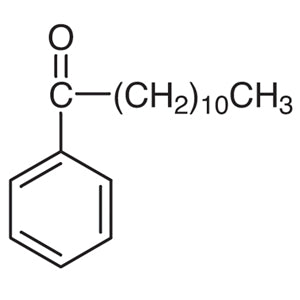
Dodecanophenone TCI L0018
Regular price From Rp 1.246.350,00Regular price -
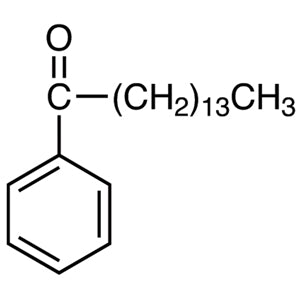
Tetradecanophenone TCI T0804
Regular price From Rp 1.538.250,00Regular price -
Pentadecanophenone TCI P1903
Regular price Rp 3.922.800,00Regular price -
Octadecanophenone TCI O0185
Regular price From Rp 1.510.950,00Regular price -
Nonadecanophenone TCI N0664
Regular price From Rp 1.590.750,00Regular price -
Heptadecanophenone TCI H0780
Regular price From Rp 2.174.550,00Regular price