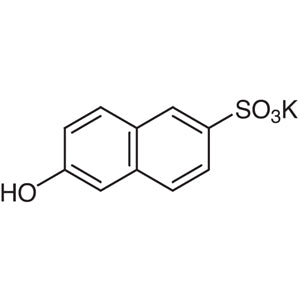
Potassium 6-Hydroxy-2-naphthalenesulfonate from TCI (product code N0703) is the potassium salt of a naphthalenesulfonic acid with a hydroxyl group at the 6-position. In dye chemistry it is known as Schaeffer's salt, and it has long been an important intermediate in dye manufacturing and research. In the laboratory it serves as a coupling component in azo synthesis. It is also a bicyclic aromatic building block whose sulfonate group makes it soluble in water. These traits make it a practical starting material for both teaching and research work.
Chemists choose this material because its two functional groups work well together. The naphthol hydroxyl group activates the aromatic ring towards electrophilic substitution, especially coupling with diazonium salts. The sulfonate group, present as a potassium salt, makes the compound and its derivatives dissolve easily in aqueous media. As a result, reactions can be run in water or other polar solvents. The products are anionic dyes that suit many different substrates. Because one well-defined reagent does both jobs, synthetic routes are simpler and working up products in aqueous systems is easier.
In Indonesia, this material is useful to organic chemistry laboratories at universities, where azo coupling is a standard exercise in synthesis courses and student research projects. Textile and dyeing laboratories can use it to prepare and study water-soluble anionic colourants for fibre application. Research laboratories that develop colorimetric and fluorescent sensors will also find it helpful, since its naphthalene core and water solubility make it a convenient platform for building new chromophores and probe molecules.
Related TCI products
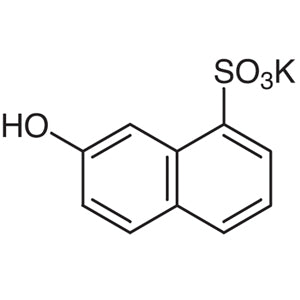
- TCI N0075 30252-40-5 Potassium 7-Hydroxy-1-naphthalenesulfonate (contains isomer)
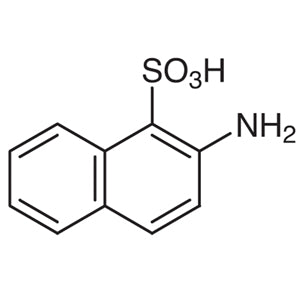
- TCI A0343 81-16-3 2-Amino-1-naphthalenesulfonic Acid
- TCI A0346 119-79-9 5-Amino-2-naphthalenesulfonic Acid
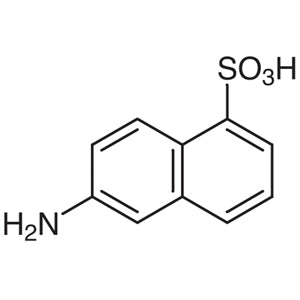
- TCI A0347 81-05-0 6-Amino-1-naphthalenesulfonic Acid
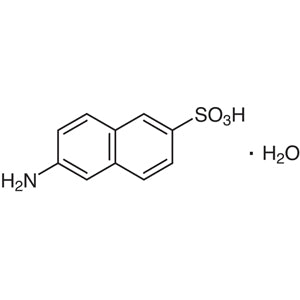
- TCI A0348 93-00-5 6-Amino-2-naphthalenesulfonic Acid Monohydrate
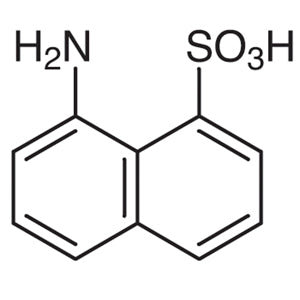
- TCI A0350 82-75-7 8-Amino-1-naphthalenesulfonic Acid
- Azo dye synthesis: the activated naphthol ring couples readily with diazonium salts, so it works well as a coupling component for preparing a wide range of azo compounds.
- Preparing water-soluble anionic dyes: the potassium sulfonate group gives the dyes water solubility, which is useful when the colourants must be applied from aqueous baths.
- Teaching experiments in organic chemistry: its long-established role as Schaeffer's salt makes it a good reagent for showing electrophilic aromatic substitution and diazo coupling to students.
- Developing colorimetric and fluorescent sensors: the bicyclic aromatic core and water solubility support the design of probe molecules that work in aqueous analytical systems.
- Building-block chemistry: the hydroxyl and sulfonate groups on a naphthalene framework offer two handles for making functionalised aromatic compounds in polar solvents.
| Brand | TCI (product code N0703) |
|---|---|
| CAS number | 833-66-9 |
| Molecular formula | — |
| Purity | — |
| Category | Chemistry > Building Blocks > Non-Heterocyclic Building Blocks |
| Pack sizes | 25g |
| Physical form | — |
| Storage | keep tightly closed in a cool, dry place, following the manufacturer's label and Safety Data Sheet |
- Chemical identity: potassium salt of 6-hydroxy-2-naphthalenesulfonic acid (Schaeffer's salt)
Keep this material in its original, tightly sealed container in a cool, dry, well-ventilated area. Protect it from moisture, direct sunlight and heat sources. Store it away from strong oxidising agents and incompatible chemicals. Reseal the container promptly after each use so the contents do not absorb moisture or become contaminated. Handle it with standard laboratory precautions: wear safety glasses, gloves and a lab coat. Avoid creating or breathing in dust, and weigh the material in a fume hood or ventilated enclosure. Wash your hands thoroughly after handling. Always read the manufacturer's Safety Data Sheet for specific hazard, storage and disposal instructions before use.
—
Produk Terkait
-
Potassium7-Hydroxy-1-naphthalenesulfonate(containsisomer) TCI N0075
Regular price Rp 1.936.200,00Regular price -
2-Amino-1-naphthalenesulfonicAcid TCI A0343
Regular price From Rp 477.750,00Regular price -
5-Amino-2-naphthalenesulfonicAcid TCI A0346
Regular price From Rp 717.150,00Regular price -
6-Amino-1-naphthalenesulfonicAcid TCI A0347
Regular price From Rp 955.500,00Regular price -
6-Amino-2-naphthalenesulfonicAcidMonohydrate TCI A0348
Regular price From Rp 1.405.950,00Regular price -
8-Amino-1-naphthalenesulfonicAcid TCI A0350
Regular price From Rp 1.008.000,00Regular price -
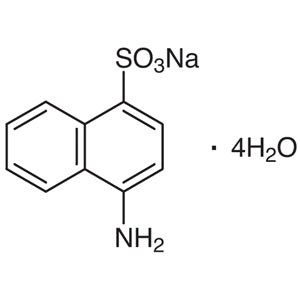
Sodium4-Amino-1-naphthalenesulfonateTetrahydrate TCI A0353
Regular price From Rp 769.650,00Regular price -
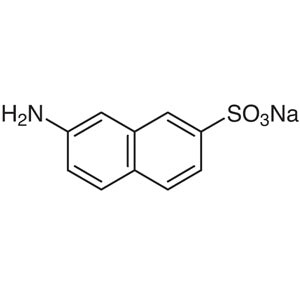
Sodium7-Amino-2-naphthalenesulfonate TCI A0355
Regular price From Rp 1.193.850,00Regular price