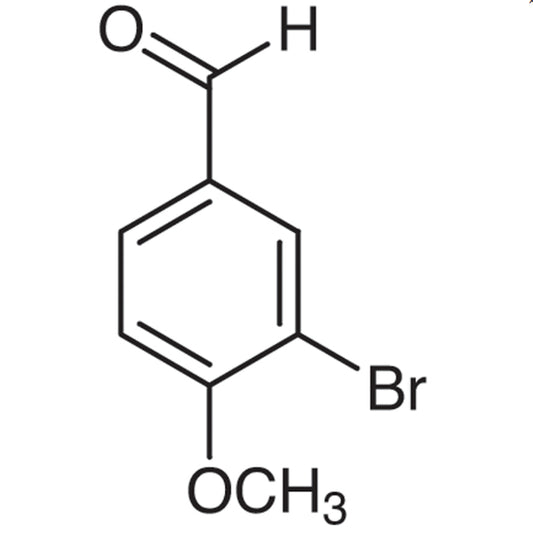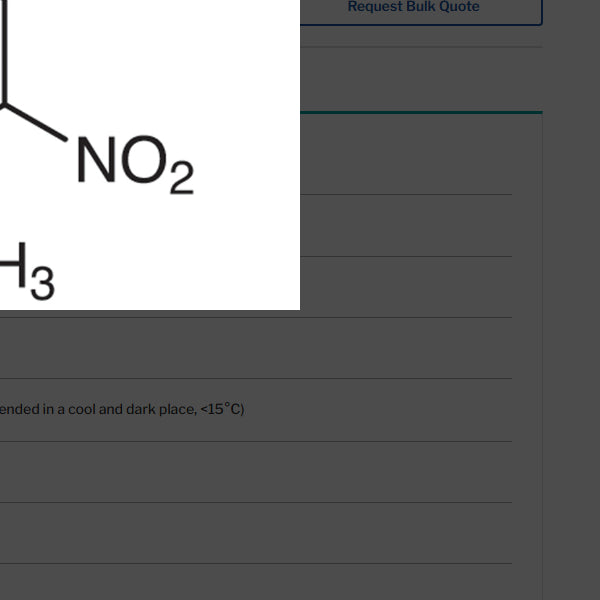
3-Nitro-p-anisaldehyde from TCI (catalogue number N0830), also known as 4-methoxy-3-nitrobenzaldehyde, is an aromatic aldehyde. It carries a methoxy group para to the formyl group and a nitro group meta to it. The compound is classed as a non-heterocyclic building block and is widely used in organic synthesis and medicinal chemistry laboratories. Its substitution pattern on the benzene ring makes it a practical starting material for pharmaceutical intermediates, dyes, ligands and other functional molecules that need a substituted aromatic core.
Researchers choose this compound because its aldehyde group takes part in many classic reactions, including Knoevenagel condensation, the Wittig reaction, reductive amination and imine formation. The nitro group can be reduced to an amine, which can then be used to build heterocyclic rings such as benzimidazoles or quinolines. The methoxy group donates electrons and the nitro group withdraws them, which gives the ring electronic properties worth studying. One material therefore gives the chemist several modification points that complement each other and can be used in sequence.
In Indonesian laboratories, 3-Nitro-p-anisaldehyde suits research groups at universities, government research institutes and industrial R&D facilities that work on organic synthesis. Typical users include postgraduate students synthesising new compounds for theses, medicinal chemistry teams preparing libraries of candidate molecules, and materials researchers developing dyes or ligands. Because it is a TCI reagent, laboratories can rely on consistent supplier documentation when planning multi-step synthetic routes, method development and teaching experiments in advanced organic chemistry courses.
- Knoevenagel condensation and Wittig reactions: the reactive aldehyde group readily forms new carbon–carbon double bonds, so chemists can extend the aromatic core into conjugated systems.
- Reductive amination and imine formation: the formyl group reacts with primary and secondary amines, which makes the compound useful for preparing substituted benzylamines and Schiff base ligands for coordination chemistry.
- Synthesis of heterocycles such as benzimidazoles and quinolines: once the nitro group is reduced to an amine, it provides a handle for ring-forming reactions that build fused nitrogen-containing heterocycles.
- Pharmaceutical intermediate preparation: several complementary reactive sites on one substituted benzene ring let medicinal chemists build diverse analogues for structure–activity studies efficiently.
- Dye and functional molecule research: the push–pull electronic character created by the electron-donating methoxy and electron-withdrawing nitro groups makes it a useful model for studying optical and electronic properties.
| Brand | TCI (catalogue number N0830) |
|---|---|
| CAS number | 31680-08-7 |
| Molecular formula | — |
| Purity | — |
| Category | Chemistry > Building Blocks > Non-Heterocyclic Building Blocks |
| Pack sizes | as listed in the current TCI catalogue for product N0830 |
| Physical form | — |
| Storage | keep tightly closed in a cool, dry place; see the supplier's SDS and label for specific conditions |
- Synonym: 4-Methoxy-3-nitrobenzaldehyde
Store 3-Nitro-p-anisaldehyde in its original tightly sealed container, in a cool, dry, well-ventilated area away from direct sunlight, heat sources and incompatible materials such as strong oxidising agents, strong bases and reducing agents. Aromatic aldehydes can slowly oxidise in air, so reseal the container promptly after each use. Handle the compound in a fume hood and wear a lab coat, safety glasses and chemical-resistant gloves. Avoid breathing dust or vapours and avoid contact with skin and eyes. Always read the Safety Data Sheet before use, and dispose of residues and contaminated materials according to your institution's chemical waste procedures.
—
Produk Terkait
-
5-Nitro-o-anisaldehyde TCI N1034
Regular price From Rp 980.700,00Regular price -
2-Hydroxy-5-nitro-m-anisaldehyde TCI H0397
Regular price Rp 2.121.000,00Regular price -
m-Anisaldehyde TCI A0478
Regular price From Rp 1.298.850,00Regular price -
o-Anisaldehyde TCI A0479
Regular price From Rp 769.650,00Regular price -
p-Anisaldehyde TCI A0480
Regular price From Rp 530.250,00Regular price -
5-Bromo-o-anisaldehyde TCI B1791
Regular price From Rp 1.776.600,00Regular price -
3-Bromo-p-anisaldehyde TCI B1790
Regular price From Rp 1.140.300,00Regular price -
3-Chloro-p-anisaldehyde TCI C1797
Regular price From Rp 903.000,00Regular price