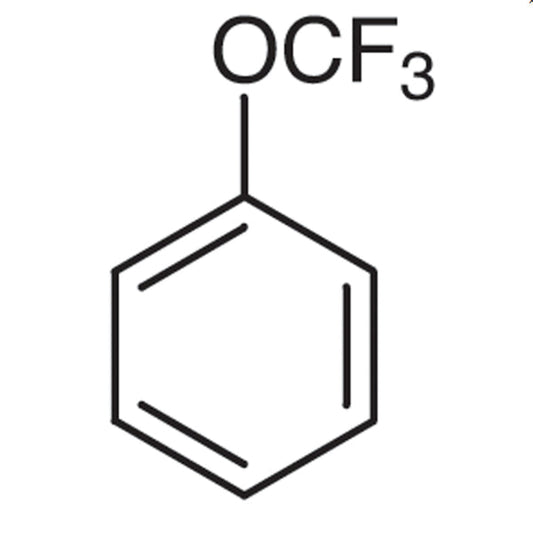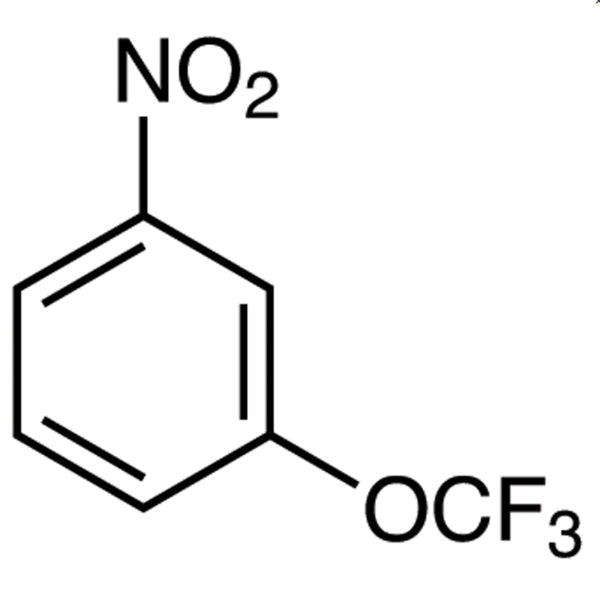
1-Nitro-3-(trifluoromethoxy)benzene from TCI (product code N0884, CAS 2995-45-1) is a substituted aromatic compound. Its molecule has a nitro group and a trifluoromethoxy (OCF3) group positioned meta to each other on a benzene ring. It belongs to the fluorinated building blocks, a class of materials that matters a great deal in medicinal chemistry, agrochemistry and modern materials science. In the laboratory, its main role is as a precursor to 3-(trifluoromethoxy)aniline, which is made by reducing the nitro group. That aniline is then the starting point for building amides, ureas, sulfonamides and heterocycles that carry the OCF3 group.
Chemists value the trifluoromethoxy group because it is strongly lipophilic, strongly electron-withdrawing and metabolically stable. Together, these properties are often used to improve membrane permeability and to make drug candidates more resistant to metabolic breakdown. Putting an OCF3 group directly onto a molecule is usually difficult. For that reason, a starting material that already carries the group, like this one, makes synthetic work much easier. The nitro group also gives a simple, controllable route for further transformation, so researchers can reach the target amine and its derivatives in fewer and more predictable steps than they would by adding the fluorinated group late in a synthesis.
In Indonesia, medicinal chemistry and agrochemical research keep growing at universities and research institutions. Laboratories working on new bioactive molecules, structure–activity relationship studies, or crop-protection candidates can use this compound as a dependable entry point to OCF3-substituted aromatic scaffolds. It also suits academic synthetic organic chemistry groups that teach or study nitro-group reduction and aniline chemistry. AMI Scientific supplies this TCI reagent to research, teaching and industrial development laboratories that need a well-defined fluorinated building block.
TCI brochures (PDF)
- Fluorination Reagents, Fluorinated Building Blocks 2026-03-18 · p. 44
Related TCI products
- TCI T2155 713-65-5 1-Nitro-4-(trifluoromethoxy)benzene
- TCI T2153 103962-05-6 1-Iodo-4-(trifluoromethoxy)benzene
- TCI T2152 175278-00-9 1-Iodo-2-(trifluoromethoxy)benzene
- TCI T2149 461-81-4 1-Chloro-4-(trifluoromethoxy)benzene
- TCI T2147 64115-88-4 1-Bromo-2-(trifluoromethoxy)benzene
- TCI T1617 456-55-3 (Trifluoromethoxy)benzene
- Synthesis of 3-(trifluoromethoxy)aniline: reducing the nitro group gives the corresponding aniline directly, which makes this compound a simple and controllable precursor for that key fluorinated intermediate.
- Construction of amide and urea derivatives: the aniline made from this compound can be coupled to form amides and ureas that keep the lipophilic, metabolically stable OCF3 group in the final structure.
- Preparation of sulfonamides for medicinal chemistry: because the trifluoromethoxy group is already in place, researchers can make OCF3-bearing sulfonamides without the difficult step of installing the group directly.
- Heterocycle synthesis for drug discovery: the derived aniline is a useful starting point for building heterocyclic systems that carry the OCF3 group, supporting work on membrane permeability and metabolic resistance.
- Agrochemical research and development: fluorinated building blocks are central to modern agrochemistry, and this compound gives a practical route to OCF3-substituted aromatic candidates for crop-protection studies.
| Brand | TCI (product code N0884) |
|---|---|
| CAS number | 2995-45-1 |
| Molecular formula | — |
| Purity | — |
| Category | Chemistry > Building Blocks > Fluorinated Building Blocks |
| Pack sizes | see the available options on the product listing |
| Physical form | see the TCI certificate of analysis or safety data sheet |
| Storage | follow the storage conditions on the TCI label and safety data sheet |
Keep this compound in its original, tightly closed container. Store it in a cool, dry, well-ventilated place away from heat, ignition sources, strong reducing agents and incompatible materials. Always check the TCI label and safety data sheet for specific storage temperature requirements. As an aromatic nitro compound, it should be handled only by trained staff in a fume hood, wearing suitable gloves, safety glasses and a laboratory coat. Do not inhale vapours or dust, and avoid contact with skin and eyes. Label secondary containers clearly, and dispose of residues and contaminated materials according to institutional and local regulations for halogenated organic chemical waste.
—
Produk Terkait
-
1-Nitro-4-(trifluoromethoxy)benzene TCI T2155
Regular price From Rp 769.650,00Regular price -
1-Iodo-4-(trifluoromethoxy)benzene TCI T2153
Regular price From Rp 1.167.600,00Regular price -
1-Iodo-2-(trifluoromethoxy)benzene TCI T2152
Regular price Rp 1.405.950,00Regular price -
1-Chloro-4-(trifluoromethoxy)benzene TCI T2149
Regular price Rp 848.400,00Regular price -
1-Bromo-2-(trifluoromethoxy)benzene TCI T2147
Regular price From Rp 637.350,00Regular price -
(Trifluoromethoxy)benzene TCI T1617
Regular price Rp 1.220.100,00Regular price -
5-Bromo-1,3-difluoro-2-(trifluoromethoxy)benzene TCI B5057
Regular price From Rp 1.087.800,00Regular price -
1-Bromo-3-fluoro-4-(trifluoromethoxy)benzene TCI B3808
Regular price From Rp 689.850,00Regular price