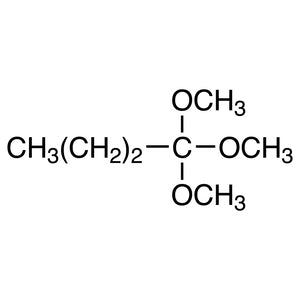
TCI O0179 Trimethyl Orthobutyrate (CAS 43083-12-1) is an orthoester derived from butyric acid. Its central carbon atom carries three methoxy groups together with a propyl chain. In organic synthesis laboratories, orthoesters like this one act as a source of functionalized carbon at the carboxylic acid oxidation level. The compound is widely used to form esters, amidines, and heterocyclic rings. Because it can introduce a butanoyl or propyl-carbon unit into a target molecule, it is a practical building block for synthetic and medicinal chemists.
Chemists choose this material for the reactivity typical of orthoesters. Under acidic conditions it readily releases methanol and forms an oxygen-stabilized carbenium ion, which then reacts with alcohols, amines, or diamines. This behaviour is the basis of the Johnson–Claisen rearrangement, in which an allylic alcohol reacts with an orthoester to give a γ,δ-unsaturated ester with fairly well-controlled stereochemistry. Orthoesters are also sensitive to water and hydrolyse easily to the corresponding ester, so dry working conditions are essential for reliable results.
In Indonesian laboratories, Trimethyl Orthobutyrate is relevant to research in synthetic organic chemistry, where it helps build carbon frameworks and functional groups in multistep routes. University research groups, pharmaceutical development laboratories, and institutions working on new active compounds can use it when a propyl-substituted carboxylic acid equivalent is needed. It suits both teaching-level demonstrations of orthoester chemistry and more advanced research projects that call for controlled carbon–carbon bond formation or heterocycle construction.
Related TCI products
- Johnson–Claisen rearrangement: reacts with allylic alcohols under acid catalysis to give γ,δ-unsaturated esters, carrying the propyl-bearing carbon into the product with fairly well-controlled stereochemistry.
- Heterocycle synthesis: its oxygen-stabilized carbenium ion reacts with diamines and related bifunctional nucleophiles, which makes it useful for building heterocyclic rings that carry a propyl substituent.
- Amidine formation: condensation with amines gives amidines, so it serves as a convenient carboxylic-acid-level carbon source for making nitrogen-containing intermediates in medicinal chemistry.
- Ester preparation: the compound hydrolyses readily or exchanges with alcohols to form butyrate esters, giving chemists a mild and controllable way to introduce the butanoyl unit.
- Building block in multistep synthesis: as a functionalized carbon source at the carboxylic acid oxidation level, it lets synthetic chemists add propyl-carbon fragments to complex target molecules.
| Brand | TCI (product code O0179) |
|---|---|
| CAS number | 43083-12-1 |
| Molecular formula | — |
| Purity | — |
| Category | Chemistry > Building Blocks > Non-Heterocyclic Building Blocks |
| Pack sizes | see the available options on the product page |
| Physical form | liquid orthoester; check the TCI certificate of analysis for confirmed details |
| Storage | keep tightly sealed and away from moisture, since the compound hydrolyses easily |
Store Trimethyl Orthobutyrate in its original, tightly closed container in a cool, dry, well-ventilated area, away from heat, sparks, and open flames. Because orthoesters hydrolyse readily when exposed to water, keep moisture out. Reseal containers straight after use, and consider storing them under an inert atmosphere once opened. Keep the material away from acids and oxidizing agents. Handle it in a fume hood, wearing safety glasses, chemical-resistant gloves, and a lab coat. Use dry glassware and anhydrous solvents during reactions. Always read the supplier's Safety Data Sheet before use and follow local rules when disposing of waste.
—
Produk Terkait
-
TriethylOrthobutyrate TCI O0173
Regular price From Rp 1.035.300,00Regular price -
2-Hydroxy-3,5,5-trimethyl-2-cyclohexen-1-one TCI T2723
Regular price Rp 1.273.650,00Regular price -
2,2,4-Trimethyl-1,3-dioxolane TCI T2575
Regular price Rp 1.803.900,00Regular price -
TrimethylOrthopropionate TCI T2288
Regular price Rp 848.400,00Regular price -
TrimethylOrthobenzoate TCI T2287
Regular price From Rp 795.900,00Regular price -
TrimethylOrthoisobutyrate TCI T2208
Regular price Rp 2.411.850,00Regular price -
2,4,4-Trimethyl-2-pentanol TCI T1962
Regular price From Rp 2.571.450,00Regular price -
TrimethylOrthovalerate TCI T0981
Regular price From Rp 2.545.200,00Regular price