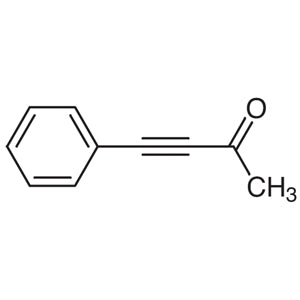
4-Phenyl-3-butyn-2-one is an organic compound widely used in chemical reactions, particularly in the synthesis of complex molecules. It serves as a key building block in organic chemistry, offering versatility in various synthetic pathways. This compound is valued for its unique molecular structure, which combines a phenyl group with a butynone functional group, enabling it to participate in a range of chemical transformations. Its reactivity makes it an essential tool for chemists working on the development of new compounds and molecular structures.
The compound exhibits high reactivity due to its triple bond and aromatic ring, which make it suitable for reactions such as coupling, cyclization, and substitution. It is chemically stable under controlled conditions but becomes highly reactive when exposed to elevated temperatures or catalysts. This dual nature allows researchers to precisely control reaction outcomes, making it a preferred choice in synthetic chemistry. Its solubility in organic solvents like ethyl acetate and ethanol further enhances its utility in laboratory settings.
In Indonesian laboratories, 4-Phenyl-3-butyn-2-one is commonly used in organic chemistry research, especially in projects focused on the synthesis of new compounds or the modification of molecular structures. It is a staple in academic and industrial research, supporting the development of pharmaceuticals, materials, and other advanced chemical products. Its reliability and performance make it a trusted reagent in both educational and applied research environments.
- Organic synthesis applications benefit from this compound's reactivity and structural versatility, enabling the creation of complex molecules with high precision.
- Cyclization reactions are enhanced by the compound's ability to form stable intermediates, facilitating the synthesis of heterocyclic compounds.
- Coupling reactions take advantage of the compound's triple bond, allowing for efficient bond formation between different functional groups.
- Substitution reactions are supported by the compound's aromatic ring, which provides a stable platform for further chemical modifications.
- Structural modification projects rely on this compound's unique molecular framework, offering a foundation for the development of novel chemical structures.
| Brand | TCI |
|---|---|
| CAS number | 1817-57-8 |
| Molecular formula | — |
| Purity | — |
| Category | Chemistry > Building Blocks > Non-Heterocyclic Building Blocks |
| Pack sizes | Available in various quantities as per supplier specifications |
| Physical form | Liquid |
| Storage | Store in a cool, dry place away from light and incompatible materials |
This compound should be stored in a cool, dry environment, away from direct sunlight and sources of heat. It is recommended to use airtight containers made of glass or high-density polyethylene to prevent contamination and evaporation. Due to its reactivity, it should be kept separate from strong oxidizing agents and incompatible substances. In laboratory settings, it is important to handle the compound with appropriate personal protective equipment, such as gloves and safety goggles, to ensure safety. Proper ventilation should be maintained when working with this material to minimize exposure risks. Always follow standard laboratory safety protocols when handling reactive organic compounds.
—
Produk Terkait
-
3-Butyn-2-one TCI B2393
Regular price From Rp 2.174.550,00Regular price -
3-Butyn-2-ol TCI B1001
Regular price From Rp 928.200,00Regular price -
3-Butyn-1-ol TCI B0799
Regular price From Rp 928.200,00Regular price -
2-Butyn-1-ol TCI B0712
Regular price From Rp 1.273.650,00Regular price -
2-Methyl-4-phenyl-3-butyn-2-ol TCI M1415
Regular price Rp 1.590.750,00Regular price -
2-Methyl-3-butyn-2-ol TCI M0180
Regular price From Rp 505.050,00Regular price -
8-Bromo-7-(2-butyn-1-yl)-3-methylxanthine TCI B4454
Regular price Rp 1.405.950,00Regular price -
(S)-(-)-3-Butyn-2-ol TCI B2910
Regular price From Rp 1.961.400,00Regular price