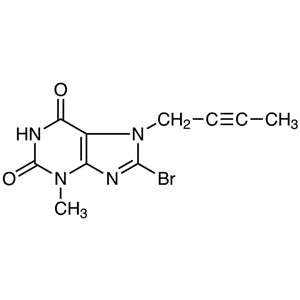
8-Bromo-7-(2-butyn-1-yl)-3-methylxanthine is a specialized chemical compound used in various laboratory experiments and scientific research. As a heterocyclic building block, it plays a crucial role in the synthesis of bioactive compounds, particularly in pharmacology and biochemistry. Its complex molecular structure and reactive functional groups make it a valuable tool for researchers aiming to develop new drugs or modify existing chemical entities. This compound is widely utilized in academic and research institutions across Indonesia, supporting a wide range of chemical investigations and innovation.
The compound's unique properties, including the presence of bromo and butyn functional groups, contribute to its reactivity and versatility in chemical reactions. These groups enable it to participate in substitution, addition, and coupling reactions, making it an ideal choice for synthetic chemists. Its ability to interact with various molecules enhances its applicability in diverse research contexts. The combination of structural complexity and reactivity ensures that it remains a preferred material for those working on advanced chemical synthesis and modification projects.
In Indonesian laboratories, this compound is commonly used in academic and research settings. It supports studies in pharmaceutical development, biochemical research, and synthetic chemistry. Its availability through reliable suppliers like AMI Scientific ensures that researchers have access to high-quality materials for their experiments. The compound's role in scientific advancement makes it an essential component in modern laboratory practices across Indonesia.
TCI brochures (PDF)
- Nucleosides, Nucleotides, Nucleic Acids and Related Reagents 2026-03-23 · p. 10
- Drug development research benefits from this compound's ability to serve as a building block for synthesizing bioactive molecules, supporting the creation of new therapeutic agents.
- Biochemical studies utilize its reactive functional groups to investigate molecular interactions and biological activity, aiding in the understanding of complex biological systems.
- Organic synthesis projects leverage its heterocyclic structure to design and produce novel chemical compounds with specific functional properties.
- Academic research in chemistry and pharmacology incorporates it to explore synthetic pathways and reaction mechanisms, enhancing scientific knowledge.
- Analytical chemistry applications use its unique properties to test and characterize chemical reactions, contributing to the advancement of analytical techniques.
| Brand | TCI |
|---|---|
| CAS number | 666816-98-4 |
| Molecular formula | — |
| Purity | — |
| Category | Chemistry > Building Blocks > Heterocyclic Building Blocks |
| Pack sizes | Available in various quantities as per supplier specifications |
| Physical form | Solid, as per standard chemical product specifications |
| Storage | Store in a cool, dry place away from light and moisture |
This compound should be stored in a cool, dry environment, away from direct light and moisture to maintain its stability and integrity. It is recommended to use airtight containers to prevent exposure to air and contaminants. Due to its reactive functional groups, it should be handled with care, using appropriate personal protective equipment such as gloves and safety goggles. Avoid contact with incompatible materials, and ensure proper ventilation in the workspace. Regular inspection of storage conditions is advised to ensure the compound remains in optimal condition for laboratory use.
—
Produk Terkait
-
1-Methylxanthine TCI M2432
Regular price From Rp 2.227.050,00Regular priceRp 1.572.900,00Sale price From Rp 2.227.050,00 -
3-Methylxanthine TCI M2073
Regular price From Rp 1.033.200,00Regular priceRp 738.150,00Sale price From Rp 1.033.200,00 -
8-Bromo-3-methylxanthine TCI B4134
Regular price Rp 1.829.100,00Regular priceRp 1.294.650,00Sale price Rp 1.829.100,00 -
AdenineHydrochlorideHemihydrate TCI A0150
Regular price From Rp 717.150,00Regular priceRp 516.600,00Sale price From Rp 717.150,00 -
Uracil TCI U0013
Regular price From Rp 742.350,00Regular priceRp 534.450,00Sale price From Rp 742.350,00 -
4-Thiouracil TCI T2757
Regular price Rp 2.835.000,00Regular priceRp 1.998.150,00Sale price Rp 2.835.000,00 -
O~6~-Benzylguanine TCI B4208
Regular price From Rp 1.220.100,00Regular priceRp 868.350,00Sale price From Rp 1.220.100,00 -
6-Benzyloxypurine TCI B3355
Regular price Rp 2.650.200,00Regular priceRp 1.869.000,00Sale price Rp 2.650.200,00