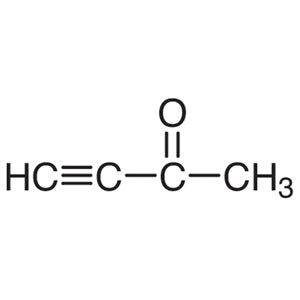
3-Butyn-2-one is an organic compound widely used as a foundational building block in the synthesis of complex molecules. Its unique molecular structure, containing both a ketone group and an alkyne group, allows it to participate in a variety of chemical reactions such as hydration, hydrogenation, and nucleophilic reactions. This versatility makes it a valuable tool for chemists working in synthetic chemistry and pharmaceutical research. In the laboratory, it serves as a key intermediate in the development of new compounds and the modification of existing molecular structures.
The reactivity of 3-Butyn-2-one stems from its dual functional groups, which enable it to interact with transition metals and electrophilic compounds. This property makes it an ideal candidate for a wide range of synthetic strategies, including coupling reactions and functional group transformations. Its ability to undergo multiple reaction pathways also enhances its utility in both academic and industrial research settings. The compound’s availability in solid form and ease of handling further contribute to its popularity among researchers.
In Indonesian laboratories, 3-Butyn-2-one is commonly used in organic chemistry research, particularly in higher education institutions and research organizations. It is an essential component of chemical kits used for synthetic experiments, especially those requiring the construction of complex molecular frameworks. Its presence in these settings underscores its importance in advancing chemical research and innovation in the region.
TCI brochures (PDF)
- Click Chemistry 2026-09-08 · p. 16
- Organic synthesis applications benefit from 3-Butyn-2-one's ability to participate in multiple reaction pathways, enabling the creation of complex molecular structures.
- Pharmaceutical research utilizes this compound for the development of new drugs, leveraging its reactivity in modifying molecular frameworks.
- Academic research in chemistry often incorporates 3-Butyn-2-one for teaching and experimental purposes, demonstrating its role in synthetic chemistry education.
- Industrial chemical processes may use this compound as a building block for the production of specialized chemicals and intermediates.
- Analytical chemistry applications can benefit from its use in the preparation of reference standards and calibration materials.
| Brand | TCI |
|---|---|
| CAS number | 1423-60-5 |
| Molecular formula | — |
| Purity | — |
| Category | Chemistry > Building Blocks > Non-Heterocyclic Building Blocks |
| Pack sizes | — |
| Physical form | Solid |
| Storage | Store in a cool, dry place away from light and incompatible materials |
3-Butyn-2-one should be stored in a cool, dry environment, away from direct sunlight and sources of heat. It is recommended to keep the compound in a sealed container to prevent exposure to moisture and air. Due to its reactivity, it should be stored separately from strong oxidizing agents and incompatible substances. Proper ventilation is essential when handling this material to minimize inhalation risks. Laboratory personnel should wear appropriate personal protective equipment, including gloves and safety goggles, to ensure safe handling. Regular monitoring of storage conditions is advised to maintain the compound's integrity and ensure safe laboratory practices.
—
Product Categories
Produk Terkait
-
3-Butyn-2-ol TCI B1001
Regular price From Rp 928.200,00Regular priceRp 648.900,00Sale price From Rp 928.200,00 -
3-Butyn-1-ol TCI B0799
Regular price From Rp 928.200,00Regular priceRp 648.900,00Sale price From Rp 928.200,00 -
2-Methyl-3-butyn-2-ol TCI M0180
Regular price From Rp 505.050,00Regular priceRp 352.800,00Sale price From Rp 505.050,00 -
(S)-(-)-3-Butyn-2-ol TCI B2910
Regular price From Rp 1.961.400,00Regular priceRp 1.371.300,00Sale price From Rp 1.961.400,00 -
(R)-(+)-3-Butyn-2-ol TCI B2909
Regular price From Rp 3.419.850,00Regular priceRp 2.390.850,00Sale price From Rp 3.419.850,00 -
4-Phenyl-3-butyn-2-one TCI P1336
Regular price From Rp 1.326.150,00Regular priceRp 927.150,00Sale price From Rp 1.326.150,00 -
10-UndecynoicAcid TCI U0054
Regular price From Rp 1.060.500,00Regular priceRp 757.050,00Sale price From Rp 1.060.500,00 -
N-(Prop-2-yn-1-yl)benzamide TCI P3113
Regular price From Rp 2.147.250,00Regular priceRp 1.517.250,00Sale price From Rp 2.147.250,00