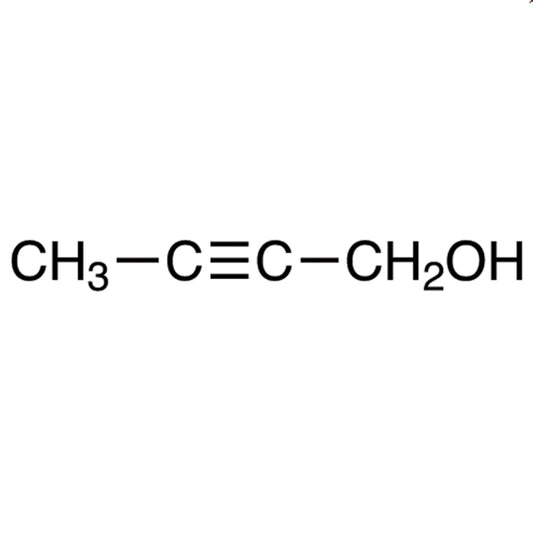
(R)-(+)-3-Butyn-2-ol is a chiral organic compound widely used in chemical synthesis, particularly in asymmetric reactions. This compound plays a crucial role in laboratories where precise control over stereochemistry is essential. It serves as a chiral building block, enabling the synthesis of complex molecules with specific spatial configurations. Its importance extends across various fields, including pharmaceutical research, industrial chemistry, and organic chemistry. Due to its optical activity, it selectively interacts with other chiral compounds, making it a valuable tool in the development of new drugs and specialized chemical products.
The unique molecular structure of (R)-(+)-3-Butyn-2-ol, featuring a butyn group and a hydroxyl group, provides it with reactivity and specificity in chemical reactions. Its chirality allows for the creation of enantiomerically pure compounds, which is critical in pharmaceutical applications where the biological activity of a compound can vary significantly between its enantiomers. Additionally, its stability under controlled conditions ensures reliable performance in laboratory settings. These properties make it a preferred choice for researchers aiming to achieve high levels of stereochemical control in their synthetic processes.
In Indonesian laboratories, (R)-(+)-3-Butyn-2-ol is commonly used in organic chemistry research, especially in asymmetric synthesis and the development of new chemical compounds. It is a staple in academic and research institutions across the country, supporting both teaching and experimental work. Its versatility and effectiveness in achieving precise stereochemical outcomes make it an essential component in the chemical toolkit of Indonesian scientists and researchers.
TCI brochures (PDF)
- Click Chemistry 2026-09-08 · p. 13
- Chiral Building Blocks 2025-04-14 · p. 8
- Asymmetric Synthesis: This compound is ideal for asymmetric synthesis due to its chiral nature, allowing the creation of enantiomerically pure compounds with high stereochemical control.
- Pharmaceutical Research: Its optical activity makes it a key reagent in the development of new drugs, where precise stereochemistry is essential for biological activity.
- Organic Chemistry Education: It is widely used in teaching and research settings to demonstrate the principles of chirality and stereochemistry in chemical reactions.
- Industrial Chemical Production: It serves as a building block for the synthesis of complex organic molecules used in various industrial applications.
- Chiral Compound Development: Its reactivity and specificity make it suitable for the synthesis of chiral compounds with tailored properties for specialized applications.
| Brand | TCI |
|---|---|
| CAS number | 42969-65-3 |
| Molecular formula | — |
| Purity | — |
| Category | Chemistry > Asymmetric Synthesis > Chiral Building Blocks |
| Pack sizes | Available in various quantities as per supplier specifications |
| Physical form | Liquid |
| Storage | Store in a cool, dry place away from light and incompatible materials |
(R)-(+)-3-Butyn-2-ol should be stored in a cool, dry environment, away from direct sunlight and sources of heat. It is recommended to keep it in a sealed container to prevent evaporation and contamination. The compound should be stored in a well-ventilated area to minimize exposure to vapors. It is important to avoid contact with incompatible substances such as strong oxidizers or acids. Proper labeling of containers is essential for safe handling and to prevent accidental use. Regular inspection of storage conditions ensures the compound remains stable and suitable for use in laboratory applications.
—
Product Categories
Produk Terkait
-
(S)-(-)-3-Butyn-2-ol TCI B2910
Regular price From Rp 1.961.400,00Regular priceRp 1.371.300,00Sale price From Rp 1.961.400,00 -
3-Butyn-2-one TCI B2393
Regular price From Rp 2.174.550,00Regular priceRp 1.520.400,00Sale price From Rp 2.174.550,00 -
3-Butyn-2-ol TCI B1001
Regular price From Rp 928.200,00Regular priceRp 648.900,00Sale price From Rp 928.200,00 -
3-Butyn-1-ol TCI B0799
Regular price From Rp 928.200,00Regular priceRp 648.900,00Sale price From Rp 928.200,00 -
2-Methyl-3-butyn-2-ol TCI M0180
Regular price From Rp 505.050,00Regular priceRp 352.800,00Sale price From Rp 505.050,00 -
(S)-1-Octyn-3-ol[omegaSide-ChainUnitforPGSynthesis] TCI O0235
Regular price From Rp 2.916.900,00Regular priceRp 2.039.100,00Sale price From Rp 2.916.900,00 -
8-Bromo-7-(2-butyn-1-yl)-3-methylxanthine TCI B4454
Regular price Rp 1.458.450,00Regular priceRp 1.035.300,00Sale price Rp 1.458.450,00 -
2-Butyn-1-ol TCI B0712
Regular price From Rp 1.273.650,00Regular priceRp 890.400,00Sale price From Rp 1.273.650,00