


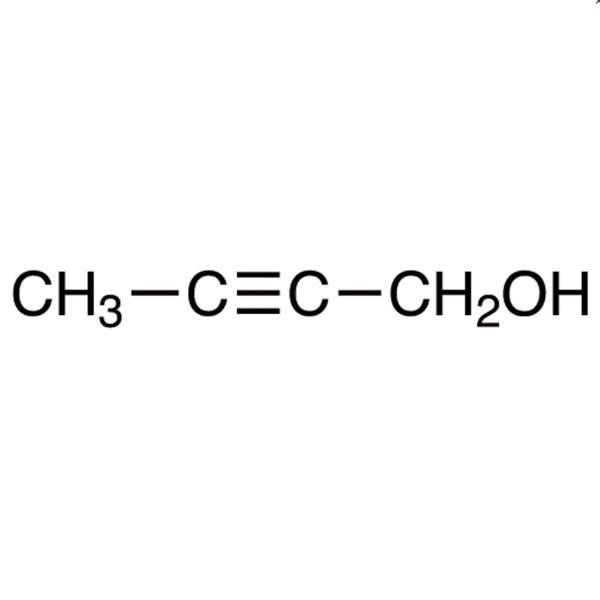

2-Butyn-1-ol is a chemical compound widely used in organic synthesis as a key building block in laboratory settings. This compound features a carbon chain with a hydroxyl group at one end and a triple bond in the middle, making it highly versatile for various chemical reactions. Its structural characteristics allow it to participate in reactions that require chirality or triple bond involvement, making it a valuable tool for chemists. In the lab, it serves as a fundamental component for the synthesis of complex molecules, particularly in the development of heterocyclic compounds and other intricate chemical structures.
The compound is preferred due to its chemical stability under certain conditions and its ability to engage in reactions such as hydration, hydrogenation, and chirality-based processes. It exhibits good solubility in organic solvents like ethyl acetate and ethanol, which simplifies mixing and reaction procedures. These properties make it a reliable and effective reagent for a wide range of chemical experiments, especially in synthetic chemistry applications. Its compatibility with various reaction conditions and solvents further enhances its utility in laboratory environments.
In Indonesian laboratories, 2-Butyn-1-ol is commonly used in scientific research and educational settings, particularly in organic chemistry and compound synthesis. It plays a crucial role in both academic and industrial research, supporting the development of new chemical compounds and materials. Its widespread use reflects its importance in advancing chemical knowledge and practical applications in the field.
- Organic synthesis is a primary application where 2-Butyn-1-ol is used for constructing complex molecules due to its triple bond and hydroxyl group.
- Heterocyclic compound development benefits from the compound's ability to participate in chirality-driven reactions and structural modifications.
- Chemical reaction testing often involves 2-Butyn-1-ol because of its stability and reactivity in various reaction conditions.
- Educational experiments in chemistry use this compound to teach students about molecular structure and synthetic techniques.
- Industrial research applications rely on 2-Butyn-1-ol for the production of specialized chemical products and materials.
| Brand | TCI |
|---|---|
| CAS number | 764-01-2 |
| Molecular formula | — |
| Purity | — |
| Category | Chemistry > Building Blocks > Non-Heterocyclic Building Blocks |
| Pack sizes | Available in various quantities as per standard laboratory supply |
| Physical form | Liquid |
| Storage | Store in a cool, dry place away from light and incompatible materials |
2-Butyn-1-ol should be stored in a cool, dry place away from direct sunlight and sources of heat. It is recommended to use sealed containers made of glass or inert plastic to prevent contamination and evaporation. The compound should be kept away from incompatible substances such as strong oxidizers and acids to avoid chemical reactions. Proper ventilation is essential when handling the material to minimize inhalation of vapors. Laboratory personnel should wear appropriate personal protective equipment, including gloves and safety goggles, when working with this compound. Regular monitoring of storage conditions ensures the compound remains stable and safe for use in laboratory settings.
—
Produk Terkait
-
3-Butyn-2-ol TCI B1001
Regular price From Rp 928.200,00Regular priceRp 648.900,00Sale price From Rp 928.200,00 -
3-Butyn-1-ol TCI B0799
Regular price From Rp 928.200,00Regular priceRp 648.900,00Sale price From Rp 928.200,00 -
2-Methyl-4-phenyl-3-butyn-2-ol TCI M1415
Regular price Rp 1.590.750,00Regular priceRp 1.111.950,00Sale price Rp 1.590.750,00 -
2-Methyl-3-butyn-2-ol TCI M0180
Regular price From Rp 505.050,00Regular priceRp 352.800,00Sale price From Rp 505.050,00 -
3-Butyn-2-one TCI B2393
Regular price From Rp 2.174.550,00Regular priceRp 1.520.400,00Sale price From Rp 2.174.550,00 -
4-Phenyl-3-butyn-2-one TCI P1336
Regular price From Rp 1.326.150,00Regular priceRp 927.150,00Sale price From Rp 1.326.150,00 -
8-Bromo-7-(2-butyn-1-yl)-3-methylxanthine TCI B4454
Regular price Rp 1.458.450,00Regular priceRp 1.035.300,00Sale price Rp 1.458.450,00 -
(S)-(-)-3-Butyn-2-ol TCI B2910
Regular price From Rp 1.961.400,00Regular priceRp 1.371.300,00Sale price From Rp 1.961.400,00


