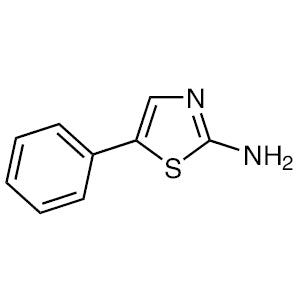
5-Phenylthiazol-2-amine from TCI is a heterocyclic compound built on a thiazole core. It carries a primary amino group at the 2-position and a phenyl ring at the 5-position. Organic and medicinal chemistry laboratories use it as a building block, a starting material for assembling more complex molecules. The 2-aminothiazole scaffold appears often in drug candidates and bioactive compounds. For this reason, researchers often use this material when they design and synthesise new series of derivatives for activity testing.
Researchers choose this compound because it has two reactive sites that work well together. The amino group at the 2-position can be acylated, converted into ureas or thioureas, turned into sulfonamides, or used in C–N coupling reactions to form secondary amines. The phenyl ring at the 5-position adds an aromatic region that affects lipophilicity and how the molecule interacts with biological targets. The thiazole ring is rich in heteroatoms, and together with the aryl substituent it gives a practical starting point for structure–activity relationship studies. Chemists can use it without having to build the thiazole ring from scratch.
In Indonesia, this kind of material is relevant to university pharmacy laboratories and organic synthesis research groups. It also suits medicinal chemistry teams working on new drug candidates. Undergraduate and postgraduate research projects that explore heterocyclic derivatives can use it as a ready-made scaffold. Research institutions that screen compound libraries for biological activity can also benefit from a consistent, well-characterised starting material from an established brand such as TCI.
TCI brochures (PDF)
- Aminothiazole Building Blocks for the Synthesis of Bioactive Compounds 2025-06-26 · p. 1
Related TCI products
- Synthesis of amide derivatives: the primary amino group at the 2-position reacts readily with acylating agents, so researchers can quickly build series of amides for comparative screening.
- Preparation of urea and thiourea analogues: the amine can be converted into ureas or thioureas, which are common motifs when exploring hydrogen-bonding interactions with biological targets.
- Sulfonamide library construction: reacting the amino group with sulfonyl chlorides produces sulfonamide derivatives, extending the range of functional groups available for activity studies.
- C–N coupling to form secondary amines: the amine can be used in C–N coupling reactions, letting chemists attach aryl or other groups to make more elaborate secondary amine structures.
- Structure–activity relationship studies: the ready-made 2-aminothiazole core with a 5-phenyl substituent provides a fixed scaffold, so researchers can vary other positions systematically without building the heterocycle themselves.
| Brand | TCI (product code P2865) |
|---|---|
| CAS number | 39136-63-5 |
| Molecular formula | — |
| Purity | — |
| Category | Chemistry > Building Blocks > Heterocyclic Building Blocks |
| Pack sizes | available in TCI standard pack sizes; please confirm the options when ordering |
| Physical form | refer to the manufacturer's product documentation |
| Storage | follow the conditions on the TCI label and Safety Data Sheet |
Store 5-Phenylthiazol-2-amine in its original, tightly closed container. Keep it in a cool, dry, well-ventilated area, away from direct sunlight, moisture, and incompatible substances such as strong oxidising agents. Always follow the specific storage conditions on the TCI label and Safety Data Sheet. Handle the compound in a fume hood or another well-ventilated workspace. Wear suitable personal protective equipment, including a lab coat, safety glasses, and chemical-resistant gloves. Avoid creating or breathing in dust, and avoid contact with skin and eyes. After use, reseal the container promptly and label it clearly. Dispose of residues and contaminated materials according to institutional and local chemical waste regulations.
—
Produk Terkait
-
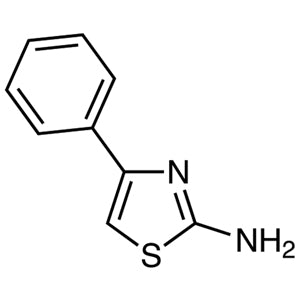
2-Amino-4-phenylthiazole TCI A2846
Regular price From Rp 1.298.850,00Regular price -
2-Phenylthiazole TCI P3197
Regular price From Rp 2.332.050,00Regular price -
4-Phenylthiazole-2(3H)-thione TCI M3790
Regular price From Rp 875.700,00Regular price -
2-Methyl-4-phenylthiazole TCI M2892
Regular price From Rp 1.961.400,00Regular price -
2-Methyl-4,5-diphenylthiazole TCI M1705
Regular price Rp 1.803.900,00Regular price -
3-Methyl-4-phenylthiazoline-2-thione TCI M0355
Regular price Rp 9.223.200,00Regular price -
Ethyl2-Amino-4-phenylthiazole-5-carboxylate TCI E0769
Regular price From Rp 1.298.850,00Regular price -
4,5,6,7-Tetrahydro-1,3-benzothiazol-2-amine TCI T4070
Regular price From Rp 2.995.650,00Regular price