


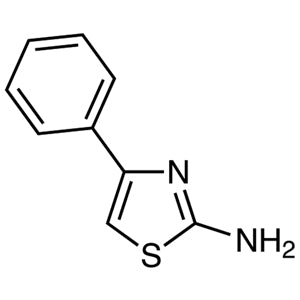
2-Amino-4-phenylthiazole is a heterocyclic compound that plays a crucial role in organic chemistry laboratories. It is widely used as a building block for synthesizing complex molecules with biological activity, including pharmaceuticals and industrial chemicals. Its unique structure, containing both nitrogen and sulfur atoms, makes it an essential component in the development of new compounds. This compound is particularly valuable in research settings where the creation of functionalized molecules is required. Its versatility allows it to be incorporated into a variety of synthetic pathways, making it a key reagent in modern chemical synthesis.
The chemical properties of 2-Amino-4-phenylthiazole make it a preferred choice for many laboratory applications. It exhibits stability under certain conditions, yet remains highly reactive in the presence of elevated temperatures or oxidizing agents. This reactivity enables it to participate in substitution, hydroxylation, and other complex functional group transformations. Its ability to interact with a wide range of reagents and conditions makes it adaptable for various synthetic strategies. The compound’s chemical stability and reactivity are key factors in its widespread use in both academic and industrial research.
In Indonesian laboratories, 2-Amino-4-phenylthiazole is commonly used in pharmaceutical and organic chemistry research. It is a valuable tool for developing new drugs and industrial chemicals due to its structural versatility. Its application spans multiple research areas, including drug discovery and chemical synthesis. As a fundamental building block, it supports the creation of complex molecules with specific biological activities, making it an essential component in many laboratory workflows.
TCI brochures (PDF)
- Aminothiazole Building Blocks for the Synthesis of Bioactive Compounds 2025-06-26 · p. 1
Related TCI products
- Pharmaceutical research utilizes 2-Amino-4-phenylthiazole for synthesizing bioactive compounds due to its structural versatility and reactivity.
- Organic chemistry experiments benefit from this compound as a building block for creating complex heterocyclic structures.
- Industrial chemical development leverages its properties for producing functionalized molecules with specific chemical functionalities.
- Drug discovery projects incorporate it to design new compounds with potential therapeutic applications.
- Analytical chemistry uses it as a reference standard for identifying and quantifying heterocyclic compounds in complex mixtures.
| Brand | TCI |
|---|---|
| CAS number | 2010-06-2 |
| Molecular formula | — |
| Purity | — |
| Category | Chemistry > Building Blocks > Heterocyclic Building Blocks |
| Pack sizes | Available in various quantities as per supplier specifications |
| Physical form | Solid powder |
| Storage | Store in a cool, dry place away from light and incompatible materials |
2-Amino-4-phenylthiazole should be stored in a cool, dry environment, away from direct sunlight and sources of heat. It is recommended to keep the compound in a tightly sealed container to prevent moisture absorption and contamination. Due to its reactivity, it should be handled in a well-ventilated area, preferably under a fume hood. Avoid contact with strong oxidizing agents or high temperatures to maintain its chemical stability. Always use appropriate personal protective equipment, such as gloves and safety goggles, when handling this compound. Proper storage and handling ensure the compound remains effective and safe for use in laboratory applications.
—
Produk Terkait
-
Ethyl2-Amino-4-phenylthiazole-5-carboxylate TCI E0769
Regular price From Rp 1.351.350,00Regular priceRp 960.750,00Sale price From Rp 1.351.350,00 -
2-Phenylthiazole TCI P3197
Regular price From Rp 2.384.550,00Regular priceRp 1.683.150,00Sale price From Rp 2.384.550,00 -
4-Phenylthiazole-2(3H)-thione TCI M3790
Regular price From Rp 928.200,00Regular priceRp 664.650,00Sale price From Rp 928.200,00 -
2-Methyl-4-phenylthiazole TCI M2892
Regular price From Rp 2.013.900,00Regular priceRp 1.423.800,00Sale price From Rp 2.013.900,00 -
5-Phenylthiazol-2-amine TCI P2865
Regular price From Rp 530.250,00Regular priceRp 386.400,00Sale price From Rp 530.250,00 -
2-Methyl-4,5-diphenylthiazole TCI M1705
Regular price Rp 1.856.400,00Regular priceRp 1.313.550,00Sale price Rp 1.856.400,00 -
3-Methyl-4-phenylthiazoline-2-thione TCI M0355
Regular price Rp 9.275.700,00Regular priceRp 6.501.600,00Sale price Rp 9.275.700,00 -
4-Methyl-5-vinylthiazole TCI M1029
Regular price Rp 1.113.000,00Regular priceRp 793.800,00Sale price Rp 1.113.000,00


