

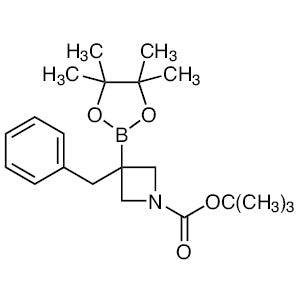
Tert-Butyl 3-Benzyl-3-(4,4,5,5-tetramethyl-1,3,2-dioxaborolan-2-yl)azetidine-1-carboxylate is a complex organic compound widely used in laboratory settings for its versatility in synthetic reactions. This compound serves as a key building block in the synthesis of heterocyclic structures, playing a crucial role in the development of new chemical entities. Its unique molecular structure, featuring both a boronic acid group and a nitrogen-containing heterocycle, makes it highly reactive and suitable for various coupling reactions. In the context of modern chemical research, this compound is essential for creating complex molecules with precise functional groups.
The compound's reactivity is further enhanced by its stable boronic acid functionality, which allows it to participate in a wide range of chemical transformations. Its ability to form stable intermediates in coupling reactions such as Suzuki and Heck makes it a preferred choice for chemists aiming for high-yield syntheses. The presence of the tert-butyl group also contributes to its solubility and stability under various reaction conditions, making it a reliable reagent in both academic and industrial research environments.
In Indonesian laboratories, this compound is commonly used in pharmaceutical and materials science research. Its application extends to the development of new drugs, advanced polymers, and functional materials. Researchers in Indonesia rely on this compound for its reliability, versatility, and compatibility with a variety of synthetic strategies, making it a valuable asset in both academic and industrial chemical research.
Advantages (TCI brochure)
- Small ring (azetidine) building block for chemical space expansion
- Aliphatic boronic ester useful for versatile conversions
TCI brochures (PDF)
- Boronic Acid Esters with Azetidine Moiety 2023-11-28 · p. 1
- Boron Compounds 2025-10-07 · p. 14
Related TCI products
- TCI C3721 2507954-86-9 tert-Butyl 3-(4-Chlorobenzyl)-3-(4,4,5,5-tetramethyl-1,3,2-dioxaborolan-2-yl)azetidine-1-carboxylate
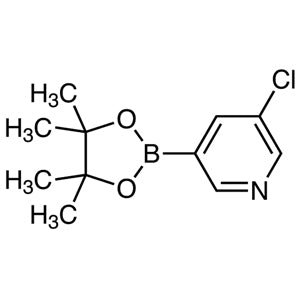
- TCI C3367 865186-94-3 3-Chloro-5-(4,4,5,5-tetramethyl-1,3,2-dioxaborolan-2-yl)pyridine
- TCI M3370 2507954-87-0 tert-Butyl 3-(4-Methylbenzyl)-3-(4,4,5,5-tetramethyl-1,3,2-dioxaborolan-2-yl)azetidine-1-carboxylate
- TCI M3369 2507954-88-1 tert-Butyl 3-(4-Methoxybenzyl)-3-(4,4,5,5-tetramethyl-1,3,2-dioxaborolan-2-yl)azetidine-1-carboxylate
- TCI M3245 883738-27-0 1-Methyl-4-[3-(4,4,5,5-tetramethyl-1,3,2-dioxaborolan-2-yl)benzyl]piperazine
- TCI T4400 942919-26-8 4-(4,4,5,5-Tetramethyl-1,3,2-dioxaborolan-2-yl)-1H-pyrrolo[2,3-b]pyridine
- Pharmaceutical research for the synthesis of complex drug molecules due to its ability to participate in coupling reactions and form stable intermediates.
- Organic chemistry experiments involving heterocyclic compound synthesis because of its unique molecular structure and reactivity.
- Materials science applications in the development of functional polymers and advanced materials due to its compatibility with various synthetic methods.
- Academic research in chemical synthesis where precise control over functional group introduction is required.
- Industrial chemical production for the creation of specialty chemicals requiring high reactivity and stability.
From the TCI brochure
- Drug discovery research
- Starting material for conversions shown in scheme (a)-(e)
| Brand | TCI |
|---|---|
| CAS number | 2296775-60-3 |
| Molecular formula | — |
| Purity | — |
| Category | Chemistry > Building Blocks > Heterocyclic Building Blocks |
| Pack sizes | Available in various quantities as per supplier specifications |
| Physical form | Solid or liquid depending on the specific product variant |
| Storage | Store in a cool, dry place away from moisture and direct sunlight |
This compound should be stored in a cool, dry environment to maintain its chemical stability. It is recommended to keep it in a sealed container to prevent exposure to moisture and air, which can affect its reactivity. Suitable storage containers include glass or high-density polyethylene (HDPE) bottles with tight-fitting lids. In laboratory settings, it should be handled with appropriate personal protective equipment (PPE) such as gloves and safety goggles to ensure safety. Avoid contact with incompatible materials and ensure proper ventilation when working with this compound. Regular monitoring of storage conditions is advised to maintain the integrity of the compound for optimal performance in chemical reactions.
References cited in the TCI brochure
- Taeho Kang. Multifaceted Substrate–Ligand Interactions Promote the Copper-Catalyzed Hydroboration of Benzylidenecyclobutanes and Related Compounds ACS Catalysis, 2020. doi:10.1021/acscatal.0c03622
Produk Terkait
-
tert-Butyl3-(4-Chlorobenzyl)-3-(4,4,5,5-tetramethyl-1,3,2-dioxaborolan-2-yl)azetidine-1-carboxylate TCI C3721
Regular price From Rp 4.001.550,00Regular price -
3-Chloro-5-(4,4,5,5-tetramethyl-1,3,2-dioxaborolan-2-yl)pyridine TCI C3367
Regular price From Rp 795.900,00Regular price -
tert-Butyl3-(4-Methylbenzyl)-3-(4,4,5,5-tetramethyl-1,3,2-dioxaborolan-2-yl)azetidine-1-carboxylate TCI M3370
Regular price From Rp 1.936.200,00Regular price -
tert-Butyl3-(4-Methoxybenzyl)-3-(4,4,5,5-tetramethyl-1,3,2-dioxaborolan-2-yl)azetidine-1-carboxylate TCI M3369
Regular price From Rp 2.227.050,00Regular price -
1-Methyl-4-[3-(4,4,5,5-tetramethyl-1,3,2-dioxaborolan-2-yl)benzyl]piperazine TCI M3245
Regular price From Rp 1.829.100,00Regular price -
4-(4,4,5,5-Tetramethyl-1,3,2-dioxaborolan-2-yl)-1H-pyrrolo[2,3-b]pyridine TCI T4400
Regular price From Rp 3.630.900,00Regular price -
4-(4,4,5,5-Tetramethyl-1,3,2-dioxaborolan-2-yl)isoxazole TCI T4396
Regular price From Rp 2.174.550,00Regular price -
1-(Tetrahydro-2H-pyran-4-yl)-4-(4,4,5,5-tetramethyl-1,3,2-dioxaborolan-2-yl)-1H-pyrazole TCI T3668
Regular price From Rp 769.650,00Regular price



![883738-27-0 1-Methyl-4-[3-(4,4,5,5-tetramethyl-1,3,2-dioxaborolan-2-yl)benzyl]piperazine - AMI Scientific](http://amiscientific.com/cdn/shop/files/TCI2510M3245.jpg?v=1768205872&width=533)
![883738-27-0 1-Methyl-4-[3-(4,4,5,5-tetramethyl-1,3,2-dioxaborolan-2-yl)benzyl]piperazine - AMI Scientific](http://amiscientific.com/cdn/shop/files/TCI2510M3245_a076a757-1c0f-4f19-8e0d-d99f5073b984.jpg?v=1769056954&width=533)
![942919-26-8 4-(4,4,5,5-Tetramethyl-1,3,2-dioxaborolan-2-yl)-1H-pyrrolo[2,3-b]pyridine - AMI Scientific](http://amiscientific.com/cdn/shop/files/TCI2510T4400.jpg?v=1767145178&width=533)

