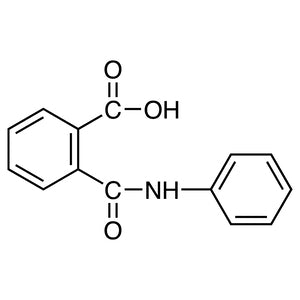
2-(Phenylcarbamoyl)benzoic Acid from TCI, also known as phthalanilic acid, is an aromatic compound with a carboxylic acid group and a phenyl amide group on adjacent positions of a benzene ring. It forms when phthalic anhydride reacts with aniline. In the chemistry laboratory it serves as a non-heterocyclic building block, as an intermediate on the route to N-phenylphthalimide, and as a model compound for studying amide-acid cyclization reactions. This makes it useful in both synthetic and teaching work.
What sets this compound apart is that its two functional groups, a carboxylic acid and a secondary amide, sit right next to each other. This arrangement allows intramolecular dehydration that closes an imide ring. For this reason, the compound is often used as an example in studies of cyclization kinetics and amide hydrolysis. Its carboxylic group can also form salts or esters and can coordinate with metal ions. This gives chemists several ways to modify it from a single starting material. Phthalanilic acid is also known in the literature as a plant growth regulator. That gives it relevance outside pure synthetic chemistry as well.
In Indonesian laboratories, this compound is useful for lecturers and students of organic chemistry who study the reactions of anhydrides and amides, as well as ring-closure chemistry. The 1g and 5g packs suit small-scale synthesis and research. They fit the needs of university teaching laboratories, final-year student projects, and research groups that need a well-characterized model compound without buying large quantities. Supplying TCI material means teams can get consistent reagent quality for repeatable experiments.
Related TCI products
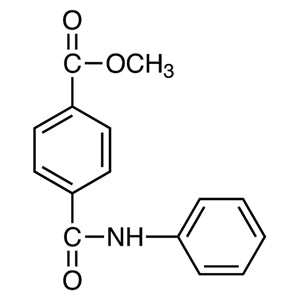
- TCI M2637 3814-10-6 Methyl 4-(Phenylcarbamoyl)benzoate
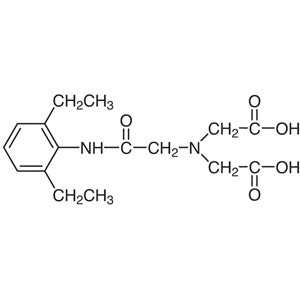
- TCI D1735 63245-28-3 N-(2,6-Diethylphenylcarbamoylmethyl)iminodiacetic Acid
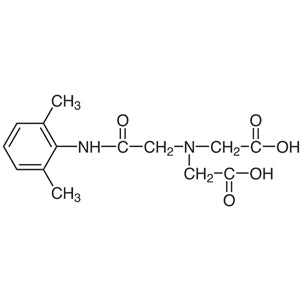
- TCI D1730 59160-29-1 N-(2,6-Dimethylphenylcarbamoylmethyl)iminodiacetic Acid
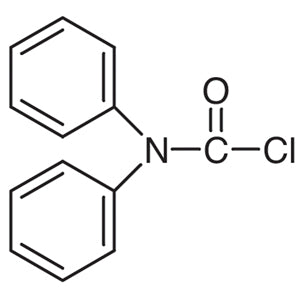
- TCI D0880 83-01-2 Diphenylcarbamoyl Chloride
- TCI T3606 117241-31-3 3,4,5-Tris(dodecyloxy)benzoic Acid
- TCI T3391 21120-65-0 4-(4-Methylphenoxy)benzoic Acid
- Synthesis of N-phenylphthalimide: the adjacent amide and carboxylic acid groups can undergo intramolecular dehydration, so the compound works as a direct intermediate for forming the imide ring.
- Cyclization kinetics studies: its well-defined amide-acid arrangement makes it a common model compound for observing how fast and under what conditions ring closure to an imide happens.
- Amide hydrolysis research: researchers use the compound as an example substrate to study how a neighboring carboxylic acid group influences cleavage of the secondary amide bond.
- Derivatization to salts, esters, and metal complexes: the free carboxylic group can form salts or esters and coordinate with metal ions, which supports varied synthetic and coordination chemistry work.
- Organic chemistry teaching: it forms from phthalic anhydride and aniline, so it clearly demonstrates anhydride and amide reactions for students in practical classes and final-year projects.
| Brand | TCI (product code P2941) |
|---|---|
| CAS number | 4727-29-1 |
| Molecular formula | — |
| Purity | — |
| Category | Chemistry > Building Blocks > Non-Heterocyclic Building Blocks |
| Pack sizes | 1g and 5g |
| Physical form | check the product label and the supplier's certificate of analysis |
| Storage | tightly closed original container, in a cool, dry place, following the TCI label and safety data sheet |
Keep 2-(Phenylcarbamoyl)benzoic Acid in its original, tightly sealed container. Store it in a cool, dry, well-ventilated area away from direct sunlight, moisture, and incompatible substances such as strong oxidizing agents and strong bases. Close the container right after each use so the material does not absorb moisture or become contaminated. Handle the compound with standard laboratory protective equipment, including safety glasses, gloves, and a lab coat. Work in a fume hood or well-ventilated area so you do not inhale dust. Avoid contact with skin and eyes. Always read the TCI safety data sheet before use, and dispose of waste according to your institution's chemical waste procedures.
—
Produk Terkait
-
Methyl4-(Phenylcarbamoyl)benzoate TCI M2637
Regular price Rp 2.332.050,00Regular price -
N-(2,6-Diethylphenylcarbamoylmethyl)iminodiaceticAcid TCI D1735
Regular price Rp 2.199.750,00Regular price -
N-(2,6-Dimethylphenylcarbamoylmethyl)iminodiaceticAcid TCI D1730
Regular price Rp 1.220.100,00Regular price -
DiphenylcarbamoylChloride TCI D0880
Regular price From Rp 610.050,00Regular price -
3,4,5-Tris(dodecyloxy)benzoicAcid TCI T3606
Regular price Rp 3.738.000,00Regular price -
4-(4-Methylphenoxy)benzoicAcid TCI T3391
Regular price From Rp 2.889.600,00Regular price -
2-(p-Tolyl)benzoicAcid TCI T2377
Regular price From Rp 769.650,00Regular price -
3,4,5-Tris(benzyloxy)benzoicAcid TCI T1869
Regular price From Rp 3.260.250,00Regular price