
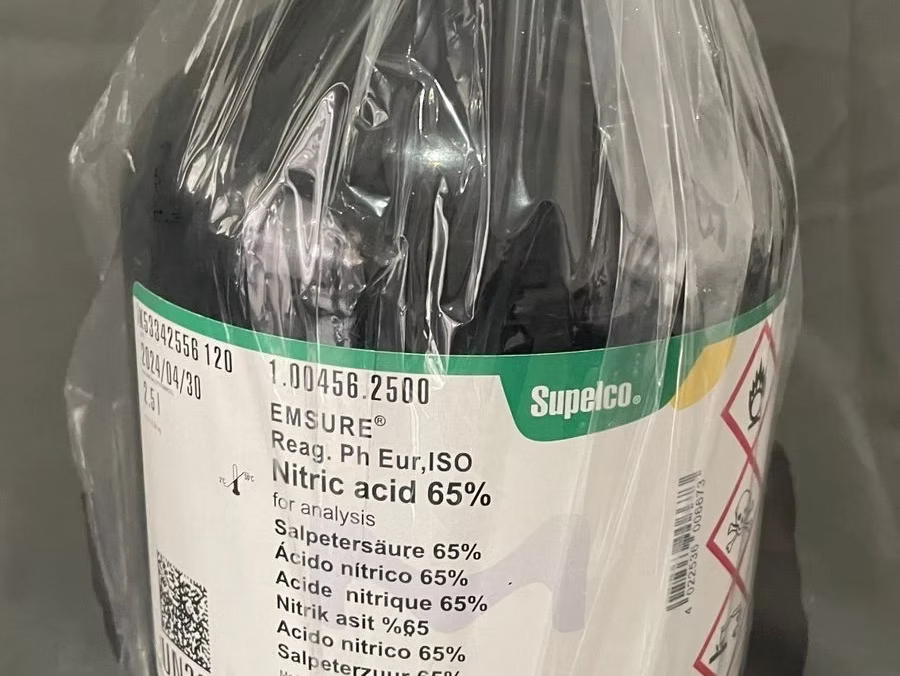
Understanding the Uses of Nitric Acid in Laboratory Testing
UpdatedShare
Nitric Acid: Properties, Structure, and Applications
Nitric acid is a colorless acidic compound with corrosive properties. Why is it corrosive? Because it ionizes completely in water, making it a strong acid. This property can make nitric acid hazardous to humans.
Buy Nitric Acid from AMI Scientific
- Nitric Acid 5 %, CAS 7697-37-2, 2.5 L – Smartlab A-1063A
- Nitric Acid 65 %, CAS 7697-37-2, 2.5 L – Smartlab A-1063B
- Nitric Acid 69-71 %, CAS 7697-37-2, 2.5 L – Smartlab A-1063
- Nitric Acid (67%) (TCI N0806)
See all grades & pack sizes (4 products) → · Ask for a price on WhatsApp
If your skin comes into contact with nitric acid, immediately flush the affected area with running water. Afterward, seek medical attention, especially if you have been exposed to a large amount of nitric acid (acid handling).
So, what is the complete explanation of nitric acid?
What Is Nitric Acid?
Nitric acid is a colorless liquid that may produce yellow fumes and has a pungent odor. Exposure to nitric acid can cause irritation to the eyes, skin, and mucous membranes.
Nitric acid is a highly corrosive substance. Contact with nitric acid can cause chemical burns. It is widely used in the production of fertilizers, dyes, and explosives.
Nitric Acid Structure
Nitric acid contains three oxygen atoms, one nitrogen atom, and one hydrogen atom. In the molecule, one oxygen atom is double-bonded to the central nitrogen atom, while another oxygen atom is single-bonded to both the nitrogen and hydrogen atoms.
The remaining oxygen atom in the nitric acid molecule carries a formal charge of −1 and is single-bonded to the central nitrogen atom. Because the central nitrogen atom is involved in four bonding interactions, it carries a formal charge of +1.
Therefore, the overall charge of the nitric acid molecule is zero. This indicates that the molecule's charge distribution can be described through resonance, in which electrons are delocalized across the structure.
Physical and Chemical Properties of Nitric Acid
a. Physical Properties
Nitric acid may release reddish-brown fumes and appear as a pale yellow liquid. The substance is highly toxic when inhaled and is corrosive to metals and biological tissues.
Other physical characteristics of nitric acid are listed below:
-
Molecular weight / molar mass = 63.01 g/mol
-
Density = 1.51 g/cm³
-
Boiling point = 83°C
-
Melting point = −42°C
-
Density = 1.5 at 77°F (NIOSH, 2023)
-
Vapor pressure = 48 mmHg
-
Relative vapor density = 1:2.2
b. Chemical Properties
Nitric acid is a strong acid that can turn blue litmus paper red. When nitric acid decomposes, it produces brown nitrogen dioxide gas.
Nitric acid reacts with metals above hydrogen in the metal activity series, releasing hydrogen gas.
Advantages of Nitric Acid
Nitric acid offers several advantages over other chemical compounds:
-
During washing, nitric acid helps prevent the formation of colloidal particles.
-
Carbonates do not precipitate alongside silver under acidic conditions.
-
Nitric acid reacts with silver to increase its solubility.
-
Silver chloride is less soluble in dilute nitric acid.
Applications of Nitric Acid
Nitric acid is used in various industrial and laboratory applications, including:
-
Production of ammonium nitrate for fertilizers
-
Plastic manufacturing
-
Dye production
-
Production of explosives, such as nitroglycerin and TNT
-
Preparation of aqua regia
-
Colorimetric testing to distinguish heroin from morphine
-
Chloride testing
-
Use as an oxidizer in liquid rocket propellants
Related Products that AMI Scientific Supply
TCI N0806 7697-37-2 Nitric Acid (67%)
Explore the related category: Synthetic Reagents
AMI Scientific is an official distributor of TCI Japan in Indonesia.
Related products we supply
AMI Scientific is the official distributor of TCI Japan in Indonesia.
