

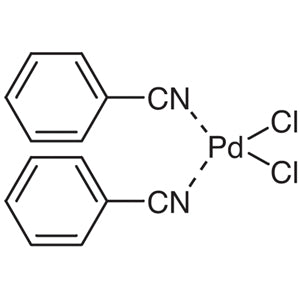
Bis(benzonitrile)palladium(II) dichloride, CAS number 14220-64-5, is a transition metal complex compound widely used in chemistry laboratories as a palladium catalyst precursor. Its structure consists of a palladium atom coordinated with two benzonitrile ligands and two chloride atoms, making it a stable and easy-to-handle source of palladium(II). In the laboratory, its main role is as a catalyst or pre-catalyst in a variety of organic synthesis reactions, particularly cross-coupling reactions and C-H bond activation, which have become the backbone of modern organic chemistry. Researchers rely on this compound to build carbon-carbon and carbon-heteroatom bonds selectively, whether for small-scale research or for the preparation of intermediates in gram quantities.
The main advantage of this compound lies in its air stability and ease of use compared with several other palladium catalysts that are sensitive to air and moisture. This makes it a practical choice for routine laboratory work, where reproducible results and simple handling are essential. The benzonitrile ligands are labile, meaning they readily detach from the metal center when the compound reacts with other ligands or substrates, so the active palladium species can be formed in situ without any additional activation step. This combination of stability and reactivity allows chemists to generate catalytically active palladium conveniently while minimizing the need for specialized apparatus or inert-atmosphere techniques.
In Indonesian laboratories, this compound is typically used in organic synthesis research, where it supports the selective formation of carbon-carbon and carbon-heteroatom bonds across a wide range of reaction types. Academic research groups and industrial R&D facilities alike employ it for both exploratory small-scale studies and the gram-scale preparation of synthetic intermediates. Because it is stable under normal handling conditions, it fits comfortably into standard laboratory workflows without requiring specialized storage infrastructure. Its role as a dependable palladium(II) source makes it a common starting point for catalyst screening and method development in the growing field of C-H activation research in Indonesia.
TCI brochures (PDF)
- C-H Bond Activation Reaction 2025-06-20 · p. 4
- Transition Metal Catalysts 2026-04-10 · p. 14
- Suzuki-Miyaura Cross Coupling Reaction 2025-12-01 · p. 22
Related TCI products
- TCI B2064 95464-05-4 [1,1'-Bis(diphenylphosphino)ferrocene]palladium(II) Dichloride Dichloromethane Adduct
- TCI B2026 40691-33-6 Bis(tri-o-tolylphosphine)palladium(II) Dichloride
- TCI B1667 13965-03-2 Bis(triphenylphosphine)palladium(II) Dichloride
- TCI B2042 14588-08-0 Bis(triphenylphosphine)palladium(II) Diacetate
- TCI P1489 7647-10-1 Palladium(II) Chloride
- TCI B3160 95408-45-0 [1,1'-Bis(di-tert-butylphosphino)ferrocene]palladium(II) Dichloride
- Cross-coupling catalyst precursor: In cross-coupling reactions, the labile benzonitrile ligands are readily displaced by substrates, generating active palladium species in situ for efficient carbon-carbon bond formation.
- C-H activation and functionalization: As a palladium(II) source, this compound enables C-H bond activation, a cornerstone of modern organic chemistry, allowing selective functionalization of otherwise unreactive positions.
- Carbon-heteroatom bond formation: It supports the selective construction of carbon-heteroatom bonds, giving researchers a reliable way to form bonds between carbon and various heteroatom functional groups in organic molecules.
- Small-scale research synthesis: For exploratory studies, its air stability and easy handling make it a convenient choice, letting researchers screen reaction conditions without inert-atmosphere equipment.
- Gram-scale intermediate preparation: When gram quantities of synthetic intermediates are needed, this compound provides a dependable, reproducible source of catalytically active palladium for scaled-up preparations.
| Brand | TCI |
|---|---|
| CAS number | 14220-64-5 |
| Molecular formula | — |
| Purity | — |
| Category | Chemistry > Catalysis and Inorganic Chemistry > C-H Activation [Catalysis] |
| Pack sizes | — |
| Physical form | — |
| Storage | Keep container tightly closed and store in a cool, dry place. |
- Product code: B1668
- Product name: Bis(benzonitrile)palladium(II) Dichloride
Bis(benzonitrile)palladium(II) dichloride is stable in air and can be stored under normal laboratory conditions. Keep the container tightly sealed and store it in a cool, dry place away from direct sunlight, heat sources, and moisture. The original manufacturer's container is the most suitable for routine storage; if repackaging is necessary, use a clean, dry, tightly sealable glass or compatible container. As with all palladium compounds, avoid ingestion, inhalation of dust, and skin contact. Wear appropriate personal protective equipment such as laboratory gloves and safety goggles, and handle the material in a well-ventilated area or fume hood. Keep it away from strong oxidizing or reducing agents and other incompatible chemicals. Dispose of waste and empty containers in accordance with local regulations for metal-containing laboratory waste.
—
Product Categories
- Catalysis and Inorganic ChemistryC-H Activation [Catalysis]Palladium Compounds [C-H Activation]
- Catalysis and Inorganic ChemistryTransition Elements [Catalysis and Inorganic Chemistry]Palladium [Catalysis and Inorganic Chemistry]
- Catalysis and Inorganic ChemistryCross-coupling Reaction using Transition Metal Catalysts [C-C Bond Formation]Palladium Catalysts [Cross-coupling Reaction using Transition Metal Catalysts]
- Synthetic ReagentsC-C Bond Formation [Synthetic Reagents]Cross-coupling Reaction using Transition Metal Catalysts [C-C Bond Formation]
- Synthetic ReagentsC-X(Non-Halogen) Bond Formation [Synthetic Reagents]C-H Bond Activation Reaction [Synthetic Reagents]
Produk Terkait
-
[1,1'-Bis(diphenylphosphino)ferrocene]palladium(II)DichlorideDichloromethaneAdduct TCI B2064
Regular price From Rp 2.068.500,00Regular price -
Bis(tri-o-tolylphosphine)palladium(II)Dichloride TCI B2026
Regular price From Rp 2.068.500,00Regular price -
Bis(triphenylphosphine)palladium(II)Dichloride TCI B1667
Regular price From Rp 1.565.550,00Regular price -
Bis(triphenylphosphine)palladium(II)Diacetate TCI B2042
Regular price From Rp 2.889.600,00Regular price -
Palladium(II)Chloride TCI P1489
Regular price From Rp 3.075.450,00Regular price -
[1,1'-Bis(di-tert-butylphosphino)ferrocene]palladium(II)Dichloride TCI B3160
Regular price From Rp 6.758.850,00Regular price -
Bis(tricyclohexylphosphine)palladium(II)Dichloride TCI B2055
Regular price From Rp 2.147.250,00Regular price -
[1,2-Bis(diphenylphosphino)ethane]palladium(II)Dichloride TCI B2016
Regular price From Rp 2.068.500,00Regular price
![95464-05-4 [1,1'-Bis(diphenylphosphino)ferrocene]palladium(II) Dichloride Dichloromethane Adduct - AMI Scientific](http://amiscientific.com/cdn/shop/files/TCI2510B2064_55725750-1d93-4607-a5e5-5c490594863a.jpg?v=1767330765&width=533)


![95408-45-0 [1,1'-Bis(di-tert-butylphosphino)ferrocene]palladium(II) Dichloride - AMI Scientific](http://amiscientific.com/cdn/shop/files/TCI2510B3160_a4c0b85c-059a-4cb6-9b5d-8c432346ca89.jpg?v=1767431571&width=533)

![19978-61-1 [1,2-Bis(diphenylphosphino)ethane]palladium(II) Dichloride - AMI Scientific](http://amiscientific.com/cdn/shop/files/TCI2510B2016_77a0dd14-0eb1-47eb-bcf6-66bd3ece39ba.jpg?v=1767330348&width=533)