


TCI C1926 O-(6-Chlorobenzotriazol-1-yl)-N,N,N',N'-tetramethyluronium Tetrafluoroborate, commonly known as TCTU, is a uronium/aminium-class coupling reagent designed specifically for amide bond formation in peptide synthesis. The reagent works by activating a carboxylic acid group into an active ester derived from 6-chloro-1-hydroxybenzotriazole, which is then attacked by a free amine group to form the peptide bond. In peptide chemistry and medicinal chemistry laboratories, reagents of this type serve as the backbone of the residue assembly process because they determine the efficiency, speed, and stereochemical purity of the final product.
The property that makes TCTU a widely preferred choice is the presence of the chloro group on the benzotriazole ring. This electron-withdrawing substituent makes the resulting active ester more reactive than its non-chlorinated counterparts, so coupling proceeds faster and reaches completion more thoroughly, including on peptide sequences that are sterically difficult to assemble. This high reactivity also helps suppress racemization, because the activated residue reacts with the amine promptly before it has the opportunity to form an oxazolone intermediate. As a tetrafluoroborate salt, the reagent offers handling characteristics suited to routine synthetic work.
In Indonesian laboratories, TCTU is typically used in university research groups, pharmaceutical research and development units, and peptide chemistry facilities that carry out manual or automated solid-phase synthesis. It is generally selected when a coupling step has failed with a milder reagent, when a difficult sequence requires more aggressive activation, or when stereochemical integrity must be preserved across a long assembly. Analysts commonly pair it with a tertiary amine base in a polar aprotic solvent according to the established protocol for the target sequence.
TCI brochures (PDF)
- Condensing Agents 2025-11-18 · p. 7
- Boron Compounds 2025-10-07 · p. 24
- Amino Acids and Peptide Synthesis Reagents 2025-08-14 · p. 37
Related TCI products
- TCI O0390 125700-71-2 O-[2-Oxo-1(2H)-pyridyl]-N,N,N',N'-tetramethyluronium Tetrafluoroborate
- TCI N0634 125700-73-4 2-(5-Norbornene-2,3-dicarboximido)-1,1,3,3-tetramethyluronium Tetrafluoroborate [Coupling Reagent for Peptide]
- TCI E0916 136849-72-4 O-[(Ethoxycarbonyl)cyanomethylenamino]-N,N,N',N'-tetramethyluronium Tetrafluoroborate
- TCI C1988 330645-87-9 O-(6-Chlorobenzotriazol-1-yl)-N,N,N',N'-tetramethyluronium Hexafluorophosphate
- TCI T2224 105832-38-0 N,N,N',N'-Tetramethyl-O-(N-succinimidyl)uronium Tetrafluoroborate
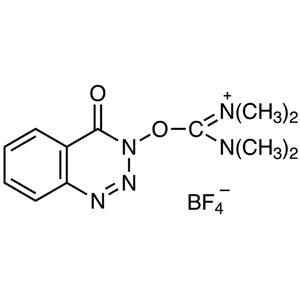
- TCI D3263 125700-69-8 O-(3,4-Dihydro-4-oxo-1,2,3-benzotriazin-3-yl)-N,N,N',N'-tetramethyluronium Tetrafluoroborate
- Solid-phase peptide synthesis (SPPS): the reagent activates the incoming protected amino acid rapidly, allowing each coupling cycle to reach completion before the next deprotection step begins on resin.
- Difficult and sterically hindered sequence coupling: the chlorinated benzotriazole active ester provides the elevated reactivity needed to drive acylation of aggregated or hindered chains to completion.
- Solution-phase amide bond formation: chemists apply the reagent to join carboxylic acid and amine fragments in medicinal chemistry work where a clean, fast condensation is required.
- Peptide fragment condensation: the low racemization tendency makes the reagent suitable for joining pre-assembled segments where stereochemical integrity at the junction residue is critical.
- Method development and coupling optimization studies: researchers use the reagent as a high-reactivity benchmark when comparing activation strategies, reaction times, and epimerization levels across protocols.
| Brand | TCI (Tokyo Chemical Industry) |
|---|---|
| CAS number | 330641-16-2 |
| Molecular formula | — |
| Purity | — |
| Category | Chemistry > Chemical Biology > Peptide Chemistry |
| Pack sizes | available in standard catalogue pack sizes; please confirm the currently listed packaging option |
| Physical form | — |
| Storage | keep in a cool, dry place in a tightly closed container, protected from moisture |
- Product Code: TCI C1926
Store the reagent in a cool, dry area inside a tightly closed original container, protected from moisture and away from incompatible materials. Uronium-type coupling reagents are sensitive to humidity, so the container should be kept sealed and returned to storage promptly after weighing; handling inside a desiccator or a dry environment is recommended for frequently opened stock. Weigh and dispense the material in a fume hood, and use gloves, safety goggles, and a laboratory coat. Avoid inhalation of dust and contact with skin or eyes. Follow the manufacturer's safety data sheet and institutional chemical waste procedures for disposal.
—
Product Categories
Produk Terkait
-
O-[2-Oxo-1(2H)-pyridyl]-N,N,N',N'-tetramethyluroniumTetrafluoroborate TCI O0390
Regular price From Rp 689.850,00Regular price -
2-(5-Norbornene-2,3-dicarboximido)-1,1,3,3-tetramethyluroniumTetrafluoroborate[CouplingReagentforPeptide] TCI N0634
Regular price From Rp 1.618.050,00Regular price -
O-[(Ethoxycarbonyl)cyanomethylenamino]-N,N,N',N'-tetramethyluroniumTetrafluoroborate TCI E0916
Regular price From Rp 637.350,00Regular price -
O-(6-Chlorobenzotriazol-1-yl)-N,N,N',N'-tetramethyluroniumHexafluorophosphate TCI C1988
Regular price Rp 505.050,00Regular price -
N,N,N',N'-Tetramethyl-O-(N-succinimidyl)uroniumTetrafluoroborate TCI T2224
Regular price From Rp 795.900,00Regular price -
O-(3,4-Dihydro-4-oxo-1,2,3-benzotriazin-3-yl)-N,N,N',N'-tetramethyluroniumTetrafluoroborate TCI D3263
Regular price From Rp 1.298.850,00Regular price -
O-(Benzotriazol-1-yl)-N,N,N',N'-bis(tetramethylene)uroniumHexafluorophosphate TCI B4805
Regular price From Rp 1.167.600,00Regular price -
O-[(Ethoxycarbonyl)cyanomethylenamino]-N,N,N',N'-tetramethyluroniumHexafluorophosphate TCI E1306
Regular price From Rp 743.400,00Regular price
![125700-71-2 O-[2-Oxo-1(2H)-pyridyl]-N,N,N',N'-tetramethyluronium Tetrafluoroborate - AMI Scientific](http://amiscientific.com/cdn/shop/files/TCI2510O0390.jpg?v=1768205996&width=533)
![125700-71-2 O-[2-Oxo-1(2H)-pyridyl]-N,N,N',N'-tetramethyluronium Tetrafluoroborate - AMI Scientific](http://amiscientific.com/cdn/shop/files/TCI2510O0390_3e9383cd-7add-42a5-bd61-c2d46aad4cdf.jpg?v=1769057222&width=533)
![125700-73-4 2-(5-Norbornene-2,3-dicarboximido)-1,1,3,3-tetramethyluronium Tetrafluoroborate [Coupling Reagent for Peptide] - AMI Scientific](http://amiscientific.com/cdn/shop/files/TCI2510N0634.jpg?v=1769181097&width=533)
![O-[(Ethoxycarbonyl)cyanomethylenamino]-N,N,N',N'-tetramethyluronium Tetrafluoroborate (CAS 136849-72-4) - TCI E0916 - AMI Scientific](http://amiscientific.com/cdn/shop/files/TCI2510E0916.jpg?v=1768205247&width=533)



![O-[(Ethoxycarbonyl)cyanomethylenamino]-N,N,N',N'-tetramethyluronium Hexafluorophosphate (CAS 333717-40-1) - TCI E1306 - AMI Scientific](http://amiscientific.com/cdn/shop/files/TCI2510E1306.jpg?v=1769180775&width=533)