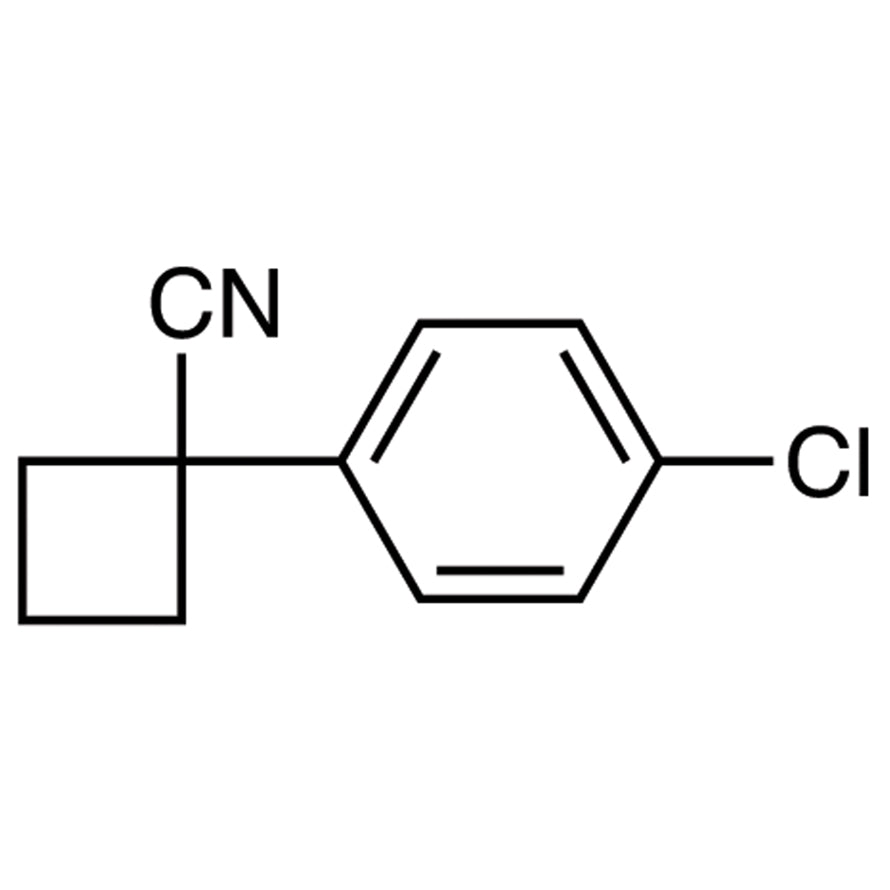
1-(4-Chlorophenyl)cyclobutanecarbonitrile is a nitrile compound that combines a strained cyclobutane ring with both a 4-chlorophenyl group and a cyano group attached to the same quaternary carbon atom. This structural arrangement makes it a valuable starting material in organic synthesis, particularly when researchers require a pre-built substituted cyclobutane framework. Constructing four-membered rings from scratch typically demands specialized conditions and considerable effort, so having this compound available as a building block delivers meaningful time savings and allows attention to focus on subsequent functional group transformations.
The property that makes this compound widely selected is the versatility of the nitrile group as a synthetic branching point. The cyano group can be reduced to primary amines, hydrolyzed to carboxylic acids or amides, or subjected to organometallic reagent addition to produce ketones. Because this functional group is attached to the quaternary carbon of the cyclobutane ring, the resulting derivative products inherit a rigid framework that restricts conformational flexibility—a characteristic highly valued in modern drug molecule design where precise three-dimensional geometry matters.
In Indonesian laboratory settings, this TCI building block serves medicinal chemistry research groups, academic organic synthesis laboratories, and pharmaceutical development teams working on novel molecular entities. Researchers typically employ it when designing synthetic routes that require cyclobutane-containing intermediates or when exploring structure-activity relationships in drug discovery projects. The compound's availability through established chemical suppliers supports ongoing research programs across university chemistry departments and industrial research facilities throughout Indonesia.
Related TCI products
- TCI C3911 4426-11-3 Cyclobutanecarbonitrile
- TCI A3039 103646-82-8 5-Amino-1-(p-tolyl)pyrazole-4-carbonitrile
- TCI P2252 14377-68-5 1-Phenylcyclobutanecarbonitrile
- TCI C4103 24973-49-7 [1,1'-Biphenyl]-2-carbonitrile
- TCI B6956 690260-67-4 2'-Bromo-[1,1'-biphenyl]-3-carbonitrile
- TCI B5965 160521-46-0 3'-Bromo[1,1'-biphenyl]-4-carbonitrile
- Medicinal chemistry synthesis: provides pre-built cyclobutane scaffolds for drug candidate development, eliminating the need to construct strained four-membered rings from simpler precursors
- Functional group transformation studies: the nitrile moiety enables multiple downstream reactions including reduction, hydrolysis, and organometallic addition for diverse derivative generation
- Structure-activity relationship research: the rigid cyclobutane framework restricts molecular conformation, allowing systematic investigation of three-dimensional geometry effects on biological activity
- Organic methodology development: serves as a model substrate for testing new synthetic procedures involving nitrile chemistry or cyclobutane ring functionalization strategies
- Academic teaching and demonstration: illustrates principles of strained ring chemistry, quaternary carbon center reactivity, and nitrile group versatility in advanced organic chemistry courses
| Brand | TCI (Tokyo Chemical Industry) |
|---|---|
| CAS number | 28049-61-8 |
| Molecular formula | — |
| Purity | — |
| Category | Chemistry > Building Blocks > Non-Heterocyclic Building Blocks |
| Pack sizes | — |
| Physical form | Solid (typical for this compound class) |
| Storage | — |
- Product Code: C3161
- Chemical Name: 1-(4-Chlorophenyl)cyclobutanecarbonitrile
Store in a cool, dry location away from direct sunlight and heat sources. Keep the container tightly sealed when not in use to prevent moisture absorption and contamination. Standard laboratory glass bottles or original manufacturer packaging are suitable storage vessels. Handle with appropriate personal protective equipment including gloves and safety glasses. Work in a well-ventilated area or fume hood when handling the material. Follow standard laboratory safety protocols for nitrile compounds and aromatic halides. Dispose of waste according to institutional chemical waste management procedures.
—
Produk Terkait
-
Cyclobutanecarbonitrile TCI C3911
Regular price From Rp 1.458.450,00Regular price -
5-Amino-1-(p-tolyl)pyrazole-4-carbonitrile TCI A3039
Regular price Rp 3.312.750,00Regular price -
1-Phenylcyclobutanecarbonitrile TCI P2252
Regular price From Rp 1.378.650,00Regular price -
[1,1'-Biphenyl]-2-carbonitrile TCI C4103
Regular price From Rp 2.094.750,00Regular price -
2'-Bromo-[1,1'-biphenyl]-3-carbonitrile TCI B6956
Regular price From Rp 2.757.300,00Regular price -
3'-Bromo[1,1'-biphenyl]-4-carbonitrile TCI B5965
Regular price From Rp 2.359.350,00Regular price -
3'-Bromo[1,1'-biphenyl]-3-carbonitrile TCI B5964
Regular price From Rp 2.094.750,00Regular price -
5-Methylthiophene-2-carbonitrile TCI M2959
Regular price Rp 1.749.300,00Regular price


![[1,1'-Biphenyl]-2-carbonitrile (CAS 24973-49-7) - TCI C4103 - AMI Scientific](http://amiscientific.com/cdn/shop/files/TCI2510C4103.jpg?v=1769180472&width=533)
![2'-Bromo-[1,1'-biphenyl]-3-carbonitrile (CAS 690260-67-4) - TCI B6956 - AMI Scientific](http://amiscientific.com/cdn/shop/files/TCI2510B6956.jpg?v=1771058291&width=533)
![3'-Bromo[1,1'-biphenyl]-4-carbonitrile (CAS 160521-46-0) - TCI B5965 - AMI Scientific](http://amiscientific.com/cdn/shop/files/TCI2510B5965.jpg?v=1769180247&width=533)
![3'-Bromo[1,1'-biphenyl]-3-carbonitrile (CAS 1040141-34-1) - TCI B5964 - AMI Scientific](http://amiscientific.com/cdn/shop/files/TCI2510B5964.jpg?v=1769144661&width=533)