


2-(9H-Carbazol-9-yl)phenylboronic Acid is a chemical compound widely used in laboratory settings for its role in organometallic reactions and the synthesis of complex molecular structures. This reagent is particularly valued for its ability to participate in various chemical transformations, especially in catalytic processes that require precise control over reaction conditions. Its unique structure, combining a boronic acid group with a carbazole ring, makes it a versatile tool for chemists working on advanced synthetic pathways.
The compound’s reactivity and specificity are enhanced by its molecular composition, which allows it to interact effectively in a range of chemical environments. Its stability under certain conditions, combined with its sensitivity to moisture and oxidation, requires careful handling to maintain its effectiveness. The presence of varying amounts of anhydride further influences its reactivity, making it a material that demands attention to storage and application protocols. These characteristics make it a reliable choice for researchers aiming to achieve high precision in their experiments.
In Indonesian laboratories, this compound is commonly used in organic chemistry research, especially in the development of new compounds and molecular modifications. Its availability and consistent quality make it a preferred option for both academic and industrial research institutions. The compound is particularly useful in applications that require controlled chemical reactions, such as the Suzuki reaction, which is crucial in the synthesis of aromatic and heterocyclic compounds.
TCI brochures (PDF)
- Building Blocks for Organic Semiconductor 2026-03-24 · p. 20
Related TCI products
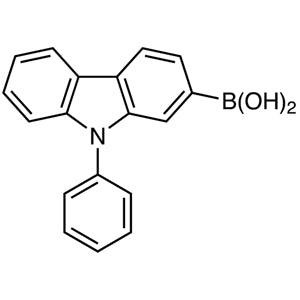
- TCI P2169 1001911-63-2 9-Phenylcarbazole-2-boronic Acid (contains varying amounts of Anhydride)
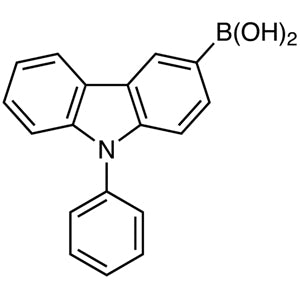
- TCI P2001 854952-58-2 9-Phenylcarbazole-3-boronic Acid (contains varying amounts of Anhydride)
- TCI N1098 1133057-98-3 [9-(Naphthalen-2-yl)-9H-carbazol-3-yl]boronic Acid (contains varying amounts of Anhydride)
- TCI E1153 669072-93-9 9-Ethylcarbazole-3-boronic Acid (contains varying amounts of Anhydride)
- TCI C3353 858131-73-4 [4'-(Carbazol-9-yl)-4-biphenylyl]boronic Acid (contains varying amounts of Anhydride)
- TCI C2967 864377-33-3 3-(9H-Carbazol-9-yl)phenylboronic Acid (contains varying amounts of Anhydride)
- Suzuki Reaction for the synthesis of aromatic and heterocyclic compounds due to its reactivity and compatibility with palladium catalysts.
- Organic synthesis of complex molecules requiring precise control over reaction conditions and functional group transformations.
- Development of new pharmaceutical compounds through targeted molecular modifications and structural alterations.
- Research in catalytic processes where boronic acid derivatives play a key role in cross-coupling reactions.
- Investigation of chemical stability and reactivity under varying environmental conditions for academic and industrial studies.
| Brand | TCI |
|---|---|
| CAS number | 1189047-28-6 |
| Molecular formula | — |
| Purity | — |
| Category | Chemistry > Organometallic Reagents > Organoboron [Organometallic Reagents] |
| Pack sizes | 25g, 100g |
| Physical form | Solid powder |
| Storage | Keep in a dry, cool place away from moisture and oxidizing agents |
This compound should be stored in a dry, cool environment to prevent moisture-induced degradation and oxidation. It is recommended to use airtight containers made of glass or high-density polyethylene to maintain its chemical integrity. Due to its sensitivity to humidity, it should be handled in a controlled laboratory setting with appropriate ventilation. Avoid exposure to light and heat to preserve its reactivity. Always use appropriate personal protective equipment when handling this material to ensure safety during experiments. Proper storage and handling are essential to maintain its effectiveness in chemical reactions.
—
Produk Terkait
-
9-Phenylcarbazole-2-boronicAcid(containsvaryingamountsofAnhydride) TCI P2169
Regular price Rp 530.250,00Regular priceRp 386.400,00Sale price Rp 530.250,00 -
9-Phenylcarbazole-3-boronicAcid(containsvaryingamountsofAnhydride) TCI P2001
Regular price Rp 1.723.050,00Regular priceRp 1.220.100,00Sale price Rp 1.723.050,00 -
[9-(Naphthalen-2-yl)-9H-carbazol-3-yl]boronicAcid(containsvaryingamountsofAnhydride) TCI N1098
Regular price Rp 4.081.350,00Regular priceRp 2.869.650,00Sale price Rp 4.081.350,00 -
9-Ethylcarbazole-3-boronicAcid(containsvaryingamountsofAnhydride) TCI E1153
Regular price Rp 2.173.500,00Regular priceRp 1.535.100,00Sale price Rp 2.173.500,00 -
[4'-(Carbazol-9-yl)-4-biphenylyl]boronicAcid(containsvaryingamountsofAnhydride) TCI C3353
Regular price From Rp 955.500,00Regular price -
3-(9H-Carbazol-9-yl)phenylboronicAcid(containsvaryingamountsofAnhydride) TCI C2967
Regular price From Rp 1.246.350,00Regular price -
4-(9H-Carbazol-9-yl)phenylboronicAcid(containsvaryingamountsofAnhydride) TCI C2926
Regular price From Rp 1.485.750,00Regular price -
Thieno[3,2-b]thiophene-2-boronicAcid(containsvaryingamountsofAnhydride) TCI T2621
Regular price Rp 5.883.150,00Regular priceRp 4.129.650,00Sale price Rp 5.883.150,00
![1133057-98-3 [9-(Naphthalen-2-yl)-9H-carbazol-3-yl]boronic Acid (contains varying amounts of Anhydride) - AMI Scientific](http://amiscientific.com/cdn/shop/files/TCI2510N1098.jpg?v=1769143156&width=533)

![[4'-(Carbazol-9-yl)-4-biphenylyl]boronic Acid (contains varying amounts of Anhydride) (CAS 858131-73-4) - TCI C3353 - AMI Scientific](http://amiscientific.com/cdn/shop/files/TCI2510C3353.jpg?v=1768204763&width=533)


![160032-40-6 Thieno[3,2-b]thiophene-2-boronic Acid (contains varying amounts of Anhydride) - AMI Scientific](http://amiscientific.com/cdn/shop/files/TCI2510T2621.jpg?v=1768206488&width=533)