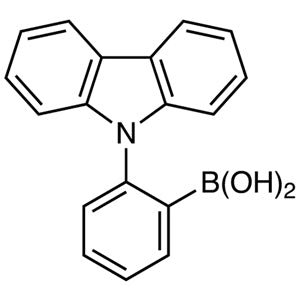
4-(9H-Carbazol-9-yl)phenylboronic Acid is a chemical compound widely used as a building block in the synthesis of complex organic molecules. This compound features a heterocyclic structure, combining a carbazole ring with a phenyl ring connected via a boronic acid group. Its unique molecular structure makes it a valuable resource for chemists working on the development of new compounds with specific biological activities. In laboratory settings, it plays a crucial role in synthetic chemistry, particularly in the creation of advanced pharmaceutical and material science applications.
The compound is favored for its stability and reactivity in various chemical reactions, especially those involving boron-based coupling reactions such as the Suzuki and Negishi reactions. These reactions are essential in the synthesis of complex organic structures, making this compound a preferred choice for researchers aiming to create functional molecules. Its ability to form stable bonds with different ligands enhances its versatility in synthetic applications, allowing for the design of compounds with tailored properties.
In Indonesian laboratories, this compound is commonly used in organic chemistry research, particularly in the fields of pharmaceutical development and advanced material synthesis. Its structural complexity and chemical versatility make it an essential tool for scientists working on innovative projects. Due to its high reactivity and adaptability, it is a key component in the pursuit of new compounds with specific biological or functional properties.
TCI brochures (PDF)
- Carbazoles 2025-06-27 · p. 5
- Boron Compounds 2025-10-07 · p. 6
- Building Blocks for Organic Semiconductor 2026-03-24 · p. 19
Related TCI products
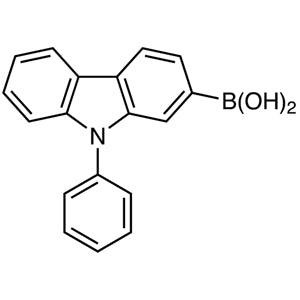
- TCI P2169 1001911-63-2 9-Phenylcarbazole-2-boronic Acid (contains varying amounts of Anhydride)
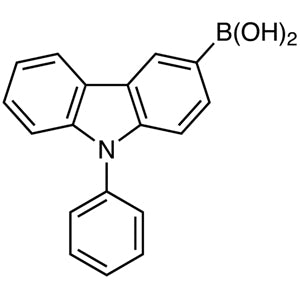
- TCI P2001 854952-58-2 9-Phenylcarbazole-3-boronic Acid (contains varying amounts of Anhydride)
- TCI C2967 864377-33-3 3-(9H-Carbazol-9-yl)phenylboronic Acid (contains varying amounts of Anhydride)
- TCI N1098 1133057-98-3 [9-(Naphthalen-2-yl)-9H-carbazol-3-yl]boronic Acid (contains varying amounts of Anhydride)
- TCI F0549 4347-33-5 5-Formyl-2-thiopheneboronic Acid (contains varying amounts of Anhydride)
- TCI E1153 669072-93-9 9-Ethylcarbazole-3-boronic Acid (contains varying amounts of Anhydride)
- Organic synthesis for the development of pharmaceutical compounds due to its reactivity in boron-based coupling reactions.
- Creation of advanced materials through the formation of complex molecular structures with high functional specificity.
- Research in medicinal chemistry for the design of bioactive molecules with targeted biological effects.
- Synthesis of heterocyclic compounds, leveraging its unique carbazole and phenyl ring structure.
- Use in academic and industrial research settings for the exploration of new chemical functionalities and applications.
| Brand | TCI |
|---|---|
| CAS number | 419536-33-7 |
| Molecular formula | — |
| Purity | — |
| Category | Chemistry > Building Blocks > Heterocyclic Building Blocks |
| Pack sizes | Available in various quantities as per supplier specifications |
| Physical form | Solid powder |
| Storage | Store in a cool, dry place away from moisture and direct sunlight |
This compound should be stored in a cool, dry environment to maintain its chemical stability. It is recommended to keep it in a sealed container to prevent exposure to moisture and air, which could affect its reactivity. Due to its potential reactivity, it should be handled in a well-ventilated laboratory setting, using appropriate personal protective equipment such as gloves and safety goggles. Avoid contact with incompatible substances, and ensure proper disposal procedures are followed in accordance with local regulations. Regular monitoring of storage conditions is advised to ensure the compound remains in optimal condition for use in laboratory applications.
—
Product Categories
Produk Terkait
-
9-Phenylcarbazole-2-boronicAcid(containsvaryingamountsofAnhydride) TCI P2169
Regular price From Rp 477.750,00Regular price -
9-Phenylcarbazole-3-boronicAcid(containsvaryingamountsofAnhydride) TCI P2001
Regular price From Rp 1.670.550,00Regular price -
3-(9H-Carbazol-9-yl)phenylboronicAcid(containsvaryingamountsofAnhydride) TCI C2967
Regular price From Rp 1.246.350,00Regular price -
[9-(Naphthalen-2-yl)-9H-carbazol-3-yl]boronicAcid(containsvaryingamountsofAnhydride) TCI N1098
Regular price Rp 4.028.850,00Regular price -
5-Formyl-2-thiopheneboronicAcid(containsvaryingamountsofAnhydride) TCI F0549
Regular price From Rp 823.200,00Regular price -
9-Ethylcarbazole-3-boronicAcid(containsvaryingamountsofAnhydride) TCI E1153
Regular price From Rp 2.121.000,00Regular price -
[4'-(Carbazol-9-yl)-4-biphenylyl]boronicAcid(containsvaryingamountsofAnhydride) TCI C3353
Regular price From Rp 955.500,00Regular price -
2-(9H-Carbazol-9-yl)phenylboronicAcid(containsvaryingamountsofAnhydride) TCI C3352
Regular price Rp 4.743.900,00Regular price

![1133057-98-3 [9-(Naphthalen-2-yl)-9H-carbazol-3-yl]boronic Acid (contains varying amounts of Anhydride) - AMI Scientific](http://amiscientific.com/cdn/shop/files/TCI2510N1098.jpg?v=1769143156&width=533)


![[4'-(Carbazol-9-yl)-4-biphenylyl]boronic Acid (contains varying amounts of Anhydride) (CAS 858131-73-4) - TCI C3353 - AMI Scientific](http://amiscientific.com/cdn/shop/files/TCI2510C3353.jpg?v=1768204763&width=533)