

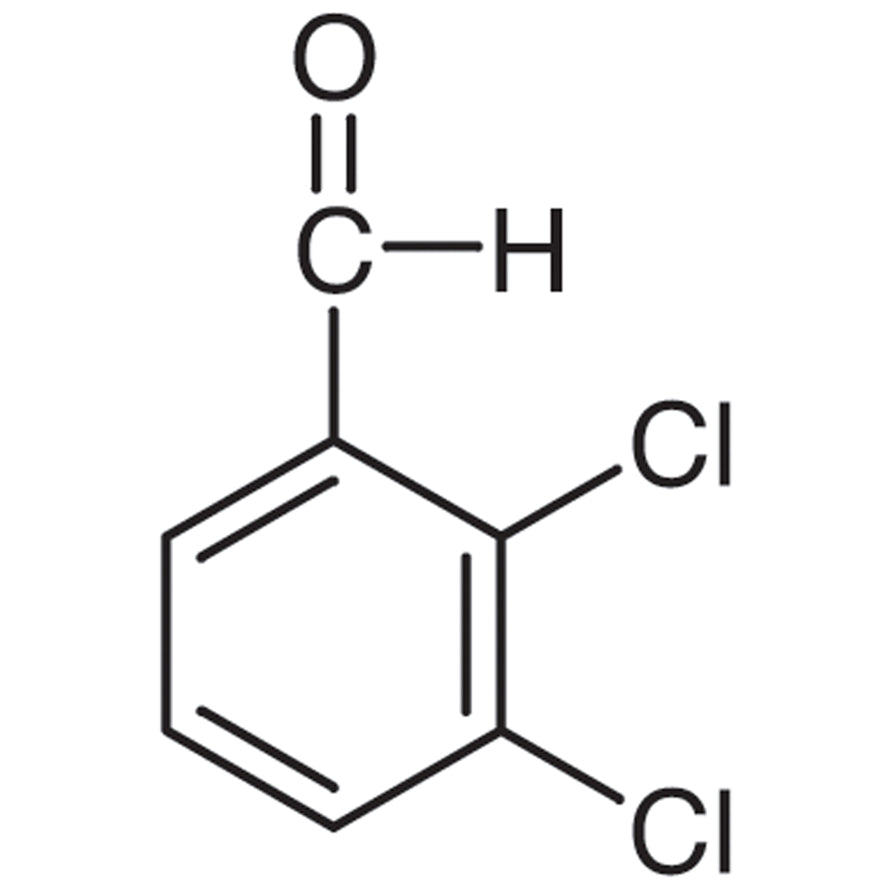
2,3-Dichlorobenzaldehyde (TCI D1666) is a chemical compound widely used in organic laboratory reactions. As a fundamental building block in chemistry, it plays a crucial role in the synthesis of aromatic and heterocyclic compounds. Its aldehyde functional group provides high reactivity, making it an essential component in substitution and oxidation reactions. This compound is particularly valued for its ability to participate in a variety of chemical transformations, supporting both academic and industrial research. Its versatility and chemical stability make it a reliable choice for chemists working in diverse experimental setups.
The compound’s chemical properties, including its polarity and reactivity, make it a preferred choice for organic synthesis. The presence of two chlorine atoms at positions 2 and 3 enhances its reactivity and allows for efficient substitution reactions. Its stability under various reaction conditions ensures consistent results, which is critical in laboratory research. Additionally, its availability in multiple packaging formats simplifies handling and storage, making it accessible for routine and specialized applications. These attributes contribute to its widespread use in both research and development settings.
In Indonesian laboratories, 2,3-Dichlorobenzaldehyde is commonly used in pure chemical research and industrial applications. Educational and research institutions frequently employ this compound for the development of new substances, catalyst testing, and drug synthesis. Its availability through AMI Scientific ensures that local researchers have reliable access to this essential chemical for their experiments and projects. The compound’s role in laboratory work is integral to advancing chemical knowledge and innovation in the region.
- Aromatic Compound Synthesis: 2,3-Dichlorobenzaldehyde is ideal for synthesizing aromatic compounds due to its reactive aldehyde group and chlorinated structure, enabling efficient substitution reactions.
- Heterocyclic Compound Development: Its chlorinated aromatic ring makes it suitable for creating heterocyclic compounds, which are essential in pharmaceutical and organic chemistry research.
- Oxidation Reactions: The aldehyde functional group allows it to participate in oxidation processes, making it valuable in reactions that require controlled oxidation conditions.
- Catalyst Testing: Its chemical stability and reactivity make it a useful material for evaluating the performance of various catalysts in organic reactions.
- Drug Synthesis: The compound is frequently used in the synthesis of pharmaceutical compounds due to its ability to form complex molecular structures through substitution and condensation reactions.
| Brand | TCI |
|---|---|
| CAS number | 6334-18-5 |
| Molecular formula | — |
| Purity | — |
| Category | Chemistry > Building Blocks > Non-Heterocyclic Building Blocks |
| Pack sizes | Available in various packaging formats for laboratory use |
| Physical form | Solid or liquid, depending on the specific product variant |
| Storage | Store in a cool, dry place away from light and moisture |
2,3-Dichlorobenzaldehyde should be stored in a cool, dry place away from direct light and moisture to maintain its chemical stability. It is recommended to use airtight containers made of materials compatible with its chemical nature, such as glass or high-density polyethylene. In laboratory settings, it is important to handle the compound with appropriate personal protective equipment, including gloves and safety goggles, to prevent skin or eye contact. Due to its reactivity, it should be kept away from incompatible substances such as strong bases or reducing agents. Proper ventilation is also essential when working with this compound to minimize exposure to vapors. Following these storage and handling guidelines ensures the safety of laboratory personnel and the integrity of the compound during experiments.
—
Produk Terkait
-
2,5-Dichlorobenzaldehyde TCI D2814
Regular price Rp 1.856.400,00Regular price -
3,5-Dichlorobenzaldehyde TCI D2012
Regular price From Rp 903.000,00Regular price -
3,4-Dichlorobenzaldehyde TCI D0332
Regular price From Rp 1.724.100,00Regular price -
2,6-Dichlorobenzaldehyde TCI D0331
Regular price From Rp 875.700,00Regular price -
2,4-Dichlorobenzaldehyde TCI D0330
Regular price From Rp 610.050,00Regular price


