

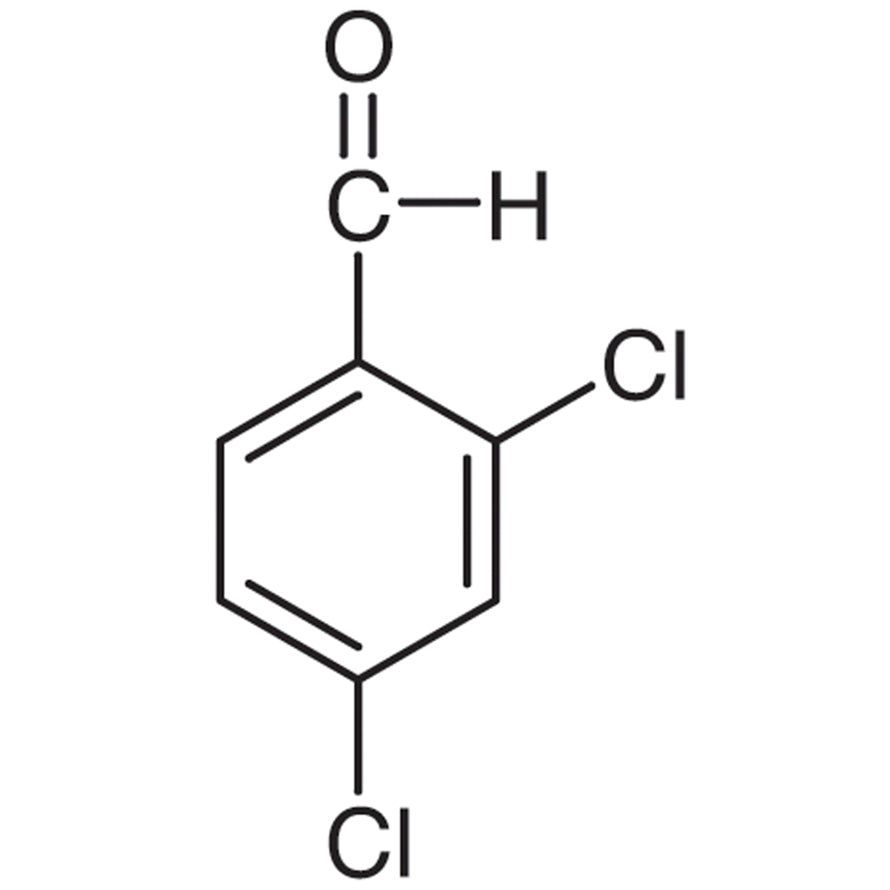
2,4-Dichlorobenzaldehyde is a versatile organic compound widely used in laboratory settings for its reactivity and structural adaptability. As an aromatic aldehyde, it serves as a key building block in synthetic chemistry, enabling the creation of complex molecules through various chemical reactions. Its presence in the category of non-heterocyclic building blocks highlights its fundamental role in organic synthesis, particularly in the development of pharmaceuticals and industrial chemicals. This compound is valued for its ability to participate in multiple reaction types, making it a staple in both academic and industrial research environments.
The compound’s unique properties, including the presence of two chlorine atoms on the benzene ring, contribute to its reactivity and functional versatility. These chlorine substituents alter the electronic environment of the molecule, enhancing its ability to undergo substitution, reduction, and coupling reactions. The stability of its molecular structure allows for predictable chemical behavior, which is essential for reproducible experimental results. Its solid form and ease of handling further support its widespread use in laboratory applications, ensuring accessibility and reliability for researchers.
In Indonesian laboratories, 2,4-Dichlorobenzaldehyde is commonly employed in chemical research, including the synthesis of pharmaceutical compounds, industrial intermediates, and studies on aromatic reactivity. Its availability and chemical properties make it a preferred choice for both basic and advanced chemical investigations. Researchers in Indonesia rely on this compound for its consistent performance and adaptability in diverse synthetic pathways.
- Synthesis of pharmaceutical compounds due to its reactivity and structural versatility for drug development.
- Industrial chemical production as a key intermediate in the manufacture of various chemical products.
- Aromatic reactivity studies to understand substitution and coupling mechanisms in organic chemistry.
- Organic synthesis of heterocyclic compounds through functional group transformations and derivatization.
- Research in chemical engineering for the development of new materials and chemical processes.
| Brand | TCI |
|---|---|
| CAS number | 874-42-0 |
| Molecular formula | — |
| Purity | — |
| Category | Chemistry > Building Blocks > Non-Heterocyclic Building Blocks |
| Pack sizes | Available in standard laboratory quantities as per supplier specifications. |
| Physical form | Solid, typically in crystalline or powder form. |
| Storage | Store in a cool, dry place away from light and moisture. |
2,4-Dichlorobenzaldehyde should be stored in a cool, dry environment to maintain its chemical integrity and prevent degradation. It is recommended to keep the compound in airtight containers to minimize exposure to moisture and air, which can affect its stability. Due to its reactivity, it should be handled in a well-ventilated area, and appropriate personal protective equipment, such as gloves and goggles, should be worn. Avoid direct contact with skin and eyes, and ensure proper disposal according to local regulations. The compound is generally stable under normal laboratory conditions but should be kept away from incompatible substances to ensure safety.
—
Produk Terkait
-
2,5-Dichlorobenzaldehyde TCI D2814
Regular price Rp 1.856.400,00Regular price -
3,5-Dichlorobenzaldehyde TCI D2012
Regular price From Rp 903.000,00Regular price -
2,3-Dichlorobenzaldehyde TCI D1666
Regular price Rp 769.650,00Regular price -
3,4-Dichlorobenzaldehyde TCI D0332
Regular price From Rp 1.724.100,00Regular price -
2,6-Dichlorobenzaldehyde TCI D0331
Regular price From Rp 875.700,00Regular price


