

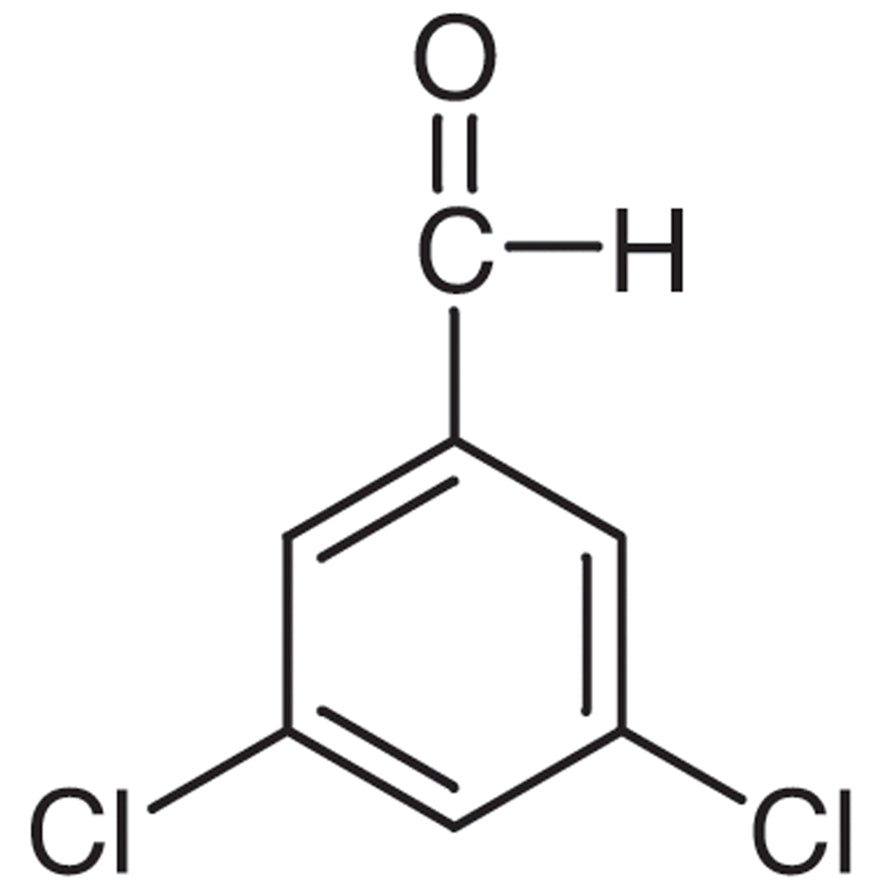
3,5-Dichlorobenzaldehyde is a versatile organic compound widely used in laboratory settings for its reactivity and structural versatility. As a key building block in synthetic chemistry, it plays a crucial role in the development of complex molecular structures. This compound is commonly employed in the synthesis of aromatic and heterocyclic compounds, making it an essential tool for chemists working in research and development. Its ability to participate in various chemical reactions, such as electrophilic substitution and oxidation, enhances its utility across multiple applications.
The chemical properties of 3,5-Dichlorobenzaldehyde make it a preferred choice in laboratory environments. Its aromatic structure, combined with two chlorine atoms at positions 3 and 5, provides strong electron-withdrawing effects, facilitating efficient chemical reactions. The compound exhibits good solubility in organic solvents like ethyl acetate and chloroform, which simplifies its use in various synthetic procedures. Additionally, its high melting point ensures stability during storage and handling, making it suitable for a wide range of experimental conditions.
In Indonesian laboratories, 3,5-Dichlorobenzaldehyde is frequently used in organic chemistry research, particularly in pharmaceutical and chemical industries. It is also integral to educational and research projects focused on the synthesis of complex compounds. Due to its availability and reliability, it remains a valuable resource for both academic and industrial applications.
- Organic synthesis applications benefit from 3,5-Dichlorobenzaldehyde’s reactivity and structural versatility, enabling the creation of complex aromatic and heterocyclic compounds.
- Pharmaceutical research utilizes this compound as a precursor for developing new drugs, leveraging its ability to participate in electrophilic substitution reactions.
- Educational laboratories use 3,5-Dichlorobenzaldehyde for teaching fundamental organic chemistry concepts, including functional group transformations and reaction mechanisms.
- Industrial chemical processes incorporate this compound due to its stability and solubility in organic solvents, supporting large-scale synthesis operations.
- Research projects in synthetic chemistry rely on 3,5-Dichlorobenzaldehyde for its role in constructing diverse molecular frameworks through oxidation and substitution reactions.
| Brand | TCI |
|---|---|
| CAS number | 10203-08-4 |
| Molecular formula | — |
| Purity | — |
| Category | Chemistry > Building Blocks > Non-Heterocyclic Building Blocks |
| Pack sizes | — |
| Physical form | — |
| Storage | Store in a cool, dry place away from light |
3,5-Dichlorobenzaldehyde should be stored in a cool, dry place away from direct sunlight to maintain its chemical integrity. It is recommended to use airtight containers to prevent moisture absorption and contamination. Due to its reactivity, it should be handled in a well-ventilated area, and appropriate personal protective equipment such as gloves and safety goggles should be worn. Avoid contact with incompatible substances, and ensure proper disposal according to local regulations. Regular monitoring of storage conditions is advised to ensure the compound remains stable and safe for use in laboratory settings.
—
Produk Terkait
-
2,5-Dichlorobenzaldehyde TCI D2814
Regular price Rp 1.856.400,00Regular price -
2,3-Dichlorobenzaldehyde TCI D1666
Regular price Rp 769.650,00Regular price -
3,4-Dichlorobenzaldehyde TCI D0332
Regular price From Rp 1.724.100,00Regular price -
2,6-Dichlorobenzaldehyde TCI D0331
Regular price From Rp 875.700,00Regular price -
2,4-Dichlorobenzaldehyde TCI D0330
Regular price From Rp 610.050,00Regular price


