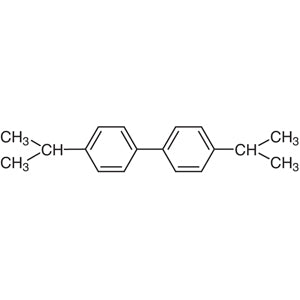
TCI D2047 4,4'-Diisopropylbiphenyl (CAS 18970-30-4) is a non-heterocyclic building block classified as an aromatic hydrocarbon, consisting of two benzene rings joined directly to one another, each carrying an isopropyl group at the para position. This symmetrical, wholly hydrocarbon structure makes it a useful starting material in organic synthesis, particularly when researchers require a rigid biphenyl framework bearing branched alkyl substituents. In the laboratory, compounds of this type serve as ligand precursors, intermediates for functional materials, and model substrates in studies of aromatic reactions and the physical properties of hydrocarbon compounds.
The characteristics that lead researchers to select this compound are its stability and the steric influence of the isopropyl groups. The biphenyl framework provides rigidity together with a distinctive conjugated electron system, while the isopropyl groups at both ends increase solubility in non-polar organic solvents, hinder overly tight crystal packing, and offer steric protection at the para positions. Because the isopropyl group is a weak electron-donating substituent, electrophilic aromatic substitution tends to be directed toward the remaining available positions, so the substitution pattern is relatively predictable. Its hydrocarbon nature also means it introduces no competing heteroatom functionality into a reaction system.
In Indonesian laboratories, a building block of this kind is typically used in university research groups, chemistry departments, and industrial R&D units working on organic synthesis and materials development. It is generally ordered as part of a synthetic route in which the biphenyl core must be elaborated further, or as a reference material in method development work. Because it is supplied in standard research pack sizes, it fits routine bench-scale experimental work rather than production-scale consumption.
- Organic synthesis starting material — the rigid biphenyl core with defined para substitution gives chemists a predictable scaffold on which to build more complex target molecules step by step.
- Ligand precursor preparation — the biphenyl backbone is a common structural motif in ligand design, and the flanking isopropyl groups provide the steric bulk often needed around a coordination site.
- Functional materials intermediates — the conjugated two-ring electron system combined with branched alkyl substituents suits research into organic materials where both rigidity and processability in solution matter.
- Aromatic reactivity studies — as a weakly electron-donating, symmetrically substituted arene, it serves as a clean model substrate for investigating electrophilic aromatic substitution behaviour and directing effects.
- Physical property and solubility investigations — the isopropyl groups disrupt close crystal packing and improve dissolution in non-polar organic solvents, making it a useful reference compound in such comparative studies.
| Brand | TCI (Tokyo Chemical Industry) |
|---|---|
| CAS number | 18970-30-4 |
| Molecular formula | — |
| Purity | — |
| Category | Chemistry > Building Blocks > Non-Heterocyclic Building Blocks |
| Pack sizes | available in standard TCI research pack sizes; please confirm the currently listed packaging option when ordering |
| Physical form | — |
| Storage | keep in the tightly closed original container, in a cool, dry, well-ventilated place away from ignition sources |
- Chemical name: 4,4'-Diisopropylbiphenyl
Store the material in its original tightly closed container in a cool, dry, well-ventilated area, away from heat, direct sunlight, open flames, and other ignition sources, and separated from strong oxidising agents. Amber glass or the manufacturer's supplied packaging is suitable; keep the closure sealed to limit contamination and vapour release. Handle in a fume hood using standard laboratory personal protective equipment, including safety glasses, chemical-resistant gloves, and a laboratory coat. Avoid inhalation of vapours and direct skin or eye contact, and use clean, dry spatulas when transferring material. Label all secondary containers clearly, keep an accurate inventory record, and dispose of residues and contaminated materials as organic chemical waste in accordance with your institution's regulations. Always consult the manufacturer's Safety Data Sheet before first use.
—
Produk Terkait
-
4-Isopropylbiphenyl TCI I0171
Regular price From Rp 2.199.750,00Regular price -
4-Ethynyl-4'-propylbiphenyl TCI E1231
Regular price From Rp 1.115.100,00Regular price -
4-Cyano-4'-propylbiphenyl TCI C2764
Regular price From Rp 530.250,00Regular price -
4-Butylbiphenyl TCI B3888
Regular price From Rp 980.700,00Regular price -
4-tert-Butylbiphenyl TCI B1811
Regular price From Rp 2.889.600,00Regular price -
3-Ethylbiphenyl TCI E0568
Regular price Rp 5.857.950,00Regular price -
4,4'-Di-tert-butylbiphenyl TCI D2450
Regular price From Rp 1.538.250,00Regular price -
4-Benzylbiphenyl TCI B1519
Regular price From Rp 1.378.650,00Regular price