

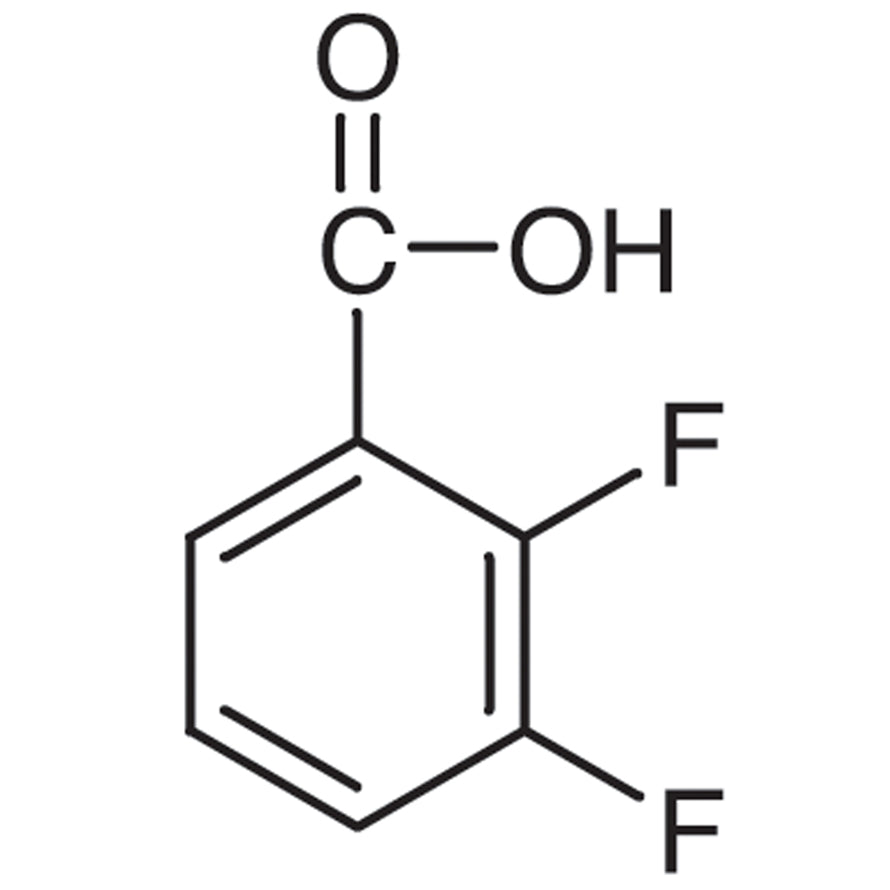
TCI D2058 2,3-Difluorobenzoic Acid is a benzoic acid carrying two adjacent fluorine atoms at the ortho and meta positions relative to the carboxylate group. The compound belongs to the fluorinated building blocks family — fluorine-containing starting materials used to introduce fluorine atoms into target molecules. In the laboratory its role is that of a ready-to-use aromatic scaffold: the carboxylate group can be converted into amides, esters or acid chlorides, or reduced, while the fluorine substitution pattern is already fixed from the outset, so researchers do not need to perform direct fluorination, which is considerably more demanding.
The property that makes this material a preferred choice is the strong influence fluorine exerts on the molecule. Fluorine is highly electronegative, so it increases the acidity of the carboxylate group, alters the electron density distribution across the ring, and activates specific positions toward nucleophilic aromatic substitution. In medicinal chemistry, the introduction of fluorine is known to improve the metabolic stability, lipophilicity and binding affinity of a drug candidate, which is why fluorinated starting materials are in high demand. As a crystalline solid, the compound is stable, easy to weigh accurately, and amenable to purification.
In Indonesian laboratories, this reagent is typically used in synthetic and medicinal chemistry work where a defined difluorinated aromatic core is required as the entry point of a synthetic route. Because the fluorine positions are already established, the material fits research groups that need reproducible starting points for analogue series, as well as laboratories building reference compounds and intermediates for further functionalisation of the carboxylate group.
TCI brochures (PDF)
- Fluorination Reagents, Fluorinated Building Blocks 2026-03-18 · p. 28
- Amide coupling and library synthesis — the carboxylate group converts readily into amides, giving a fixed difluorinated aromatic core for building series of structurally related analogues.
- Esterification and acid chloride formation — the carboxylic acid is a standard handle for conversion into esters or acid chlorides used in subsequent condensation and acylation steps.
- Nucleophilic aromatic substitution studies — the electron-withdrawing fluorine atoms activate specific ring positions, making this compound a suitable substrate for controlled aromatic substitution chemistry.
- Medicinal chemistry intermediates — fluorine introduction improves metabolic stability, lipophilicity and binding affinity, so this building block serves candidate molecule preparation without direct fluorination.
- Reduction chemistry toward difluorobenzyl derivatives — the carboxylate can be reduced to access related alcohol-level fluorinated intermediates while the ring substitution pattern remains intact.
| Brand | TCI |
|---|---|
| CAS number | 4519-39-5 |
| Molecular formula | — |
| Purity | — |
| Category | Chemistry > Building Blocks > Fluorinated Building Blocks |
| Pack sizes | available in standard TCI research-scale packaging; please confirm the required size when ordering |
| Physical form | crystalline solid |
| Storage | keep in a tightly closed original container, protected from moisture |
Store the material in its original tightly closed container in a cool, dry, well-ventilated area, away from moisture and incompatible substances, particularly bases and strong oxidising agents. Glass containers with chemically resistant closures are suitable for transfers and sub-sampling. As a carboxylic acid, the solid and its dust may irritate the skin, eyes and respiratory tract, so handle it in a fume hood using safety glasses, gloves and a laboratory coat. Weigh with clean, dry spatulas to avoid contamination and caking, close containers promptly after use, and always consult the manufacturer's safety data sheet before handling and before disposal of residues.
—
Produk Terkait
-
4-Bromo-2,6-difluorobenzoicAcid TCI B3447
Regular price From Rp 452.550,00Regular price -
3,5-DifluorobenzoicAcid TCI D2596
Regular price From Rp 980.700,00Regular price -
3,4-DifluorobenzoicAcid TCI D1908
Regular price From Rp 980.700,00Regular price -
2,4-DifluorobenzoicAcid TCI D1833
Regular price From Rp 1.378.650,00Regular price -
2,5-DifluorobenzoicAcid TCI D1699
Regular price Rp 848.400,00Regular price -
2,6-DifluorobenzoicAcid TCI D1629
Regular price Rp 2.147.250,00Regular price -
3-Chloro-2,4-difluorobenzoicAcid TCI C2517
Regular price From Rp 1.220.100,00Regular price -
2-Chloro-4,5-difluorobenzoicAcid TCI C1460
Regular price From Rp 903.000,00Regular price


